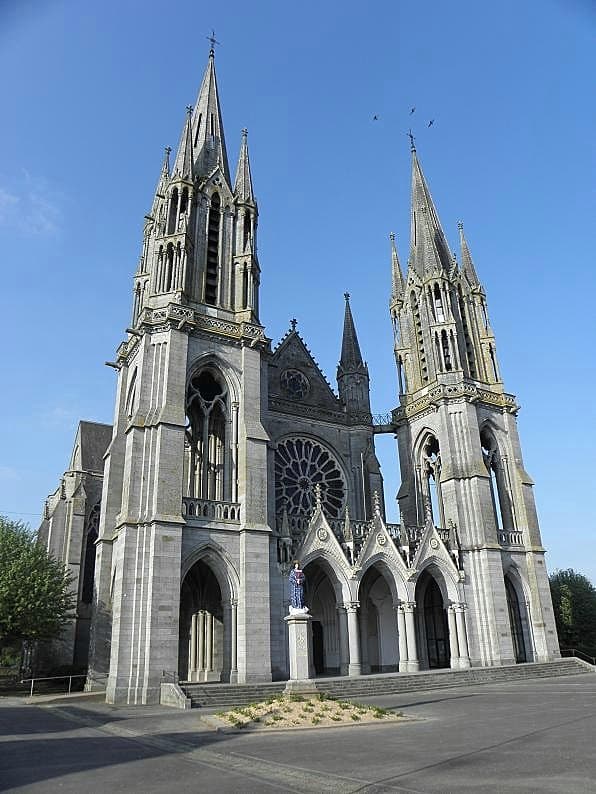
Our Lady of Pontmain
Photo: GO69 / Wikimedia Commons · CC0
The story
Skip to the verdict ↓On January 17, 1871, four children in the French village of Pontmain reported seeing an apparition of a tall woman in the night sky surrounded by stars; adults present saw only a bright star, and a ceasefire followed within days.
On the evening of January 17, 1871, during the Franco-Prussian War, farmer César Barbedette's sons Eugene (12) and Joseph (10) were watching him work when they noticed a tall, beautiful woman in the night sky above a neighbor's house. The woman was about twice human height, dressed in dark blue with gold stars, and wore a blue crown. Two other children — Françoise Richer (11) and Jeanne-Marie Lebosse (9) — were summoned and also saw the figure. Over approximately two hours, the figure displayed three sentences in golden script: 'But pray my children,' 'God will hear you in a little while,' and 'My Son allows himself to be moved.' A white veil then covered the figure and she disappeared.
What the Adults Saw
The adults present — including the parish priest and two religious sisters — could not see the figure the children described. They reported a bright star in the otherwise clear sky but nothing more. The children tried to describe what they saw, and the adults confirmed only the star.
The Military Context
The Prussian advance in the direction of Laval halted after the evening of the reported apparition, and a general armistice followed on January 28. Armistice negotiations had been initiated on January 11, a week before the apparition.
Recognition
Bishop Wicart of Laval approved the apparition in 1872, just one year after the event. The shrine at Pontmain remains active and the apparition is canonically recognized. Pontmain's theological message centered on hope during wartime and the efficacy of prayer.
Too thin a record to say either way.
Reviewer Notes
Miracles Jar weighs each claim two ways — how extraordinary it would be, and how strong the evidence is.
Assessed by Miracles Jar AI
Adults present saw nothing; child-only perception and subsequent armistice are ambiguous; quicker church approval than most suggests political/wartime context influenced judgment.
Overall verdict. Adults present saw nothing; child-only perception and the subsequent armistice are ambiguous; quicker church approval than most suggests political/wartime context influenced judgment.
Reasoning. Pontmain presents an interesting but problematic evidential structure: the four child witnesses saw a detailed apparition including a scrolling text message, while the adult witnesses present (including two nuns and the parish priest) saw only a bright star or nothing at all. This differential perception — children seeing everything, adults nothing — is consistent with either a genuine phenomenon visible only to children (theologically plausible within the apparition tradition) or with children collaboratively elaborating on a shared imaginative experience while adults honestly reported what was actually visible. The Prussian advance halting within days is offered as a predictive fulfillment but is better explained by military factors (armistice negotiations already underway). Church approval came in 1872 after a one-year investigation.
The differential perception problem. This is the critical weakness. The adult-child differential is unusual even within the apparition tradition, where most cases involve some visible phenomenon (lights, glow) perceived by multiple age groups. If a real phenomenon, why could trained religious adults not perceive it?
On the military context as predictive fulfillment. The apparition's message said 'But God will hear you in a little while,' and the pause in the Prussian advance near Laval is offered as fulfillment. But armistice negotiations between France and Prussia were already underway, having been initiated on January 11, a week before the apparition; military historians attribute the ceasefire to diplomatic and strategic factors, and the pause near Laval reflects logistical and diplomatic factors. The apparition did not precede the ceasefire with sufficient specificity to constitute a testable prediction.
On witness consistency. Four children gave consistent accounts of a complex apparition including a scrolling text message visible to them simultaneously. Internal consistency among child witnesses is notable; however, children in a group can rapidly co-construct shared narratives.
On the speed of approval. Church approval within one year is unusually fast by Catholic apparition standards and occurred during the Franco-Prussian War's immediate aftermath — a period of intense national religious sentiment in France. Bishop Wicart's 1872 approbation was granted just one year after the event, unusually fast by Catholic standards. Rapid approval suggests pastoral/political motivations may have accelerated the process. Pontmain's theological message (hope during wartime, prayer's efficacy) aligned with the needs of French Catholic national sentiment in 1871, which may help explain the rapid ecclesiastical response.
Evidence ledger — what the verdict rests on
Adults present including a priest and two nuns saw only a bright star, not the detailed apparition described by the children
Differential perception is the critical weakness: if a real phenomenon, why could trained religious adults not perceive it?
The Prussian military advance halted within days of the apparition; the apparition's message said 'But God will hear you in a little while'
Armistice negotiations between France and Prussia were already underway; military historians attribute the ceasefire to diplomatic and strategic factors
Four children gave consistent accounts of a complex apparition including a scrolling text message visible to them simultaneously
Internal consistency among child witnesses is notable; however, children in a group can rapidly co-construct shared narratives
Church approval within one year is unusually fast and occurred during the Franco-Prussian War's immediate aftermath — a period of intense national religious sentiment in France
Rapid approval suggests pastoral/political motivations may have accelerated the process
What would raise the meter: Instrumented or physical evidence — measurements, samples, footage that survives analysis — would raise this.
What would lower it: A controlled observation reproducing the experience naturally (lighting, suggestion, pareidolia) would move it down.
How we weigh every claim — the full method, deductions and all →
The natural explanation
The leading natural account for this case is misperception: how honest witnesses get it wrong. Read what it explains — and where it stops.
The same wonder, across traditions
This claim is one of many that make the same assertion across faiths. See it side by side in When a Figure Appears.
Sources
Tagged by proximity to the event. Primary sources are direct or contemporaneous; tertiary are downstream retellings.
- 1.Primarychurch document
Bishop Wicart of Laval, "Approbation by Bishop of Laval", 1872· no public link
Granted just one year after event; unusually fast by Catholic apparition standards
- 2.Tertiaryother
"Our Lady of Pontmain — EWTN and standard reference summaries", 2020· no public link
Covers eyewitness accounts including differential perception between children and adults
Cases like this
Nearest on the map — similar in how miraculous they’d be, and how strong the evidence is.