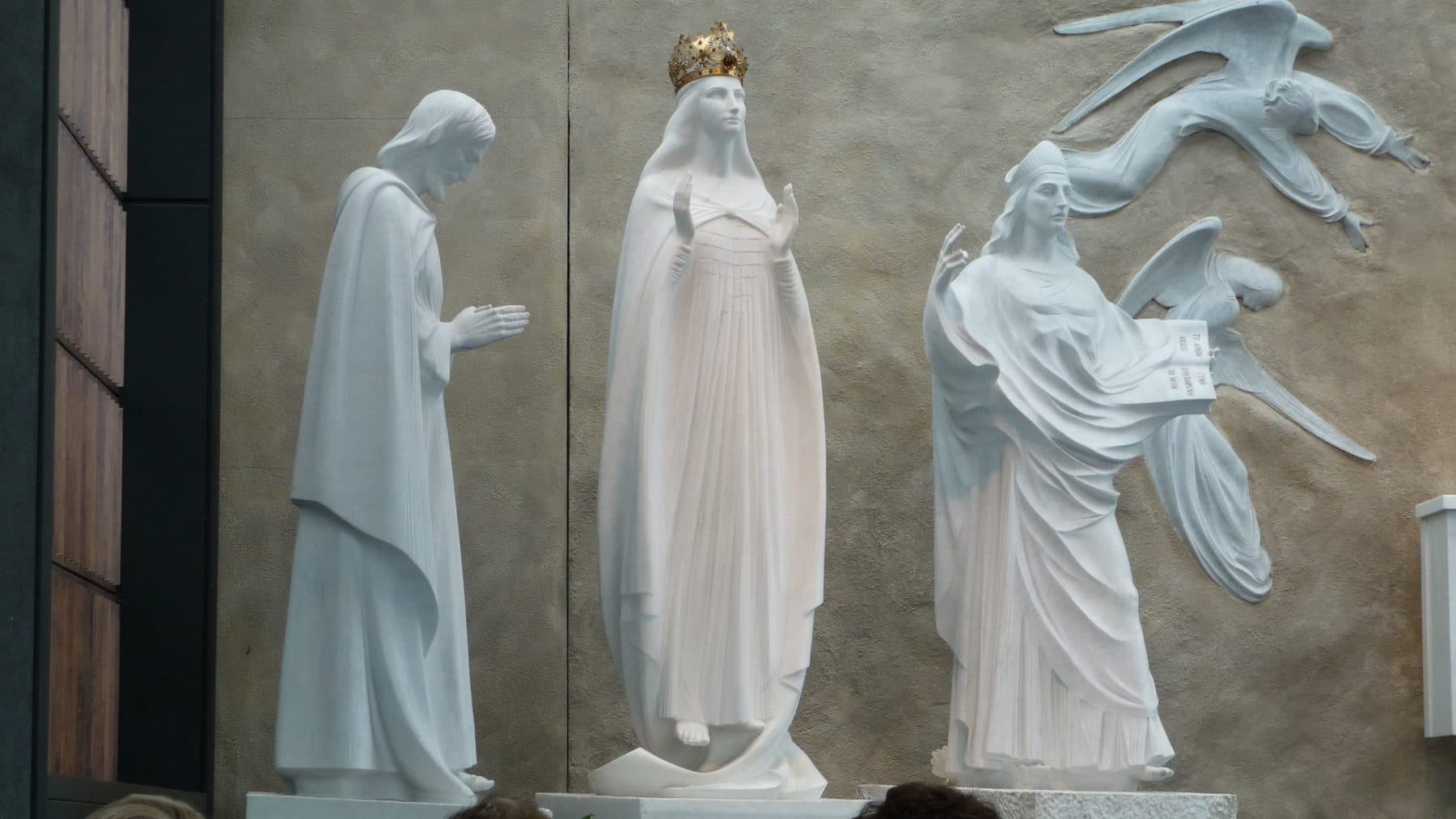
Our Lady of Knock
Photo: Cary Bass-Deschenes / Wikimedia Commons · CC BY-SA 2.0
The story
Skip to the verdict ↓Shortly after eight on the wet evening of 21 August 1879, two women in the village of Knock, in the west of Ireland, stopped at the gable wall of the parish church and saw figures standing against it, lit and silent in the rain. They called for others. Fifteen people gathered and watched for the better part of two hours — three figures they took for Mary, Joseph, and a bishop — as the rain kept falling.
The two women who first noticed the glowing figures were Mary McLoughlin (housekeeper to the local priest) and Mary Byrne, and the wall was the south gable of St. John the Baptist Church. The tableau consisted of three figures — identified by witnesses as Mary (in white with a golden crown), Joseph (to her right), and a bishop figure identified as St. John the Evangelist (to her left holding a book) — alongside a plain altar with a cross and a lamb, all glowing white.
The Commission
Archbishop John MacHale of Tuam established an inquiry commission led by Canon Ultan Bourke within weeks. The commission collected sworn depositions from all 15 witnesses — ranging in age from 5 to 75, male and female — who gave mutually consistent descriptions of the figures' positions, clothing, and the glow. The commission concluded the testimony was 'trustworthy and satisfactory.' A second commission in 1936 re-interviewed surviving witnesses and found no inconsistencies with the original testimony.
The Record
No investigation was conducted into possible projection or lighting sources in 1879. The figures never moved and never spoke — no messages and no requests were reported. The year 1879 was a severe agricultural crisis year in Mayo (the 'Land War'). The apparition conveyed exclusively Roman Catholic liturgical imagery.
Recognition
Official Catholic recognition came 100 years later, in 1979, when Pope John Paul II visited Knock. The shrine receives approximately 1.5 million visitors annually. No miraculous cures are formally associated with Knock under a medical bureau process comparable to Lourdes.
It happened — and nature accounts for it.
Reviewer Notes
Miracles Jar weighs each claim two ways — how extraordinary it would be, and how strong the evidence is.
Assessed by Miracles Jar AI
Multi-witness consistency is the strongest argument; no physical evidence and no words spoken make independent verification impossible.
On the witness record: Knock is unusual in having 15 independent witness depositions taken within weeks of the event by an ecclesiastical commission — a stronger evidentiary record than most apparitions. The witnesses ranged in age from 5 to 75, included both men and women, and gave mutually consistent accounts of the figures and their positions. This consistency across age groups, without apparent coordination or motive for collective fabrication, is the strongest single piece of evidence and is harder to fake than single-witness accounts.
On the silence: The apparition was completely silent — no messages, no requests — which is unusual and makes it harder to dismiss as religiously motivated fabrication, since nothing theological was conveyed. However, silence could equally reflect that witnesses genuinely saw an unexplained light display and retrospectively interpreted it through Catholic iconography. The figures' never moving and never speaking is consistent with either a genuine vision or an optical effect such as a magic lantern projection or luminous gas, though no evidence for these was found.
On physical evidence: No physical trace of the apparition remained. No photograph, physical impression, or any material evidence was produced; the apparition left no trace. Absence of physical evidence is expected if the apparition was a shared perceptual experience or projected light. The detail that the rain-soaked ground beneath the glowing figures was reportedly dry supports authenticity to believers but could equally reflect post-hoc elaboration.
On context: The event occurred in a period of intense Irish Catholic identity formation under British rule (post-Famine Ireland, Catholic identity under British rule), creating strong cultural pressure toward shared religious experiences; intense communal religious experience under stress is well-documented. This sociological context is suggestive but not sufficient to explain away consistent multi-witness testimony. The apparition conveying exclusively Roman Catholic liturgical imagery is consistent with what that community would expect to see — and also with what a motivated fabricator would stage.
On the commission finding and recognition timing: The commission's finding was "trustworthy and satisfactory," not "supernatural." Definitive church approval came only in 1979, 100 years later.
Evidence ledger — what the verdict rests on
Fifteen witnesses of varying ages gave mutually consistent depositions within weeks of the event to a formal commission, without apparent coordination or motive for collective fabrication
Strongest single piece of evidence; consistency across age groups is harder to fake than single-witness accounts
The apparition was completely silent — no messages, no requests — which is unusual and makes it harder to dismiss as religiously motivated fabrication (nothing theological was conveyed)
Silence could equally reflect that witnesses genuinely saw an unexplained light display and retrospectively interpreted it through Catholic iconography
No photograph, physical impression, or any material evidence was produced; the apparition left no trace
Absence of physical evidence is expected if the apparition was a shared perceptual experience or projected light
The event occurred in a period of intense Irish Catholic identity formation under British rule, creating strong cultural pressure toward shared religious experiences
Sociological context is suggestive but not sufficient to explain away consistent multi-witness testimony
What would raise the meter: Instrumented or physical evidence — measurements, samples, footage that survives analysis — would raise this.
What would lower it: A controlled observation reproducing the experience naturally (lighting, suggestion, pareidolia) would move it down.
How we weigh every claim — the full method, deductions and all →
The natural explanation
The leading natural account for this case is misperception: how honest witnesses get it wrong. Read what it explains — and where it stops.
The same wonder, across traditions
This claim is one of many that make the same assertion across faiths. See it side by side in When a Figure Appears.
Sources
Tagged by proximity to the event. Primary sources are direct or contemporaneous; tertiary are downstream retellings.
- 1.Primarytestimony
"Depositions of the Witnesses to the Knock Apparition", 1879· no public link
15 witness statements collected by Canon Bourke's commission within weeks of the event; housed at Knock Shrine
- 2.Tertiaryother
"Knock Shrine Wikipedia article with commission references", 2024· no public link
Synthesis of MacPhilpin (1880), Jayo (2008), and Knock Shrine archival material
- 3.Secondarychurch document
"Second Commission of Enquiry, Knock", 1936· no public link
Reinterviewed surviving witnesses decades later; findings consistent with 1879 commission
Cases like this
Nearest on the map — similar in how miraculous they’d be, and how strong the evidence is.