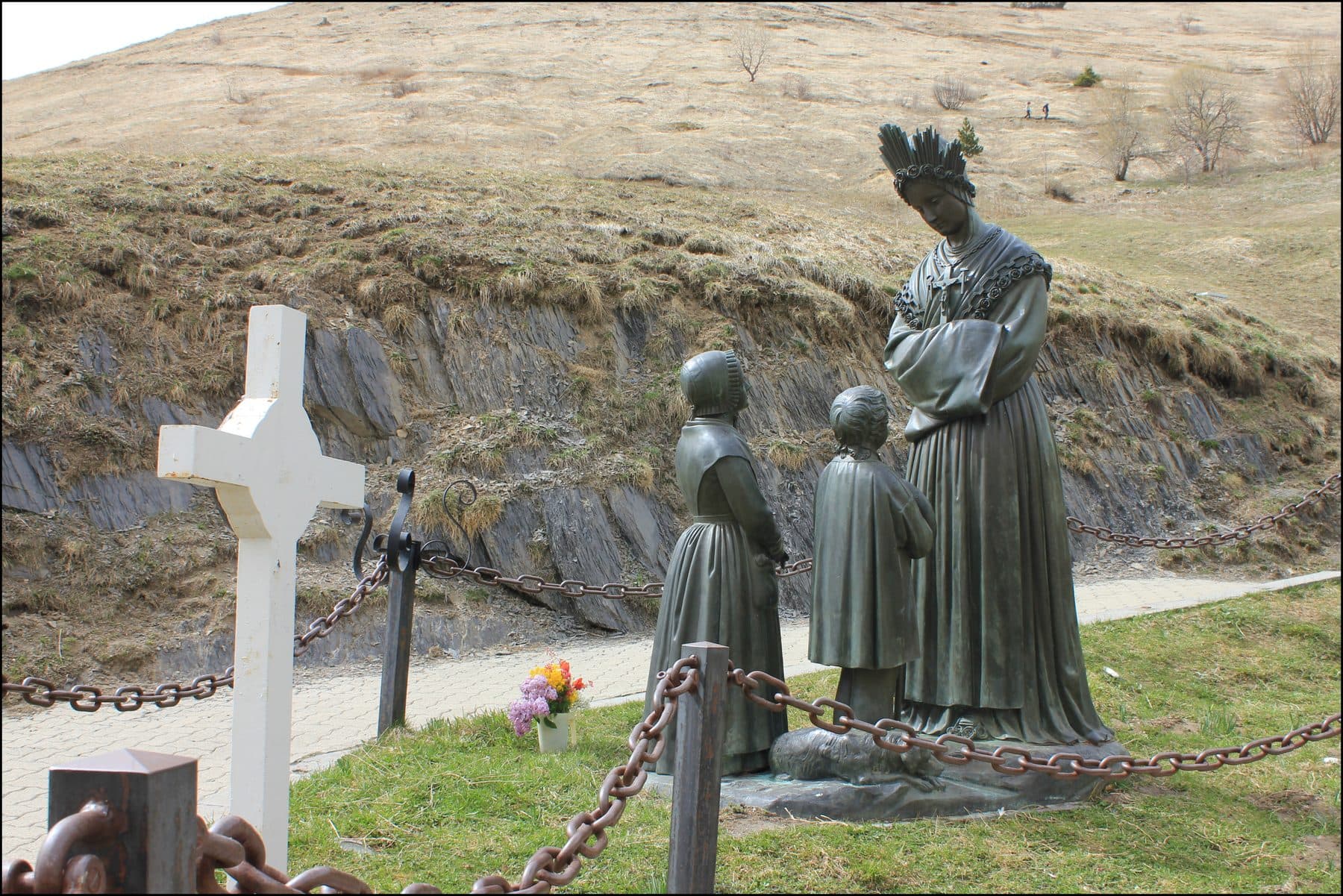
Our Lady of La Salette
Photo: Daniel Culsan / Wikimedia Commons · CC BY-SA 4.0
The story
Skip to the verdict ↓On September 19, 1846, two young French shepherd children reported a weeping apparition on a mountain near La Salette who delivered a message of penance; the event was approved by the Church in 1851 but subsequently complicated by the visionaries' divergent later claims.
On the afternoon of September 19, 1846, Mélanie Calvat (14) and Maximin Giraud (11) were tending cattle on a mountain above La Salette-Fallavaux in the French Alps when they reported finding a weeping woman seated on a stone, who rose and addressed them in French and local patois. She lamented the failure to keep Sunday holy and to abstain from meat on Fridays, warned of impending famine if the people did not repent, and gave each child a private 'secret.' She then rose and disappeared toward the summit.
The Commission
Bishop Philibert de Bruillard of Grenoble appointed a commission of inquiry that spent five years investigating. The commission found the children's testimony credible, noted reported cures at the site, and concluded the apparition worthy of belief. The bishop promulgated formal recognition on September 19, 1851 — exactly five years after the event. He stated that approval applied only to the original 1846 apparition.
Mélanie's Later Publication
Mélanie published her 'secret' in 1879, presenting a text longer than what she had submitted to the Pope in 1851 — including new apocalyptic revelations about priests, bishops, and the Church's future that she had not mentioned before. The Holy Office placed the work on the Index Librorum Prohibitorum in 1923. When Abbé Michel Corteville discovered the original 1851 letters in the Vatican Secret Archives in 1999, they showed that both children's original secrets were brief and theologically modest, differing from Mélanie's expanded version. Maximin defended the original 1846 apparition until his death without seeking further supernatural attention.
The Catholic Encyclopedia described Mélanie's expanded secret as 'a work of imagination.'
Legacy
La Salette remains a recognized Marian shrine with active pilgrimage. The Missionaries of Our Lady of La Salette is a religious congregation founded in connection with the apparition. The apparition's message — essentially a call to observe Sunday and fast days — is treated by the Church as the authentic core, with Mélanie's later additions disregarded.
It happened — and nature accounts for it.
Reviewer Notes
Miracles Jar weighs each claim two ways — how extraordinary it would be, and how strong the evidence is.
Assessed by Miracles Jar AI
Original event plausibly credible; subsequent elaborations by Mélanie severely undermine the case and suggest psychological deterioration or deliberate embellishment.
The 1846 apparition was approved by the Diocese of Grenoble after a five-year commission review; the two children, Mélanie Calvat and Maximin Giraud, gave consistent initial testimony under official questioning. However, the credibility of the case was significantly damaged by Mélanie's later behavior: in 1879 she published a vastly expanded 'secret' containing entirely new apocalyptic revelations, which the Holy Office placed on the Index Librorum Prohibitorum in 1923 as contrary to the faith. The Catholic Encyclopedia assessed her expanded secret as 'a work of imagination.' Maximin, by contrast, lived a modest and credible life. The original 1846 message (urging Sunday observance and abstinence) is theologically uncontroversial and consistent with the children's catechetical environment.
Weighing of the evidence:
- Two children from different families gave mutually consistent initial accounts and maintained them under independent questioning by civil and church authorities. The consistency of the original testimony supports the credibility of the 1846 event independent of later complications.
- The original 1851 letters to Pope Pius IX, discovered in the Vatican archives in 1999, show the children's secrets were brief and simple — contradicting Mélanie's much longer 1879 publication. Mélanie's dramatic expansion of the secret over decades is a serious credibility problem that casts retrospective doubt on her original testimony.
- The Holy Office placed Mélanie's 1879 published secret on the Index in 1923 as 'contrary to the faith,' and the Catholic Encyclopedia described it as 'a work of imagination.' This is a rare instance of the Church itself formally discrediting a Marian visionary's extended claims.
- Maximin Giraud lived a sober, unremarkable life and defended the original 1846 apparition credibly until his death, without seeking further supernatural attention. His contrasting conduct strengthens the original report while confirming the problem was specific to Mélanie.
Evidence ledger — what the verdict rests on
Two children from different families gave mutually consistent initial accounts and maintained them under independent questioning by civil and church authorities
Consistency of original testimony supports credibility of the 1846 event independent of later complications
Original 1851 letters to Pope Pius IX (discovered in Vatican archives in 1999) show the children's secrets were brief and simple — contradicting Mélanie's much longer 1879 publication
Mélanie's dramatic expansion of the secret over decades is a serious credibility problem that casts retrospective doubt on her original testimony
The Holy Office placed Mélanie's 1879 published secret on the Index in 1923 as 'contrary to the faith,' and the Catholic Encyclopedia described it as 'a work of imagination'
Rare instance of the Church itself formally discrediting a Marian visionary's extended claims
Maximin Giraud (the male visionary) lived a sober, unremarkable life and defended the original 1846 apparition credibly until his death, without seeking further supernatural attention
His contrasting conduct strengthens the original report while confirming the problem was specific to Mélanie
What would raise the meter: Documented recurrence in cases with no expectancy pathway — or records ruling out functional overlay — would raise the meter.
What would lower it: Evidence of symptom relapse, revised diagnosis, or undisclosed treatment would lower the evidence bar.
How we weigh every claim — the full method, deductions and all →
The natural explanation
The leading natural account for this case is expectation, suggestion & the placebo response. Read what it explains — and where it stops.
The same wonder, across traditions
This claim is one of many that make the same assertion across faiths. See it side by side in Images That Weep, Bleed, and Stir and When a Figure Appears.
Sources
Tagged by proximity to the event. Primary sources are direct or contemporaneous; tertiary are downstream retellings.
- 1.Primarytestimony
Mélanie Calvat and Maximin Giraud, "Original Secrets of La Salette (letters to Pope Pius IX, rediscovered 1999)", 1851· no public link
Found by Abbé Corteville in Vatican archives 1999; shows original secrets were brief, contradicting Mélanie's expanded 1879 version
- 2.Secondaryinvestigation
"La Salette — Sorting Fact from Fiction", 2023· no public link
Catholic Answers Magazine review of evidential and credibility issues; covers Mélanie's later claims and Index condemnation
- 3.Primarychurch document
"Decree of Holy Office placing Mélanie's 1879 work on the Index", 1923· no public link
Establishes Vatican-level rejection of Mélanie's expanded secret as contrary to the faith; most directly relevant church ruling
Cases like this
Nearest on the map — similar in how miraculous they’d be, and how strong the evidence is.