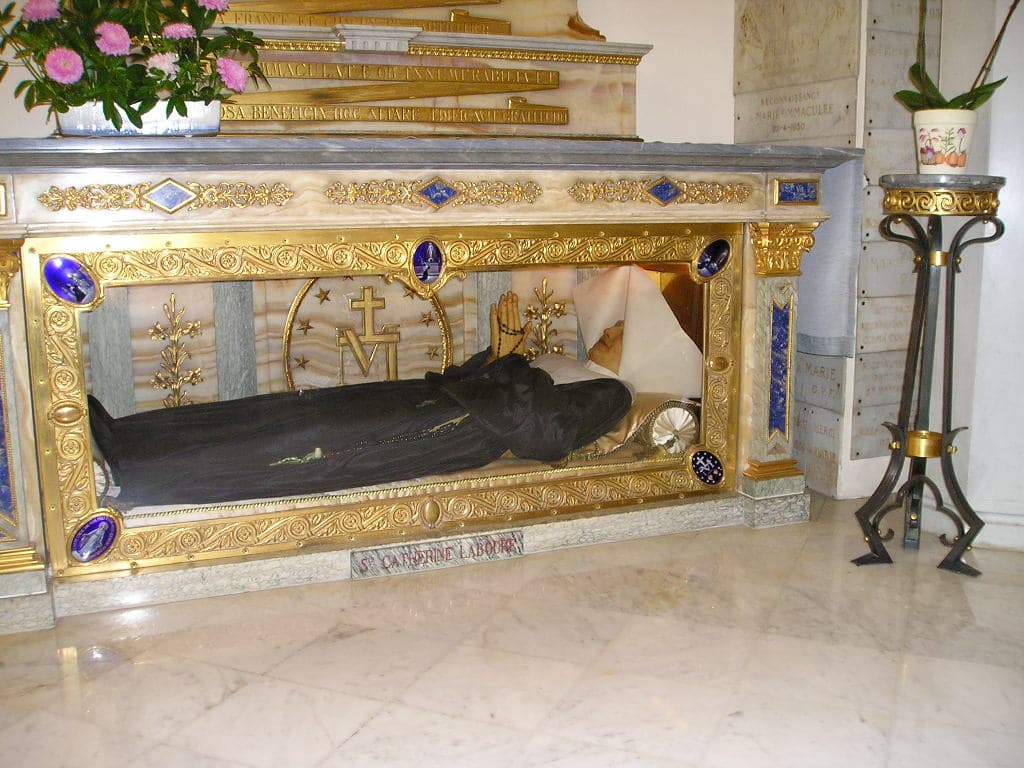
Catherine Labouré — Blue Eyes After 57 Years
Photo: André Leroux / Wikimedia Commons · Public domain
The story
Skip to the verdict ↓When Catherine Labouré's body was exhumed in 1933 for beatification — 57 years after her death — physicians reported it was flexible and fresh, with blue eyes intact; her body remains on display in Paris at the Chapel of the Miraculous Medal.
The Vincentian Visionary
Catherine Labouré entered the Daughters of Charity in Paris in 1830, the same year she reported visions of the Virgin Mary that led to the creation of the Miraculous Medal. She spent the rest of her life in obscurity, only revealing her identity as the visionary shortly before her death in 1876. By the time she died, over a billion Miraculous Medals had been produced.
The 1933 Exhumation
In 1933, 57 years after Catherine's burial, her body was exhumed as part of the beatification process. The coffin was opened in the presence of Cardinal Verdier, the Archbishop of Paris, civil officials, and physicians. Those present reported the body appeared fresh, the skin had not darkened, the limbs were supple, and the eyes — blue in life — were still blue and intact. This testimony comes from multiple witnesses.
The Display at Rue du Bac
Catherine was beatified in 1933 and canonized in 1947. Her body was placed in a glass reliquary under the altar at the Chapel of the Miraculous Medal in Paris, where it can be viewed today. Unlike Bernadette Soubirous, no wax mask over the face has been documented publicly for Catherine.
Open Questions
No chemical or forensic analysis of the tissue has been published in peer-reviewed literature. Whether embalming was performed at death — a common practice for prominent religious in 19th-century France — is not clearly established in available sources.
It happened — and nature accounts for it.
Reviewer Notes
Miracles Jar weighs each claim two ways — how extraordinary it would be, and how strong the evidence is.
Assessed by Miracles Jar AI
Eyewitness accounts survive but the evidence is inadequate to confirm the facts; natural causes not fully ruled out.
Weighing of the exhumation testimony. The 1933 exhumation was witnessed by Cardinal Verdier, civil officials, and physicians who reported genuinely unusual preservation — flexible limbs and intact eyes after 57 years. These accounts are primary, credible, and from multiple witnesses with no obvious motive to falsify; this testimony is the core of the incorruptibility claim. Against this, the Paris climate and soil conditions, the quality of the 19th-century cedar coffin, and the possibility of unrecorded embalming at death cannot be ruled out from available public records. No independent forensic chemical analysis of the tissue has been published to exclude natural preservation mechanisms.
On the absence of embalming records. No documented embalming at death is recorded in available Vincentian records, which weakly favors authenticity — but absence of evidence is not evidence of absence, and the records may be incomplete.
On the lack of forensic analysis. No independent chemical or forensic analysis of the tissue has been published. This is a neutral, moderate factor: it cannot confirm or rule out adipocere, mummification, or undisclosed preservation.
On burial conditions. Burial was in Paris in a 19th-century coffin with vault conditions unknown without inspection. This moderately favors a natural account: cedar coffins and certain soil/humidity conditions can dramatically slow decay.
On the present-day display. What visitors see today versus the original tissue condition is not independently verifiable.
Relative interest. The case carries more intrinsic interest than John XXIII or Padre Pio because the natural mechanisms are less fully documented, but that ambiguity cuts both ways.
Evidence ledger — what the verdict rests on
Physicians and Cardinal Verdier witnessed flexible limbs and intact blue eyes at 1933 exhumation — 57 years after death
Multiple official witnesses; report is primary-source and credible
No documented embalming at death recorded in available Vincentian records
Absence of evidence is not evidence of absence; records may be incomplete
No independent chemical or forensic analysis of tissue published
Cannot confirm or rule out adipocere, mummification, or undisclosed preservation
Burial in Paris: 19th-century coffin, vault conditions unknown without inspection
Cedar coffins and certain soil/humidity conditions can dramatically slow decay
What would raise the meter: Long-term follow-up documenting permanence, in a condition with a near-zero spontaneous-resolution base rate, would raise the meter.
What would lower it: A documented relapse, or case literature showing the condition fluctuates or remits on its own, would move it down.
How we weigh every claim — the full method, deductions and all →
The natural explanation
The leading natural account for this case is spontaneous remission & the body's own recovery. Read what it explains — and where it stops.
Sources
Tagged by proximity to the event. Primary sources are direct or contemporaneous; tertiary are downstream retellings.
- 1.Primarychurch document
"Saint Catherine Labouré of the Miraculous Medal XVII: Death and Glory (Vincentians.com)", 2011· no public link
Cites exhumation witnesses including Cardinal Verdier; describes physical condition
- 2.Tertiaryother
"Catherine Labouré — Wikipedia", 2024· no public link
General biography; beatification and canonization timeline
- 3.Tertiarynews
"It Has Been 141 Years and the Body of Catherine Labouré Is Still Intact (Lethbridge News Now, 2017)", 2017· no public link
Summarizes condition reports; notes body remains on public display
Cases like this
Nearest on the map — similar in how miraculous they’d be, and how strong the evidence is.