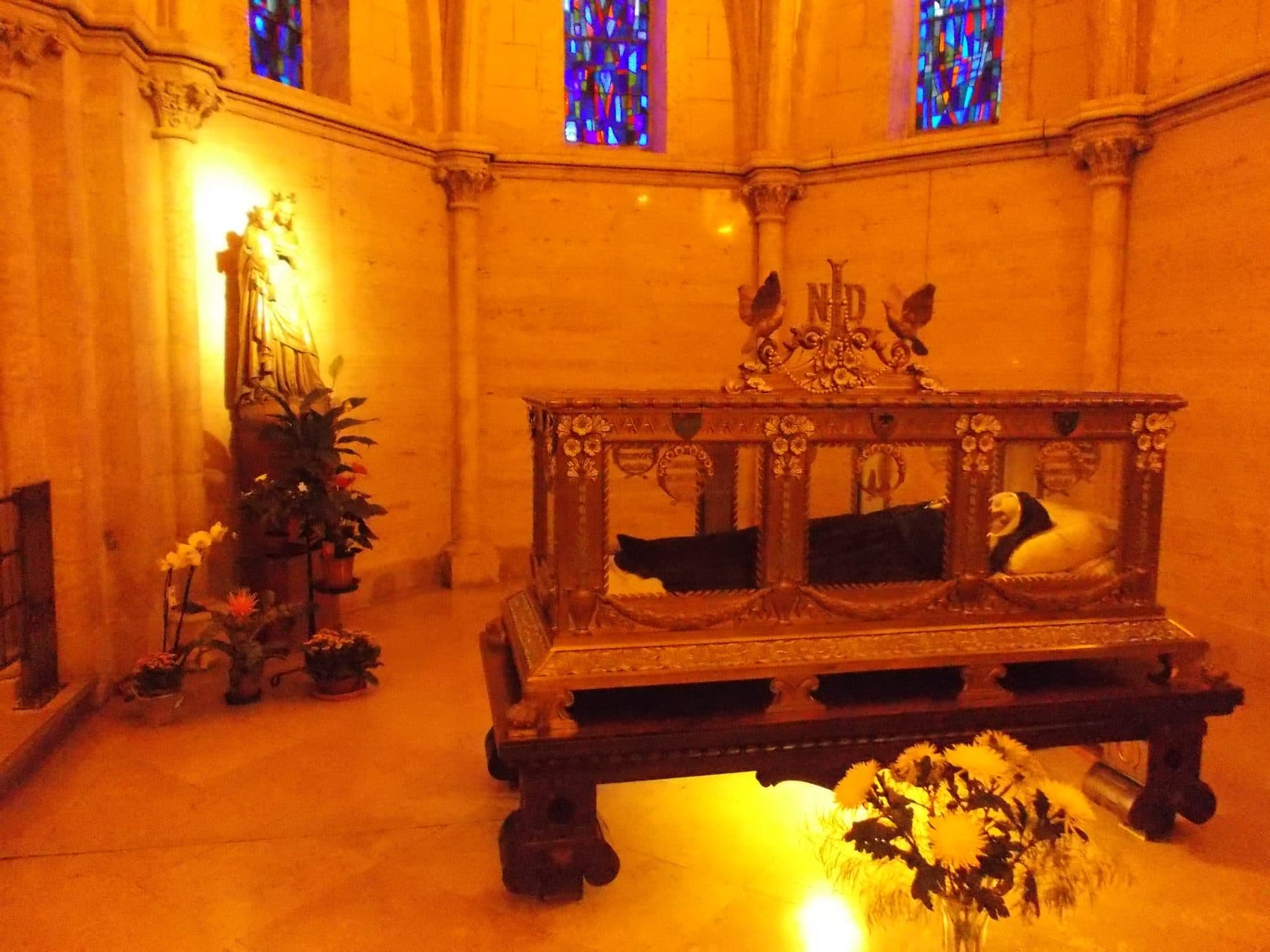
The Incorruptibility of Bernadette Soubirous
Photo: Itto Ogami / Wikimedia Commons · CC BY 3.0
The story
Skip to the verdict ↓The body of the Lourdes visionary, displayed at Nevers, is often called incorrupt — but a wax mask covers the face, and natural preservation can account for the rest.
Bernadette Soubirous, the visionary of Lourdes, died in 1879 and was buried at the convent of Saint-Gildard in Nevers. Her body was exhumed three times — in 1909, 1919, and 1925 — as part of the process toward canonization. It now lies in a glass reliquary, and pilgrims often describe it as perfectly preserved, as though she were merely asleep.
What Is on Display
At exhumation the exposed skin of the face and hands had darkened and sunk. A Parisian firm, Pierre Imans, was commissioned to make a thin wax mask for the face and wax casts for the hands. The serene, lifelike face and hands that visitors see are, in significant part, this wax overlay.
The Preservation
The exhumation reports describe the body as better preserved than expected for the time it had been buried; the 1909 report in particular records a body in notably better condition than would be expected after thirty years of burial. The body was also embalmed and treated during the exhumation process.
Bodies buried in cool, sealed, low-oxygen ground can decay slowly. Fats can convert to adipocere ("grave wax"), a substance that resists decomposition and can hold a body's form for decades.
It happened — and nature accounts for it.
Reviewer Notes
Miracles Jar weighs each claim two ways — how extraordinary it would be, and how strong the evidence is.
Assessed by Miracles Jar AI
The lifelike face owes much to a wax overlay, and the body's preservation has ordinary explanations. The popular 'perfectly incorrupt' framing is not what the record shows.
This is a case that asks whether the preservation requires a supernatural explanation. The documentary record points to ordinary mechanisms.
Where this lands. The strongest popular version of this claim — a *perfectly incorrupt* body, untouched by decay — is not what the documentation supports. The most arresting feature, the lifelike face and hands, is in significant part a wax overlay rather than original tissue, applied precisely because the exposed skin had discolored and shrunk. Set the wax aside and the underlying preservation is still real but not inexplicable: cool, sealed, low-oxygen burial conditions and saponification (adipocere formation) are documented natural mechanisms that slow or arrest decay, and the reported condition sits well within what those ordinary mechanisms produce. The embalming and treatment applied during exhumation further complicate any claim of untouched preservation.
The genuine, better-than-expected preservation noted in the 1909 report is the only point pulling the other way, and it is weak: the natural account covers the observations without strain. The careful answer is markedly less dramatic than the legend, and a supernatural explanation is correspondingly very unlikely.
The original exhumation reports do describe better-than-expected preservation, but the natural account covers the observations without strain — which is why the case is less settled than it might first appear, even if the direction is clear.
Evidence ledger — what the verdict rests on
The face and hands on display are covered by a wax mask and casts, applied because the exposed skin had discolored and shrunk.
Cool, sealed, low-oxygen burial conditions and saponification (adipocere formation) are documented natural mechanisms that slow or arrest decay.
The body was embalmed/treated during the exhumation process, further complicating any claim of untouched preservation.
The 1909 exhumation report does describe a body in notably better condition than expected for thirty years of burial.
What would raise the meter: Long-term follow-up documenting permanence, in a condition with a near-zero spontaneous-resolution base rate, would raise the meter.
What would lower it: A documented relapse, or case literature showing the condition fluctuates or remits on its own, would move it down.
How we weigh every claim — the full method, deductions and all →
The natural explanation
The leading natural account for this case is spontaneous remission & the body's own recovery. Read what it explains — and where it stops.
Sources
Tagged by proximity to the event. Primary sources are direct or contemporaneous; tertiary are downstream retellings.
- 1.Primarychurch document
"Official exhumation reports, Diocese of Nevers (1909, 1919, 1925)"· no public link
Describe the condition of the body at each exhumation and the decision to apply wax to face and hands for display.
- 2.Secondaryinvestigation
"Records of the Imans atelier (wax mask and casts)"· no public link
The Parisian firm Pierre Imans produced the wax facial mask and hand casts now seen on the displayed body.
Further reading
- The Incorruptibles — Joan Carroll Cruz
- Looking for a Miracle — Joe Nickell
Cases like this
Nearest on the map — similar in how miraculous they’d be, and how strong the evidence is.