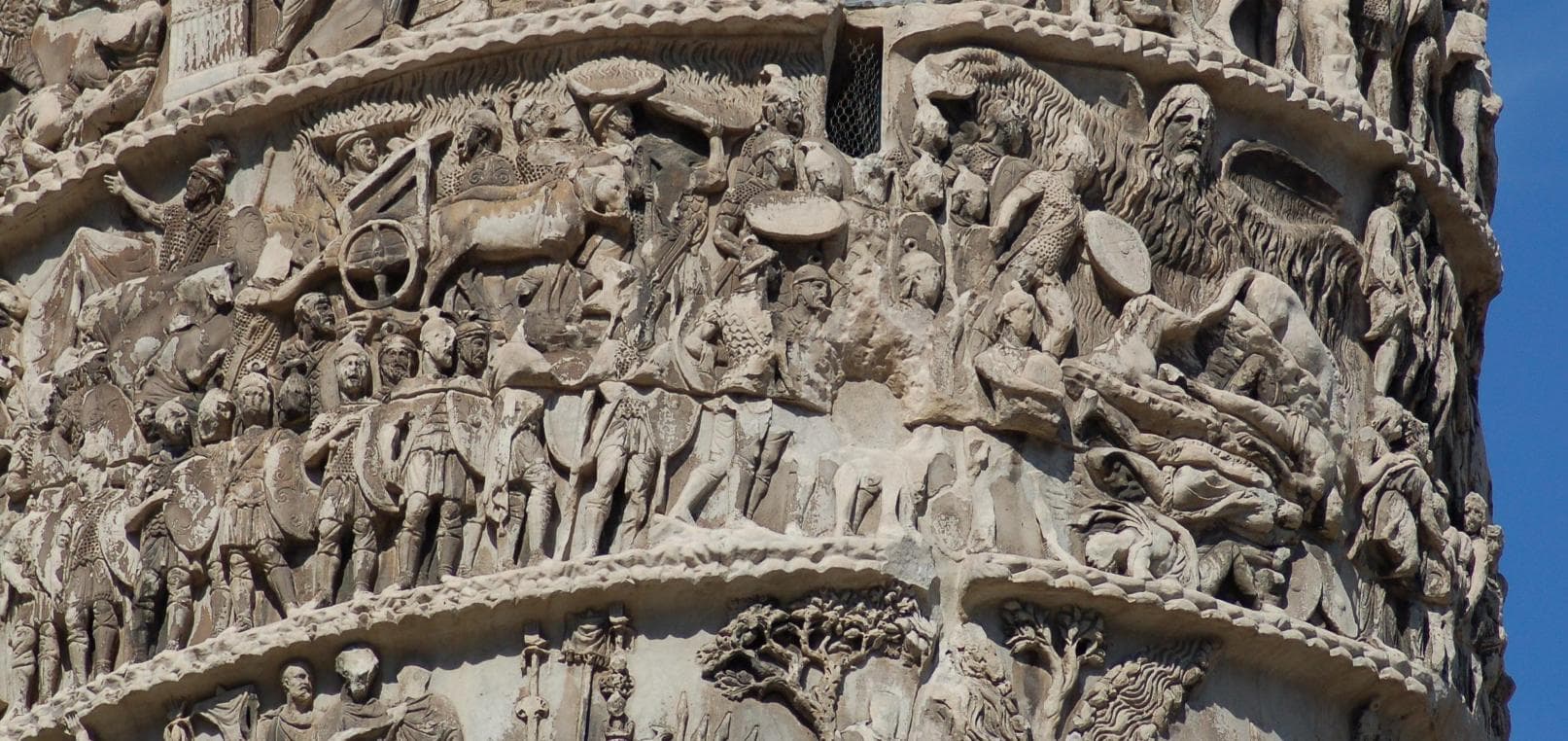
The Rain Miracle of Marcus Aurelius — One Storm, Four Claimants (172 CE)
Photo: Cristiano64 / Wikimedia Commons · CC BY-SA 3.0
The story
Skip to the verdict ↓During Marcus Aurelius's campaign against the Quadi north of the Danube, in 172 CE by the usual dating, a Roman force cut off in enemy territory and collapsing from thirst was saved when a violent storm broke over the field; the soldiers drank as they fought while lightning and hail struck the enemy. Within a generation the rescue had four rival explanations — an Egyptian magician's invocation of Mercury, the prayers of Christian soldiers, the emperor's own piety, and the anonymous winged rain god carved into the Column of Marcus Aurelius in Rome.
A Roman army trapped in the territory of the Quadi, north of the Danube, was dying of thirst when a storm broke over the battlefield and saved it. The usual date is 172 CE; some reconstructions say 174. Within a generation, four different parties had explained the rescue four different ways.
The fullest account is Cassius Dio's Roman History. The Quadi had surrounded a Roman force in country of their choosing and were content to wait: the day was hot, the Romans were exhausted by wounds and thirst, and surrender seemed a matter of hours. Then, Dio writes, 'a mighty rain, not without divine interposition, burst upon them.' The soldiers caught the water in their helmets and shields and drank as they fought. Hail and lightning fell with the rain, and by the accounts that survive, fell hardest on the enemy: 'those on the one side were being drenched and drinking, the others were being consumed by fire and dying.' The army came out alive.
Rome put the scene in stone. The Column of Marcus Aurelius, the state's commemoration of the Danube wars completed around 193 CE, carries the rain miracle as one of the most important scenes on the monument: a winged divine figure, wings spread wide, streaming rain down over the Roman ranks. The sculptor, working for the imperial house and closer in time than any surviving text, named no god at all.
Four Claimants
Dio credits court magic. Harnuphis, 'an Egyptian magician, who was a companion of Marcus,' had 'invoked by means of enchantments various deities and in particular Mercury' — and an inscription naming Harnuphis was found at Aquileia, one of Marcus's bases. Xiphilinus, the eleventh-century monk through whom Dio's text survives, breaks into his own source to object: the rain came through the prayers of Christian soldiers from Melitene, he says, and the emperor named their unit the Thundering Legion in gratitude. The Twelfth legion had carried the title Fulminata for more than a century before the battle.
The Christian claim itself is older than Xiphilinus. Tertullian, writing around 197 CE, points to letters of Marcus Aurelius in which the emperor 'bears his testimony that that Germanic drought was removed by the rains obtained through the prayers of the Christians who chanced to be fighting under him,' and Eusebius repeats the story in the fourth century, noting the split record: 'This story is related by non-Christian writers who have been pleased to treat the times referred to, and it has also been recorded by our own people.'
The fourth claimant is the emperor himself. The Historia Augusta reports that 'by his prayers he summoned a thunderbolt from heaven against a war-engine of the enemy, and successfully besought rain for his men when they were suffering from thirst.'
The Record
A pagan historian, Christian apologists and an imperial biographer all confirm that rain saved a Roman army in the Quadi campaign, and the state carved the scene into a column while veterans of the war were alive to look at it. They disagree on the cause. Dio attributed the rain to an Egyptian's spell to Mercury; Xiphilinus and the earlier Tertullian and Eusebius to Christian prayer; the Historia Augusta to the emperor's own prayers; and the column's sculptor to a rain god he left unnamed. Every surviving telling preserves the same timing — not rain somewhere during a war, but rain at the hour an army had begun to die, with lightning reported on the enemy's side of the field.
It happened — best read as remarkable timing, not the miraculous.
Reviewer Notes
Miracles Jar weighs each claim two ways — how extraordinary it would be, and how strong the evidence is.
Assessed by Miracles Jar AI
The storm is among the best-attested rescues of the ancient world precisely because every tradition wanted credit for it: Egyptian magic, Christian prayer, imperial piety and an anonymous rain god all claim the same clouds. Weather over a summer campaign needs no sponsor, and the fight over attribution shows the meaning arrived after the rain.
The storm happened. This is carried by hostile witnesses in rare agreement — the Roman, Christian, pagan, and Egyptian accounts all record the rain and the reversal of the battle. Hostile witnesses agreeing on the core fact is the strongest corroboration antiquity offers. The open question is whether the rain needed a sponsor.
The natural ledger runs three deep. First, summer thunderstorms over central Europe are ordinary weather, and an army collapsing from heat and thirst implies exactly the conditions in which afternoon storms build. Second, selection shapes what survives: Rome fought engagements beyond counting, almost none rescued by the sky, and battles that no storm saved produced no columns. Third, the four contradictory attributions — Harnuphis the Egyptian magician, Christian prayer by the Legio XII Fulminata, imperial piety, and an unnamed rain god on the column — show meaning arriving after the event. Each tradition claimed clouds that had already done their work. Competing post-hoc claims are evidence about the claimants, not the clouds.
The four attributions, and their complications, are each documented. The Thundering Legion title — Fulminata — predates the battle by more than a century, which is a known defect in the Christian attribution. The winged figure on the Column of Marcus Aurelius, completed around 193 CE, is not identified as Christ in the iconography. Tertullian (around 197 CE), Eusebius (fourth century), Cassius Dio (via the eleventh-century monk Xiphilinus), and the Historia Augusta all record the event with different explanations. Some of that sharpness in the accounts is probably the storytellers' work, since every surviving telling is partisan.
The storm was real. Weather meeting a desperate army at the Quadi frontier in 172 or 174 CE is what carries the event. The competition for the miracle began before the ground was dry, and it has never produced a winner. The probability that the storm was more than weather meeting a desperate army is very low — around one in ten.
Evidence ledger — what the verdict rests on
The storm and the rescue are attested by a near-contemporary historian, a state monument completed within about two decades, and rival religious traditions that confirm the event while fighting over its cause
Hostile witnesses agreeing on the core fact is the strongest corroboration antiquity offers
Summer thunderstorms over central Europe are base-rate weather, and an army dying of thirst implies exactly the heat in which afternoon storms build
The mechanism requires no addition; only the timing carries the claim
Selection shapes the record: of the countless engagements Rome fought, the one rescued by a storm is the one commemorated in stone and claimed by three theologies
Battles that no storm saved produced no columns
The attributions contradict each other and one is demonstrably defective: the Thundering Legion already bore the title Fulminata more than a century before the battle, and every telling is partisan
Competing post hoc claims are evidence about the claimants, not the clouds
What every source preserves is the timing: rain not merely during the campaign but at the hour the army had begun to die, with lightning reported falling on the enemy
Dio: 'a mighty rain, not without divine interposition, burst upon them'
What would raise the meter: Independent documentation shrinking the coincidence window (timestamps, third-party records) would move this.
What would lower it: Evidence the timing window was wider than reported would move it down.
How we weigh every claim — the full method, deductions and all →
The natural explanation
The leading natural account for this case is coincidence & the law of truly large numbers. Read what it explains — and where it stops.
The same wonder, across traditions
This claim is one of many that make the same assertion across faiths. See it side by side in Deliverance Against the Odds.
Sources
Tagged by proximity to the event. Primary sources are direct or contemporaneous; tertiary are downstream retellings.
- 1.Primaryother
The fullest ancient account: the surrounded army, Harnuphis the Egyptian magician who 'invoked by means of enchantments various deities and in particular Mercury,' the Xiphilinus interpolation crediting Christian soldiers, the editorial notes that the title Fulminata 'was in fact used more than a century before the rain miracle' and that Harnuphis 'is known from an inscription that was found at Aquileia,' and the dating to 172
- 2.Primaryother
The fourth-century Christian version: the Melitene legion's prayers, 'lightning drove the enemy to flight' while 'a shower refreshed the army,' the Thundering Legion naming claim via Apolinarius, and the concession that 'this story is related by non-Christian writers... and it has also been recorded by our own people'
- 3.Primaryother
Tertullian, trans. in Ante-Nicene Fathers (New Advent), "Apology, Chapter 5", 197
The earliest Christian claim, within about 25 years of the event: letters of Marcus Aurelius in which he 'bears his testimony that that Germanic drought was removed by the rains obtained through the prayers of the Christians who chanced to be fighting under him'
- 4.Primaryother
The imperial-piety version: 'By his prayers he summoned a thunderbolt from heaven against a war-engine of the enemy, and successfully besought rain for his men when they were suffering from thirst' — with the editor's note dating the Quadi campaign to 174
- 5.Secondaryother
Wikipedia, "Column of Marcus Aurelius — Wikipedia", 2026
The physical record: the column completed around 193 CE under Septimius Severus, the rain-miracle relief counted among the most important scenes on the monument, and Dio's lines 'a mighty rain, not without divine interposition, burst upon them' and 'those on the one side were being drenched and drinking, the others were being consumed by fire and dying'
Cases like this
Nearest on the map — similar in how miraculous they’d be, and how strong the evidence is.