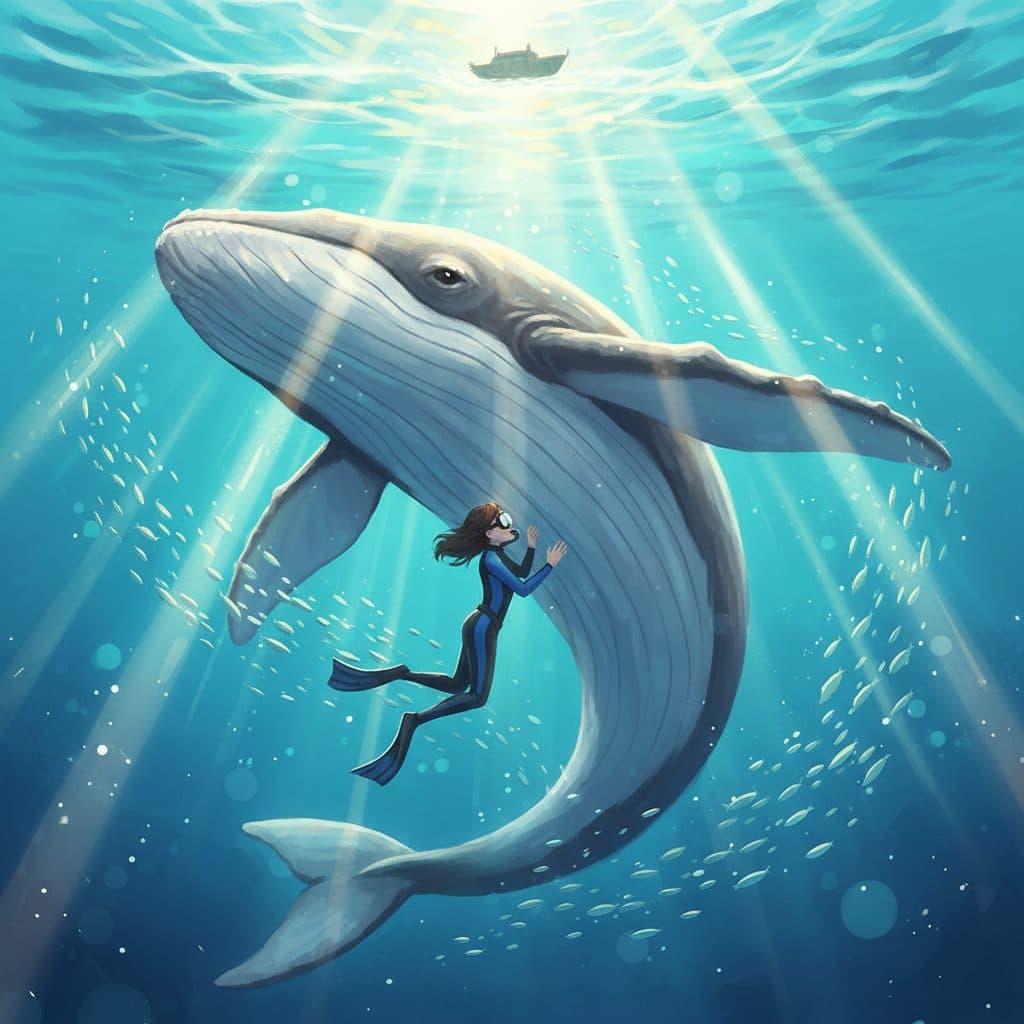
Nan Hauser — Ten Minutes Under a Humpback's Fin (2017)
Illustration: AI-generated dramatization (Gemini Flash Image)
The story
Skip to the verdict ↓Marine biologist Nan Hauser, 63, was in the water off Rarotonga in the Cook Islands when a humpback whale spent ten and a half minutes pushing her, rolling her along its body, and trying to tuck her under its pectoral fin; a tiger shark her crew estimated at estimated at 15 to 20 feet was in the water nearby, and the whale ferried her back toward her boat — the encounter is on video, and the question it leaves is intent.
Nan Hauser, a marine biologist then 63 years old, was in the water off Muri Beach, Rarotonga, in the Cook Islands when an adult male humpback whale began pushing her through the sea with its head, rolling her along its body, and working to tuck her under its pectoral fin. It went on for ten and a half minutes. Her organization dates the encounter September 14, 2017; some early coverage placed it in October, and the footage went wide that January. Cameras were running throughout.
A tiger shark was in the water. Her dive crew spotted it during the encounter; locals who saw the footage put it at 20 feet, 'as big as a pickup truck.' Hauser, who has worked around tiger sharks for decades, said: 'This was like a truck.' The whale eventually moved her back toward the research boat, and she climbed out with scrapes and bruises.
'I've spent 28 years underwater with whales, and have never had a whale so tactile,' she said. The contact was dangerous in itself: 'If he held me under his pectoral fin, I would have drowned.' She later called the encounter 'the most terrifying thing that I have ever experienced.'
The Science
Humpbacks are documented doing something like this for other species. Marine ecologist Robert Pitman's research records humpbacks mobbing orcas and shielding seals from attack, behavior published under the heading of interspecies altruism, and Hauser cites that work herself. Marine ecologist Rob Harcourt argued that curiosity explains tactile humpback behavior without any protective motive, and cautioned: 'Whales do and have killed people inadvertently.' The video documents the whale's behavior, not its perception.
The Return
On September 29, 2018, a year and 15 days later, a male humpback approached her in the same waters and lifted her on its head, gently this time. She identified it as the same animal by two notches on the tail fluke and a white mark on the head. 'There was absolutely no doubt in my mind that he recognized me,' she said, and elsewhere: 'It was like seeing your dog that you haven't seen in six months.' Photo-identification by fluke marking is a standard field method; here it was applied by Hauser herself.
It happened — best read as remarkable timing, not the miraculous.
Reviewer Notes
Miracles Jar weighs each claim two ways — how extraordinary it would be, and how strong the evidence is.
Assessed by Miracles Jar AI
The behavior is on film and the shark was real; whether the one caused the whale's response is the open question, and the strongest reading of 'more than coincidence' here resolves into documented animal behavior, not miracle.
This case is unusual because the believer-side reading is itself a natural hypothesis. If the whale was protecting Hauser, that is animal cognition doing something documented elsewhere in the species, not a suspension of nature. The filmed behavior is extraordinary by her own 28-year baseline, the shark was real, and the protective hypothesis has peer company in Robert Pitman's data on humpbacks mobbing orcas and shielding seals; curiosity remains the rival that cannot be excluded. Few documented cases of animal protection of a human carry this much evidence. What the whale intended is unknown.
From the scientific discussion: the footage documents the whale's behavior, not its perception. Intent is the one thing the video cannot show. The shark's role as the whale's motive is inference. Rob Harcourt offered the curiosity reading — "Whales do and have killed people inadvertently" — and that reading comes from inside the same field.
On the return encounter: the photo-ID method was applied by Hauser herself — the one researcher with everything invested in the answer. Both facts belong in the record: the identification method is standard (fluke notches and head markings), and the analyst is not disinterested.
Facts on record: 63 years old; Muri Beach, Rarotonga, Cook Islands; adult male humpback; pushing/rolling/tucking under pectoral fin; ten and a half minutes; September 14, 2017, with an October wobble on the date and footage released in January; tiger shark seen by dive crew; locals described it as "20 feet" and "as big as a pickup truck"; "This was like a truck"; return to research boat; scrapes and bruises; "28 years underwater"; "would have drowned"; "most terrifying thing that I have ever experienced"; Robert Pitman on mobbing orcas, shielding seals, and interspecies altruism — Hauser cites it; Harcourt's curiosity reading; September 29, 2018, "a year and 15 days later"; lifted on head gently; two tail-fluke notches and a white head mark; "absolutely no doubt in my mind that he recognized me"; "like seeing your dog that you haven't seen in six months"; photo-ID by fluke is a standard method applied by Hauser.
The verdict (unchanged, not re-graded): this is a genuinely uncertain case in the animal-providence category — the evidence is real but not conclusive.
Evidence ledger — what the verdict rests on
The ten-and-a-half-minute encounter — the pushing, rolling, and attempted tucking under the pectoral fin — is on video and undisputed
The rare animal-providence case where the central behavior is filmed rather than recalled
A large tiger shark was independently seen in the water by her dive crew during the encounter
The shark's presence is corroborated; size estimates (15 to 20 feet) are eyewitness
Humpbacks are documented interfering with predators on behalf of other species, including Robert Pitman's records of humpbacks mobbing orcas and shielding seals
The believer-side reading has peer company in the animal-behavior literature — and is itself a natural mechanism
Curiosity explains tactile humpback behavior without invoking protection, and the shark's role as motive is inference the video cannot confirm
Rob Harcourt's reading; his caution that whales 'do and have killed people inadvertently' also reframes the encounter's risk
The 2018 reunion identification rests on Hauser's own reading of her own photographs, and the encounter date wobbles between September and October 2017 across accounts
Standard field methods, single-analyst application; noted rather than smoothed
What would raise the meter: Instrumented or physical evidence — measurements, samples, footage that survives analysis — would raise this.
What would lower it: A controlled observation reproducing the experience naturally (lighting, suggestion, pareidolia) would move it down.
How we weigh every claim — the full method, deductions and all →
The natural explanation
The leading natural account for this case is misperception: how honest witnesses get it wrong. Read what it explains — and where it stops.
The same wonder, across traditions
This claim is one of many that make the same assertion across faiths. See it side by side in Deliverance Against the Odds.
Sources
Tagged by proximity to the event. Primary sources are direct or contemporaneous; tertiary are downstream retellings.
- 1.Primarytestimony
Nan Hauser, Center for Cetacean Research and Conservation, "Saved By A Whale", 2018
Her own account: the 10.5-minute duration, the tucking under the pectoral fin, the return to the boat, the terror framing, and the September 29, 2018 reunion with the identified individual
- 2.Secondarynews
Contemporaneous coverage: the crew-spotted tiger shark ('as big as a pickup truck,' about 20 feet), her 28-year baseline and drowning fear, the Pitman altruism research she cites, and Rob Harcourt's curiosity counter-reading
- 3.Secondarynews
The 'like a truck' shark quote, the ferrying back to the boat, the documented-altruism context, and the reunion identification by tail notches and head mark
Cases like this
Nearest on the map — similar in how miraculous they’d be, and how strong the evidence is.