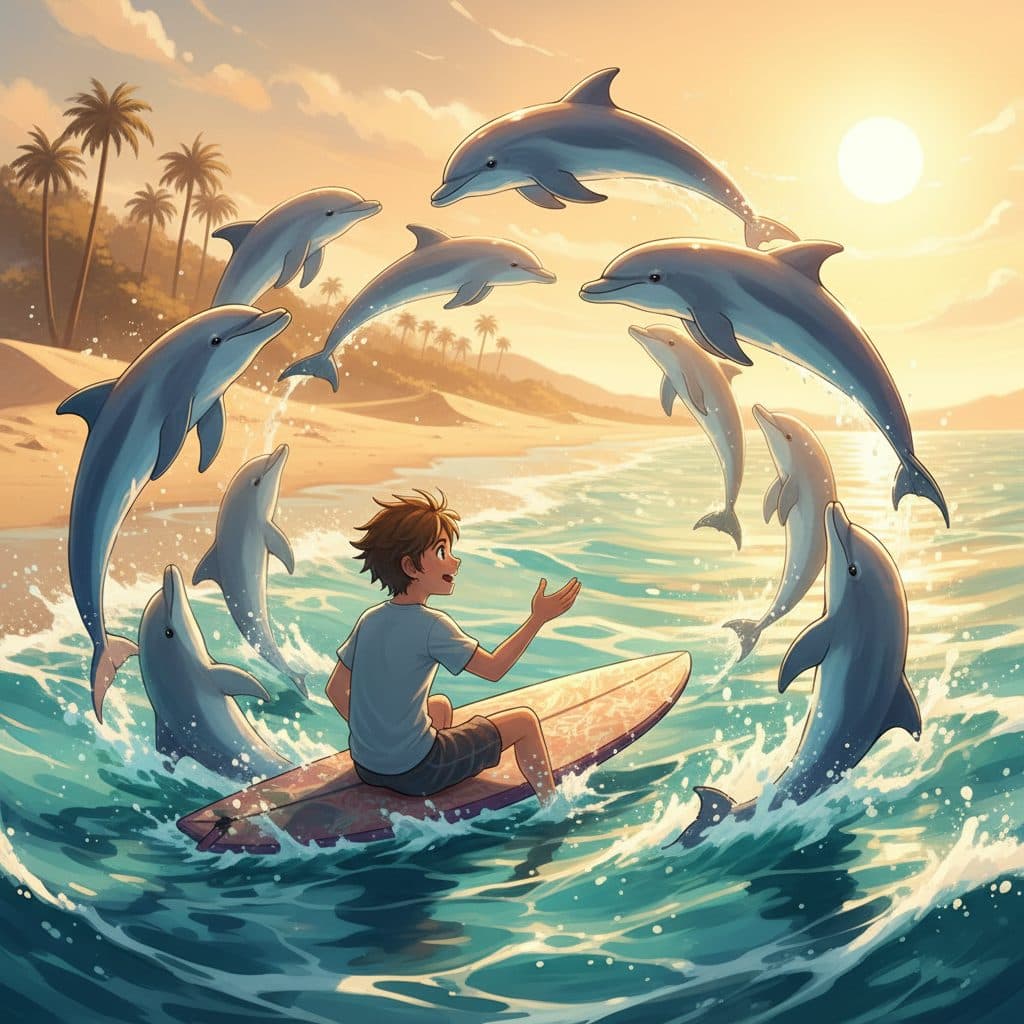
Todd Endris and the Ring of Dolphins (2007)
Illustration: AI-generated dramatization (Gemini Flash Image)
The story
Skip to the verdict ↓On August 28, 2007, a 15-foot great white shark struck the surfer Todd Endris three times at Marina State Beach in Monterey Bay, California, tearing the skin from his back and mauling a leg to the bone. A pod of bottlenose dolphins formed a ring around him, by his account, holding the shark off long enough for him to catch a wave to shore, where a surf-leash tourniquet and a friend's first aid kept him alive. He took 500 stitches and 200 staples. Endris died in an unrelated car crash in 2016.
On August 28, 2007, a great white shark about 15 feet long struck the surfer Todd Endris three times at Marina State Beach in Monterey Bay, California. It peeled the skin from his back and tore his right leg toward the bone. Endris was 24 at the time.
The injuries were severe. Endris said he lost about half his blood, and later described the surgery: 'You could see my lungs when they were sewing me up.' He reached the beach on a wave, made a tourniquet from his surfboard leash, and was kept alive by a friend's first aid until paramedics arrived. Surgeons closed his wounds with roughly 500 dissolvable stitches and 200 staples. He recovered over about six weeks, went back to surfing, and became an advocate for protecting white sharks.
By Endris's account, a pod of about fifteen bottlenose dolphins closed around him as the shark attacked, slapping the water, and 'kind of created a wall between me and the shark.' That barrier, he said, gave him the seconds he needed to catch a wave to shore. He has said it is the dolphins he credits with holding the shark off.
Endris died on September 1, 2016, in a car crash while on a camping trip.
It happened — best read as remarkable timing, not the miraculous.
Reviewer Notes
Miracles Jar weighs each claim two ways — how extraordinary it would be, and how strong the evidence is.
Assessed by Miracles Jar AI
The attack and the survival are documented down to the stitch count; what stays open is the dolphins. Bottlenose pods do mob sharks and do converge on thrashing water, so their presence needs no intention — but Monterey Bay's dolphins are among the few animals that harass great whites, and whether they shielded a man or reacted to the same shark cannot be settled from one survivor's account.
This is a question about whether a dolphin pod shielded Endris by intention or converged on the same shark and commotion — with the well-documented attack on one side and a single unrecorded first-person account of the dolphins on the other.
What is documented vs. disputed
The attack, the injuries, and the survival are documented in contemporary and follow-up press, with consistent figures and Endris's own quotes: the 15-foot great white, three strikes, 500 dissolvable stitches and 200 staples, roughly half his blood lost. The facts of the attack are not in question. The disputed, load-bearing element is what the dolphins were doing and whether it was directed at protecting Endris.
The case for and against
The natural reading has two parts.
First, dolphins are real, present in Monterey Bay, and are among the few animals known to mob and harass white sharks; pods will surround and drive off threats, and they sometimes converge on disturbances in the water — including a thrashing, bleeding animal — without any intention directed at a human. The behavior Endris saw is within the documented range of cetacean activity around predators and disturbances.
Second, the primary rival is misperception layered on chance: a man in a life-threatening attack, losing blood, is not a calm or reliable witness, and the meaning of a dolphin pod's movement — protecting him, versus reacting to the same shark, versus mobbing the commotion — is exactly the kind of thing a terrified witness reads charitably. There is no film and no second observer; the account is Endris's, vivid and consistent but singular, and animal-rescue narratives are a genre with a strong pull toward intentional readings.
What the natural reading must absorb is that the pod's presence, whatever drove it, plausibly did interpose mass and chaos between Endris and the shark long enough to matter, and that bottlenose dolphins are in fact one of the few animals that harass white sharks. Whether that was protection of him or proximity to the same event cannot be resolved from a single first-person account.
Where this lands
Animal agency is genuinely on the table here in a way that pure timing is not — which sets this apart from clean-coincidence cases. But the evidence is held down by the single-witness, unrecorded account. The attack and the survival are documented down to the stitch count; what stays open is the dolphins. Bottlenose pods do mob sharks and do converge on thrashing water, so their presence needs no intention — but Monterey Bay's dolphins are among the few animals that harass great whites, and whether they shielded a man or reacted to the same shark cannot be settled from one survivor's account.
Endris died on September 1, 2016, in a car crash on a camping trip, unrelated to the 2007 attack — one chapter of a life this story is only part of.
Evidence ledger — what the verdict rests on
The attack, the injuries, and the survival are documented in contemporary and follow-up press, with consistent figures and Endris's own quotes
15-foot great white, three strikes, 500 stitches and 200 staples, roughly half his blood lost
Bottlenose dolphins are present in Monterey Bay, are among the few animals that mob and harass white sharks, and converge on disturbances in the water
Their presence is within the documented range of cetacean behavior around predators and commotion
The dolphins' presence, whatever drove it, plausibly interposed mass and chaos between Endris and the shark long enough for him to reach a wave
Mobbing behavior can have the effect of a barrier without a protective intention toward a human
The protective reading rests on a single first-person account from a man in a life-threatening, blood-loss situation, with no recording
A terrified witness reads ambiguous animal movement charitably; the genre pulls toward intention
Whether the pod shielded Endris or reacted to the same shark and commotion cannot be distinguished from the available evidence
Misperception layered on coincidental proximity is the primary rival
What would raise the meter: Instrumented or physical evidence — measurements, samples, footage that survives analysis — would raise this.
What would lower it: A controlled observation reproducing the experience naturally (lighting, suggestion, pareidolia) would move it down.
How we weigh every claim — the full method, deductions and all →
The natural explanation
The leading natural account for this case is misperception: how honest witnesses get it wrong. Read what it explains — and where it stops.
The same wonder, across traditions
This claim is one of many that make the same assertion across faiths. See it side by side in Deliverance Against the Odds.
Sources
Tagged by proximity to the event. Primary sources are direct or contemporaneous; tertiary are downstream retellings.
- 1.Primarynews
September 21, 2016: the August 28, 2007 attack by a 15-foot great white at Marina State Beach on the 24-year-old Endris, his quote that the dolphins 'kind of created a wall between me and the shark,' the 500 dissolvable stitches and 200 staples, the lost half his blood, the 'You could see my lungs when they were sewing me up' line, and his death on September 1, 2016 in a car crash on a camping trip
- 2.Secondarynews
TODAY / Associated Press, "Dolphins save surfer from becoming shark's bait", 2007
Contemporary 2007 account: the three strikes, the pod of bottlenose dolphins forming a barrier that let Endris reach shore, and the friend's first aid that saved his life
- 3.Secondarynews
Surfer, "Detailed Account; Monterey Surfer Recovers", 2007
Surf-press account of the attack sequence, the surf-leash tourniquet, and the recovery
Cases like this
Nearest on the map — similar in how miraculous they’d be, and how strong the evidence is.