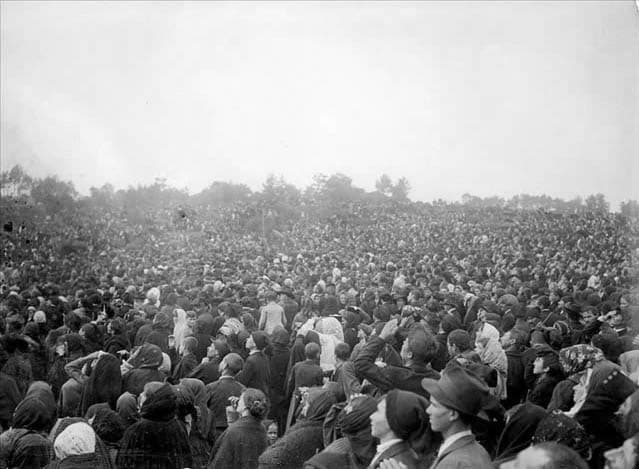
The Miracle of the Sun at Fátima
Photo: Judah Bento Ruah (O Século / Illustração Portuguesa, 1917) / Wikimedia Commons · Public domain
The story
Skip to the verdict ↓Three shepherd children near Fátima had been saying for months that a sign would come on 13 October 1917, 'so that all may believe.' By that morning a crowd somewhere between thirty and a hundred thousand had gathered in a muddy field in the rain to see whether it would. Then, they said, the clouds broke and the sun began to move.
The three shepherd children were Lúcia dos Santos and her cousins Francisco and Jacinta Marto, and the message naming 13 October had been given to them on 13 July 1917. The crowd gathered that day at the Cova da Iria.
What the Witnesses Reported
After a morning of heavy rain, observers said the clouds parted and the sun appeared as a spinning disc that could be looked at without pain, throwing off colors across the landscape. Many described it as careening toward the earth before returning to its place. Some reported that the previously soaked ground and their own clothing had dried.
> "The sun trembled, made sudden incredible movements outside all cosmic laws — the sun 'danced.'" — Avelino de Almeida, *O Século*
Almeida wrote for an anticlerical newspaper. The event was reported by multiple newspapers within days.
What Others Saw
The reports were not uniform. Accounts differed on the duration, the direction of motion, and the colors. A number of people present said they saw nothing out of the ordinary. No telescope, observatory, or instrument anywhere recorded a solar anomaly that day, and the phenomenon was not observed at distant observatories.
It happened — and nature accounts for it.
Reviewer Notes
Miracles Jar weighs each claim two ways — how extraordinary it would be, and how strong the evidence is.
Assessed by Miracles Jar AI
An extraordinary mass-witness event with a genuine evidentiary core — but strong naturalistic candidates and inconsistent reports keep it short of decisive.
We come down clearly on the side of a natural explanation. A genuinely physics-suspending event is unlikely here, and the optical and crowd-psychology evidence leaves us comfortable saying so.
The case for. The strongest fact in its favor is the advance prediction: the children named the date months ahead — roughly three months in advance — and a very large crowd (tens of thousands) assembled as predicted and reported something. What a purely psychological account struggles with is precisely this prediction. The date was set in advance and the crowd came expecting *something* — and reported it. That does not prove the sun moved, but it does separate Fátima from an ordinary rumor. Press coverage is near-contemporaneous and includes a secular, anticlerical paper (*O Século*) not inclined to favor the Church — which makes Almeida's report of an unusual solar phenomenon notable.
The case against. Eyewitness descriptions diverge sharply — colors, motion, duration — and some in the crowd reported seeing nothing unusual. The most economical natural account combines the optics of staring at a partially clouded sun (prolonged staring through thinning cloud can produce afterimages, apparent motion, and color shifts) with the powerful effect of shared expectation in a keyed-up crowd; collective expectation amplifies shared reports. No instrument recorded any change, and the phenomenon was not observed at distant observatories. Notably, the physicist-priest Stanley L. Jaki (*God and the Sun at Fátima*, 1999) accepts the event yet argues for a meteorological (atmospheric) mechanism rather than a suspension of physics.
Where this lands. The predictive element is genuinely striking; the phenomenon itself is not cleanly established and remains underdetermined by the evidence. Several plausible natural mechanisms can produce exactly this spread of reports. The prediction is remarkable; the phenomenon itself is not. That tension — a remarkable advance prediction sitting atop a non-uniform, instrumentally unrecorded phenomenon — is what keeps the entry short of decisive.
A note on sources. John De Marchi's *The True Story of Fátima / The Immaculate Heart* (1952) compiles many eyewitness testimonies gathered decades after the event — rich but retrospective. Almeida's 1917 *Reportagem* in *O Século* is the primary near-contemporaneous account.
Evidence ledger — what the verdict rests on
The date was announced roughly three months in advance, and a very large crowd (tens of thousands) gathered as predicted.
Reported by multiple newspapers within days, including a secular anticlerical one not inclined to favor the Church.
Eyewitness descriptions diverge sharply — colors, motion, duration — and some in the crowd reported seeing nothing unusual.
Prolonged staring at the sun through thinning cloud can produce afterimages, apparent motion, and color shifts; collective expectation amplifies shared reports.
No instrument recorded any change, and the phenomenon was not observed at distant observatories.
What would raise the meter: Instrumented or physical evidence — measurements, samples, footage that survives analysis — would raise this.
What would lower it: A controlled observation reproducing the experience naturally (lighting, suggestion, pareidolia) would move it down.
How we weigh every claim — the full method, deductions and all →
The natural explanation
The leading natural account for this case is misperception: how honest witnesses get it wrong. Read what it explains — and where it stops.
Sources
Tagged by proximity to the event. Primary sources are direct or contemporaneous; tertiary are downstream retellings.
- 1.Primarynews
Avelino de Almeida, "Reportagem (eyewitness account of 13 October 1917)", O Século (Lisbon), 1917· no public link
Almeida wrote for an anticlerical paper, which makes his report of an unusual solar phenomenon notable.
- 2.Secondarybook
John De Marchi, "The True Story of Fátima / The Immaculate Heart", 1952· no public link
Compiles many eyewitness testimonies gathered decades after the event — rich but retrospective.
- 3.Secondaryacademic
Stanley L. Jaki, "God and the Sun at Fátima", 1999· no public link
A physicist-priest who accepts the event yet argues for a meteorological (atmospheric) mechanism rather than a suspension of physics.
Further reading
- Fátima: The Great Sign — Francis Johnston
- Looking for a Miracle — Joe Nickell
Cases like this
Nearest on the map — similar in how miraculous they’d be, and how strong the evidence is.