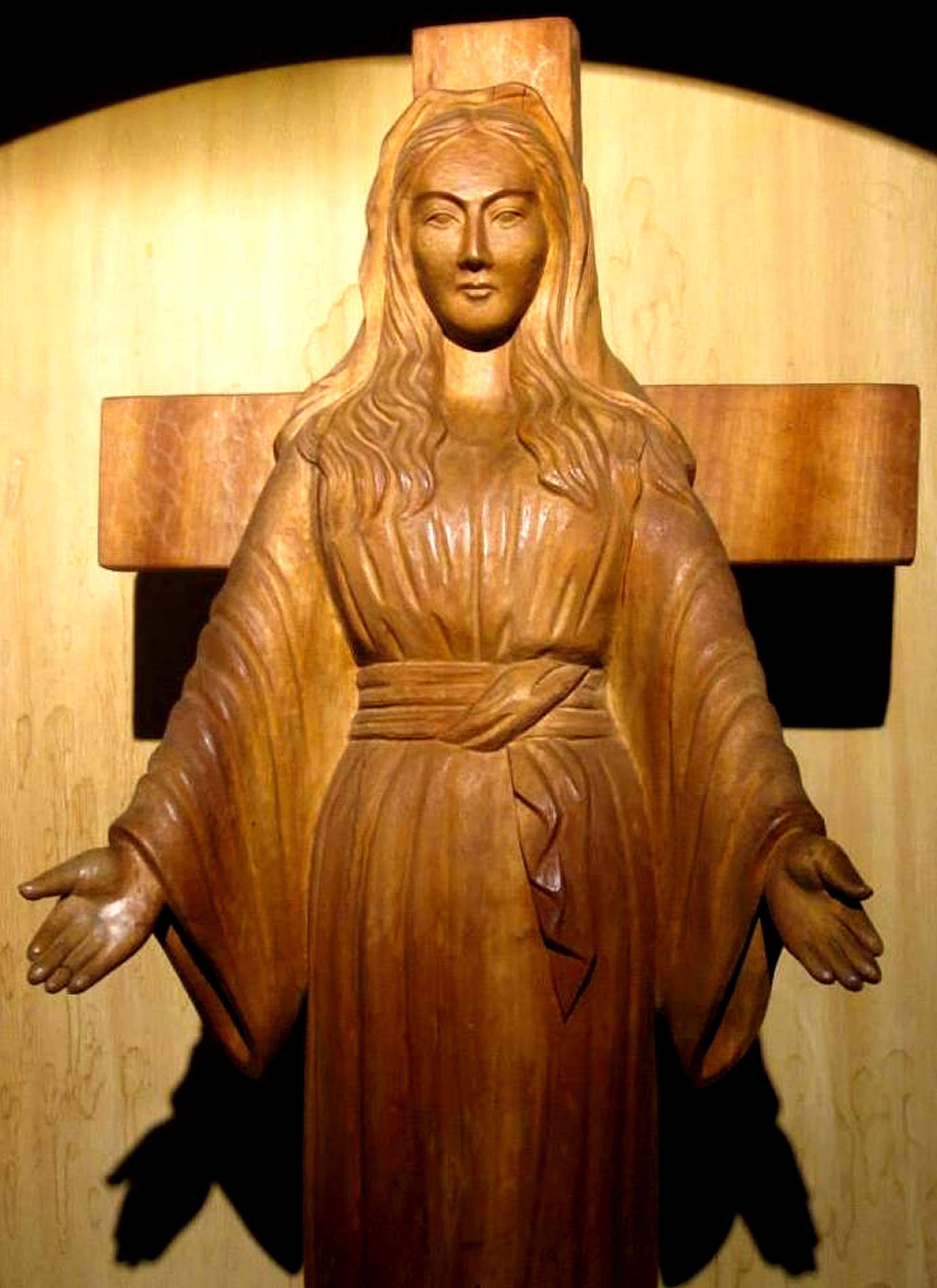
Our Lady of Akita: Weeping Wooden Statue
Photo: SICDAMNOME / Wikimedia Commons · CC BY-SA 4.0
The story
Skip to the verdict ↓A wooden statue of the Virgin Mary at the Institute of the Handmaids of the Eucharist in Akita, Japan wept on 101 documented occasions between 1973 and 1981, with tears and blood analyzed as human biological fluids; Bishop Ito approved veneration in 1984.
The events at Akita began on July 6, 1973, when Sister Agnes Katsuko Sasagawa — then completely deaf — reported receiving locutions from a guardian angel and subsequently from a wooden statue of Mary at the Institute of the Handmaids of the Eucharist in Akita, Japan. The statue, a figure of the Virgin Mary carved from a single block of Japanese katsura wood, subsequently exhibited three unusual phenomena: a cross-shaped wound on its right palm that bled from July 27, 1973 and later healed, apparent sweating that reportedly emitted a sweet fragrance, and repeated weeping.
The Weeping
The statue wept on 101 occasions between January 4, 1975, and September 15, 1981. TV Tokyo Channel 12 videotaped a weeping episode in December 1978.
The Forensic Analysis
Father Teiji Yasuda, the convent's chaplain and primary chronicler of the events, had samples of the secretions analyzed. According to his account, Dr. Eiji Okuhara of Akita University's biochemistry department conducted initial tests, then forwarded samples to forensic specialist Dr. Kaoru Sagisaka, who identified the materials as human fluids: blood type B from the wound, with the tears and perspiration typed AB — two different blood types. Sister Agnes herself was reportedly cured of her deafness in 1973; the deafness recurred and was reportedly cured again in 1982.
Ecclesial Response
Bishop John Shojiro Ito conducted an eight-year investigation and on April 22, 1984 issued a pastoral letter authorizing veneration within the Diocese of Niigata, recognizing 'the supernatural character of a series of mysterious events.' He explicitly stated the matter awaited final Holy See judgment. The Vatican's Congregation for the Doctrine of the Faith — then headed by Cardinal Joseph Ratzinger — never formally endorsed the recognition. In June 1988, Bishop Ito met with Cardinal Ratzinger (later Pope Benedict XVI), who gave verbal approval to the 1984 letter while declining to render judgment on the credibility of the events; Ratzinger reportedly called the events 'reliable and worthy of belief.' Archbishop Peter Shirayanagi of Tokyo stated in 1990 that the events were no longer to be taken seriously.
Natural Explanations
Proposed natural mechanisms for weeping icons include capillary action drawing moisture through wood, oil from venerating hands absorbed and later exuded, condensation from temperature shifts, and microbial activity in old paint layers. The laboratory analysis of the Akita fluid has not been independently published.
Too thin a record to say either way.
Reviewer Notes
Miracles Jar weighs each claim two ways — how extraordinary it would be, and how strong the evidence is.
Assessed by Miracles Jar AI
Biological fluid typing is a significant evidential feature; ecclesial approval is mid-level only; no independent secular scientific verification of the weeping mechanism.
The two blood types reported — per Fr. Yasuda's account, blood type B from the palm wound and tears/sweat type AB — are consistent with a human source but not with a single adulterant. The statue being a single block of katsura wood means no biological mechanism exists for it to produce human fluids, making any genuine secretion intrinsically anomalous — an argument entirely conditional on the forensic claim being accurate; if the analysis is flawed or the samples were contaminated, it collapses. No peer-reviewed publication of the Okuhara/Sagisaka results exists, the chain of custody is not publicly documented, and the analysis is known only through Fr. Yasuda's 1989 account — an explicitly religious testimony by the convent's chaplain. Archbishop Shirayanagi of Tokyo issued a statement in 1990, illustrating the divided state of Catholic hierarchical opinion: Bishop John Shojiro Ito of Niigata issued a pastoral letter on April 22, 1984 affirming the supernatural character of the events; the Congregation for the Doctrine of the Faith never formally endorsed it; Cardinal Joseph Ratzinger (later Pope Benedict XVI) gave verbal approval in June 1988 — reportedly calling the events 'reliable and worthy of belief,' a statement often cited by promoters but not a formal doctrinal pronouncement; Shirayanagi's 1990 statement did not endorse that conclusion. Whether the laboratory analysis was rigorous and the chain of custody unimpeached has not been independently published; that gap limits what the analysis can prove.
The natural mechanisms proposed for weeping statues — capillary transfer of applied substances, condensation on cold surfaces, and deliberate concealed application — do not straightforwardly explain blood-typed biological fluid. That said, the laboratory analysis has not been independently published and its methodology cannot be assessed.
Sister Agnes's reported hearing cure (1973, recurrence, cure again in 1982) is a secondary claim that cannot be independently verified.
Evidence ledger — what the verdict rests on
Biological analysis attributed to forensic specialist Dr. Kaoru Sagisaka identified the statue's secretions as human fluids of distinct blood types — per Fr. Yasuda's account, blood type B from the palm wound, tears and sweat type AB — results inconsistent with water, oil, or a single adulterant.
If the testing was conducted properly, this is the strongest single evidential point; samples were reportedly provided without case history, but the analysis has never been independently published and is known only through Fr. Yasuda's account
The statue is carved from a single block of katsura wood — no biological mechanism exists for a wood statue to produce human biological fluids, making any genuine secretion intrinsically anomalous.
Conditional on the forensic claim being accurate; if the analysis is flawed or the samples were contaminated, this argument collapses
TV Tokyo Channel 12 videotaped a weeping episode in December 1978, providing visual documentation that the phenomenon occurred.
Confirms the weeping occurred; does not confirm its cause or preclude manipulation
Archbishop Peter Shirayanagi (Tokyo) stated in 1990 that the Akita events were no longer to be taken seriously, and the Holy See has never issued definitive approval.
Higher-ranking hierarchical skepticism coexists with diocesan-level approval, indicating unresolved institutional disagreement
The weeping occurred exclusively within a closed convent with no independent secular or scientific observers present during episodes; all biological sampling was post-hoc.
Absence of independent witnessing during events limits evidentiary weight of subsequent analysis
What would raise the meter: Adversarial scrutiny with real power to expose deception — hostile investigators, controlled conditions — coming back clean would raise the evidence bar.
What would lower it: A confession, an exposed method, or a documented financial motive would drive the evidence bar toward zero.
How we weigh every claim — the full method, deductions and all →
The natural explanation
The leading natural account for this case is deception: hoaxes, cold reading & stagecraft. Read what it explains — and where it stops.
The same wonder, across traditions
This claim is one of many that make the same assertion across faiths. See it side by side in Images That Weep, Bleed, and Stir.
Sources
Tagged by proximity to the event. Primary sources are direct or contemporaneous; tertiary are downstream retellings.
- 1.Primarychurch document
John Shojiro Ito, "Bishop John Ito's Pastoral Letter authorizing veneration of Our Lady of Akita", 1984· no public link
Formal diocesan approval after eight-year investigation; recognized supernatural character; awaits Holy See final judgment
- 2.Tertiaryother
"Our Lady of Akita — Wikipedia (citing laboratory analysis and Archbishop Shirayanagi's 1990 statement)", 2024· no public link
Summarizes blood-typing results, TV Tokyo videotaping, and competing hierarchical assessments
- 3.Tertiarychurch document
"A Message From Our Lady — Akita, Japan", 2001· no public link
EWTN compilation of Akita events including Sister Agnes's messages and the 101 weeping count
- 4.Tertiarynews
"Our Lady of Akita's 1973 Message to Japanese Nun Still Resonates", 2023· no public link
Global Sisters Report; confirms Cardinal Ratzinger's 1988 verbal approval to Bishop Ito
- 5.Secondarybook
Yasuda, Teiji, "Our Lady of Akita: The Tears, the Message, the Miracles", 1989· no public link
Account by the convent's chaplain; primary English-language source for event chronology and the Okuhara/Sagisaka analysis findings; religiously motivated
Cases like this
Nearest on the map — similar in how miraculous they’d be, and how strong the evidence is.