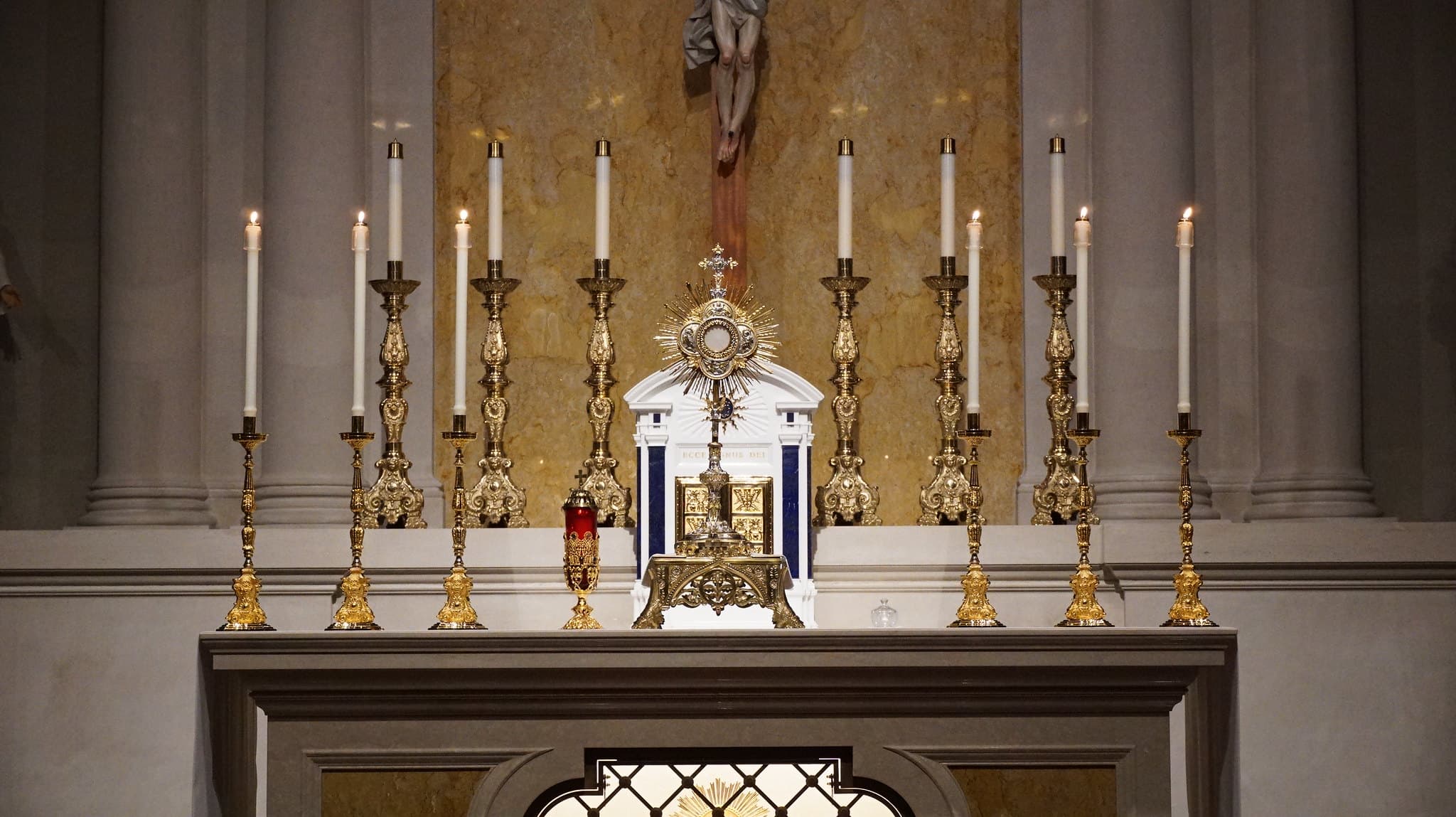
Eucharistic Miracle of Buenos Aires (1996)
Photo: Kategombos · CC BY-SA 4.0
The story
Skip to the verdict ↓On 18 August 1996, a priest in Buenos Aires found a consecrated communion host discarded at the back of his church. Following the rule for such things, Fr. Alejandro Pezet dropped it into a glass of water to dissolve it and set it in the tabernacle. Weeks later, someone looked in the glass. The host had not dissolved — it had turned to a reddish, fleshy substance.
The church was Santa Maria in Buenos Aires. Then-Archbishop Jorge Mario Bergoglio (later Pope Francis) oversaw the investigation and authorized scientific analysis.
The Laboratory Examination
In 1999, cardiologist and forensic pathologist Dr. Frederick Zugibe received a sample without being told its origin. He identified it as inflamed human cardiac muscle — specifically tissue from the left ventricular wall near the valves — containing white blood cells he stated indicated the tissue was alive or very recently alive when sampled. A famous quote attributed to him asks how cells could still be moving if the person died in 1996. His written signed report is publicly available.
How the Investigation Was Conducted
The investigation was organized by Ricardo Castañon Gomez, a clinical psychologist who has investigated multiple claimed Eucharistic miracles. Kearse & Ligaj (2024) note that no blind study design with mixed control slides was used. No chain-of-custody log documents the host from church tabernacle to laboratory. Zugibe's family has disputed how his statements were presented in promotional videos, and the full unedited interview footage has never been released for independent scrutiny. AB blood type is often cited in connection with the case; it is shared by roughly 5% of the population and appears in multiple miracle claims.
Too thin a record to say either way.
Reviewer Notes
Miracles Jar weighs each claim two ways — how extraordinary it would be, and how strong the evidence is.
Assessed by Miracles Jar AI
Intriguing pathology finding but investigator bias, no chain of custody, and no independent replication.
The pathology finding. Dr. Zugibe, a forensic pathologist and cardiologist, identified the sample as inflamed left-ventricular cardiac muscle with white blood cells indicative of living or very recently living tissue, and was reportedly blind to the sample's origin during testing. His written report is publicly available (Zugibe FT, "Forensic Pathology Review of Eucharistic Miracle from Buenos Aires," 2005; via NACN-USA). This case has unusually detailed scientific examination for a eucharistic miracle claim.
Investigator selection bias. The investigation was organized and the lab selection controlled by Ricardo Castañon Gomez, a clinical psychologist with no analytical chemistry credentials. That he has investigated multiple claimed Eucharistic miracles raises the question of investigator selection bias, and a critic of miracle claims questions his objectivity.
The disputed quotation. Zugibe's family has disputed the quotation attributed to him about "pulsating cells" / cells still moving, and raised concerns that his statements were edited and taken out of context in promotional videos. The full unedited footage has never been released. This raises significant concern about whether the famous quote is accurately represented.
No replication. No second laboratory independently confirmed Zugibe's tissue identification. A single-examiner finding without replication is insufficient for scientific consensus. Standard chain-of-custody documentation was not followed, and Kearse & Ligaj (2024) note the lack of blind study design and mixed control slides.
On the AB blood type: often cited as striking, it is shared by roughly 5% of the population and appears in multiple miracle claims, which may reflect sample contamination or selection.
Where this lands: Three unresolved problems remain — (1) the investigation was not conducted under standard forensic protocols; (2) only one laboratory performed analysis; (3) key evidentiary materials (full Zugibe footage, documented chain of custody) remain unavailable. These gaps prevent a scientific verdict either way. Supporting sources: National Catholic Register, "Three Eucharistic Miracles" (2023), on methodology and credibility gaps; Kearse K & Ligaj F (2024) on standardization in evaluation.
Evidence ledger — what the verdict rests on
Zugibe identified inflamed left-ventricular cardiac muscle with active white blood cells
Zugibe was reportedly blind to the sample origin; his written report is publicly available
Investigation controlled by a clinical psychologist (Castañon Gomez), not an independent scientific body
No analytical chemistry credentials; critic of miracle claims questions his objectivity
Zugibe's family disputes the quotation attributed to him about 'pulsating cells'; full footage unreleased
Raises significant concern about whether the famous quote is accurately represented
No second independent laboratory confirmed Zugibe's tissue identification
Single-examiner finding without replication is insufficient for scientific consensus
What would raise the meter: Adversarial scrutiny with real power to expose deception — hostile investigators, controlled conditions — coming back clean would raise the evidence bar.
What would lower it: A confession, an exposed method, or a documented financial motive would drive the evidence bar toward zero.
How we weigh every claim — the full method, deductions and all →
The natural explanation
The leading natural account for this case is deception: hoaxes, cold reading & stagecraft. Read what it explains — and where it stops.
Sources
Tagged by proximity to the event. Primary sources are direct or contemporaneous; tertiary are downstream retellings.
- 1.Primaryinvestigation
Zugibe FT, "Forensic Pathology Review of Eucharistic Miracle from Buenos Aires", 2005· no public link
Zugibe's own written report; available via NACN-USA; nacn-usa.org/wp-content/uploads/Zugibe-scanned-reports-26-3-05-and-15-3-05-RON-ack.pdf
- 2.Secondarynews
"Three Eucharistic Miracles: Which Cases Have Undergone the Most Extensive Scientific Analysis?", 2023· no public link
National Catholic Register review of methodology and credibility gaps; ncregister.com
- 3.Secondaryacademic
Kearse K, Ligaj F, "Scientific Analysis of Eucharistic Miracles: Importance of a Standardization in Evaluation", 2024· no public link
Notes lack of blind study design and mixed control slides in Buenos Aires investigation
Cases like this
Nearest on the map — similar in how miraculous they’d be, and how strong the evidence is.