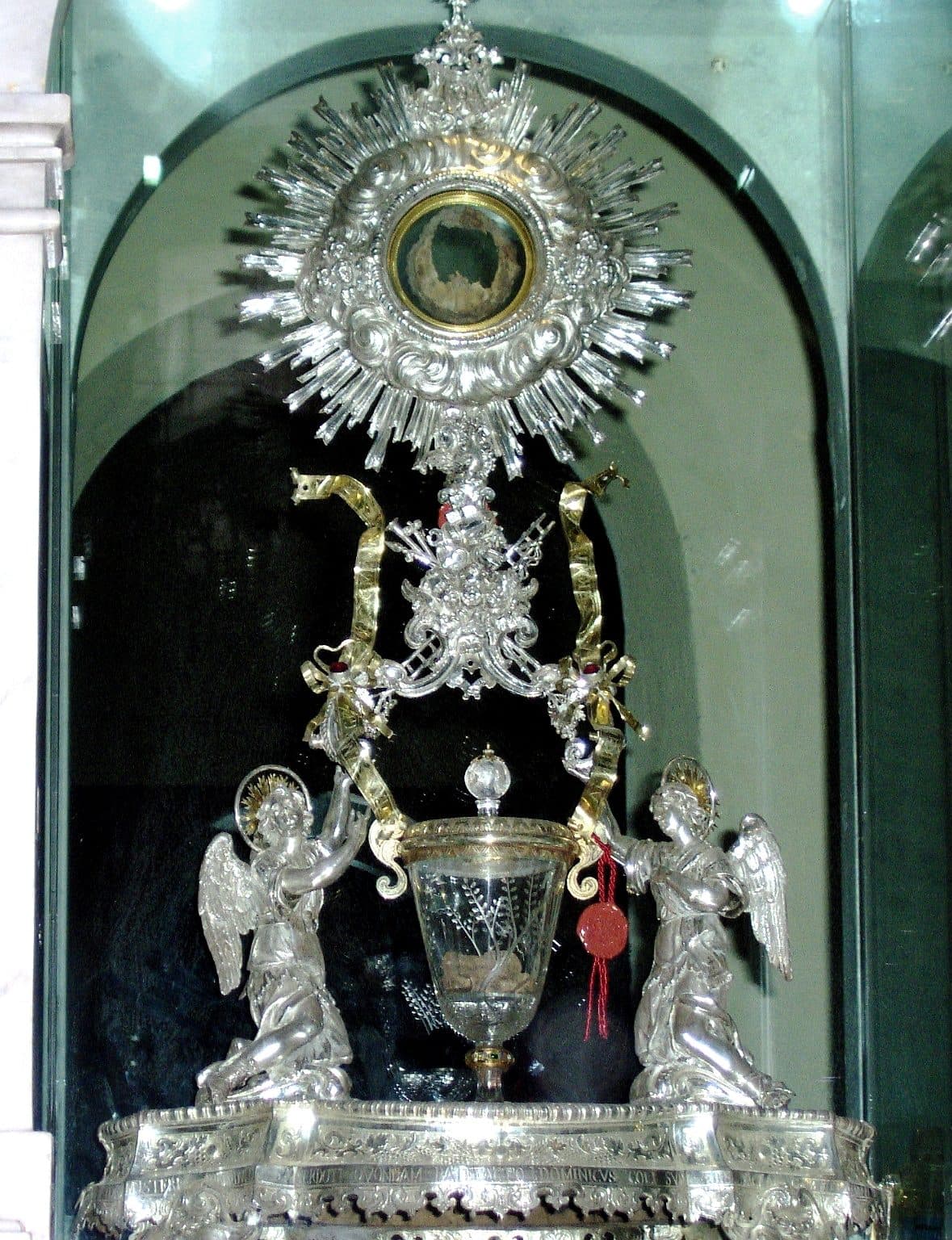
The Eucharistic Miracle of Lanciano
Photo: Junior / Wikimedia Commons · Public domain
The story
Skip to the verdict ↓In a church in Lanciano, on Italy's Abruzzo coast, a fragment of what tradition calls flesh and a few dark pellets of what it calls blood have been venerated for more than a thousand years — since, the story goes, a doubting monk watched the bread and wine of his Mass visibly change. In 1970 an anatomy professor, Odoardo Linoli, was finally permitted to examine the relic under a microscope.
Tradition places that monk around the 8th century, and the doubt that drove him was of the Real Presence in the host and wine of the Mass. The relics — the "flesh" and the pellets of "blood" — have been preserved and venerated at the church ever since.
The Examination
In 1970–71, Odoardo Linoli, a professor of anatomy and histology, was permitted to examine the relics. He reported that the flesh was striated muscle of the myocardium (heart wall), that the blood was human, and that both shared blood type AB. The findings were published and have been widely cited.
The Provenance
There is no continuous, documented record tying the object in the reliquary today to the 8th century. The relic has been venerated and displayed openly for centuries. The 1971 study was not followed by independent, modern, multi-laboratory work — DNA analysis or controlled dating — on fresh sampling.
Too thin a record to say either way.
Reviewer Notes
Miracles Jar weighs each claim two ways — how extraordinary it would be, and how strong the evidence is.
Assessed by Miracles Jar AI
A genuinely surprising laboratory result attached to a relic with an unverifiable thousand-year provenance — striking, but the chain of custody is the whole problem.
Where this lands
The 1971 analysis is the case's strength: a qualified anatomist reported that the "flesh" is human myocardium and the "blood" is human, type AB. That result is the kind of thing that should move a careful reader — and then the chain of custody collapses it.
What we have is a striking analytical result attached to an unverifiable object. Over a thousand years of veneration, the relic could have been substituted, restored, or replaced at any number of points — a millennium of handling and reverence provides ample opportunity for substitution, whether deliberate or innocent. The tissue may well be human heart muscle. That tells us almost nothing about whether it appeared miraculously thirteen centuries ago.
An extraordinary claim of this sort demands the kind of independent, modern, multi-laboratory work — DNA, controlled dating — that the 1971 study, credentialed as it was, never received. The relic having been venerated and displayed openly for centuries at least argues against a recent, casual fabrication, but that is weak counterweight against an unbridgeable provenance gap. Until the relic is subjected to controlled modern testing — and the provenance gap is, by its nature, unbridgeable — this stays a case with very low certainty despite its fame. A real heart-tissue sample of unknown origin is interesting; it is not evidence that it appeared miraculously in the 700s. The key fact — age and origin — is precisely what cannot be established.
Evidence ledger — what the verdict rests on
A 1971 examination by a qualified anatomist reported the tissue to be human heart muscle and the blood to be human, type AB.
The relic has been venerated and displayed openly for centuries, which at least argues against a recent, casual fabrication.
There is no continuous, documented chain of custody linking the present relic to the 8th-century event.
The 1971 study was not followed by independent, modern multi-lab analysis (e.g., DNA, dating) on controlled sampling.
A millennium of handling and reverence provides ample opportunity for substitution, whether deliberate or innocent.
What would raise the meter: Adversarial scrutiny with real power to expose deception — hostile investigators, controlled conditions — coming back clean would raise the evidence bar.
What would lower it: A confession, an exposed method, or a documented financial motive would drive the evidence bar toward zero.
How we weigh every claim — the full method, deductions and all →
The natural explanation
The leading natural account for this case is deception: hoaxes, cold reading & stagecraft. Read what it explains — and where it stops.
Sources
Tagged by proximity to the event. Primary sources are direct or contemporaneous; tertiary are downstream retellings.
- 1.Secondaryacademic
Odoardo Linoli, "Histological, immunological and biochemical study of the flesh and blood of the Eucharistic miracle of Lanciano", 1971· no public link
The professor of anatomy who performed the 1970–71 examination; reported myocardial tissue and type AB blood. Not independently replicated on fresh sampling.
- 2.Tertiarychurch document
"Parish and diocesan records of the relic's veneration, Lanciano"· no public link
Attest to long veneration but do not establish a continuous, verifiable chain of custody back to the 8th century.
Further reading
- Eucharistic Miracles — Joan Carroll Cruz
Cases like this
Nearest on the map — similar in how miraculous they’d be, and how strong the evidence is.