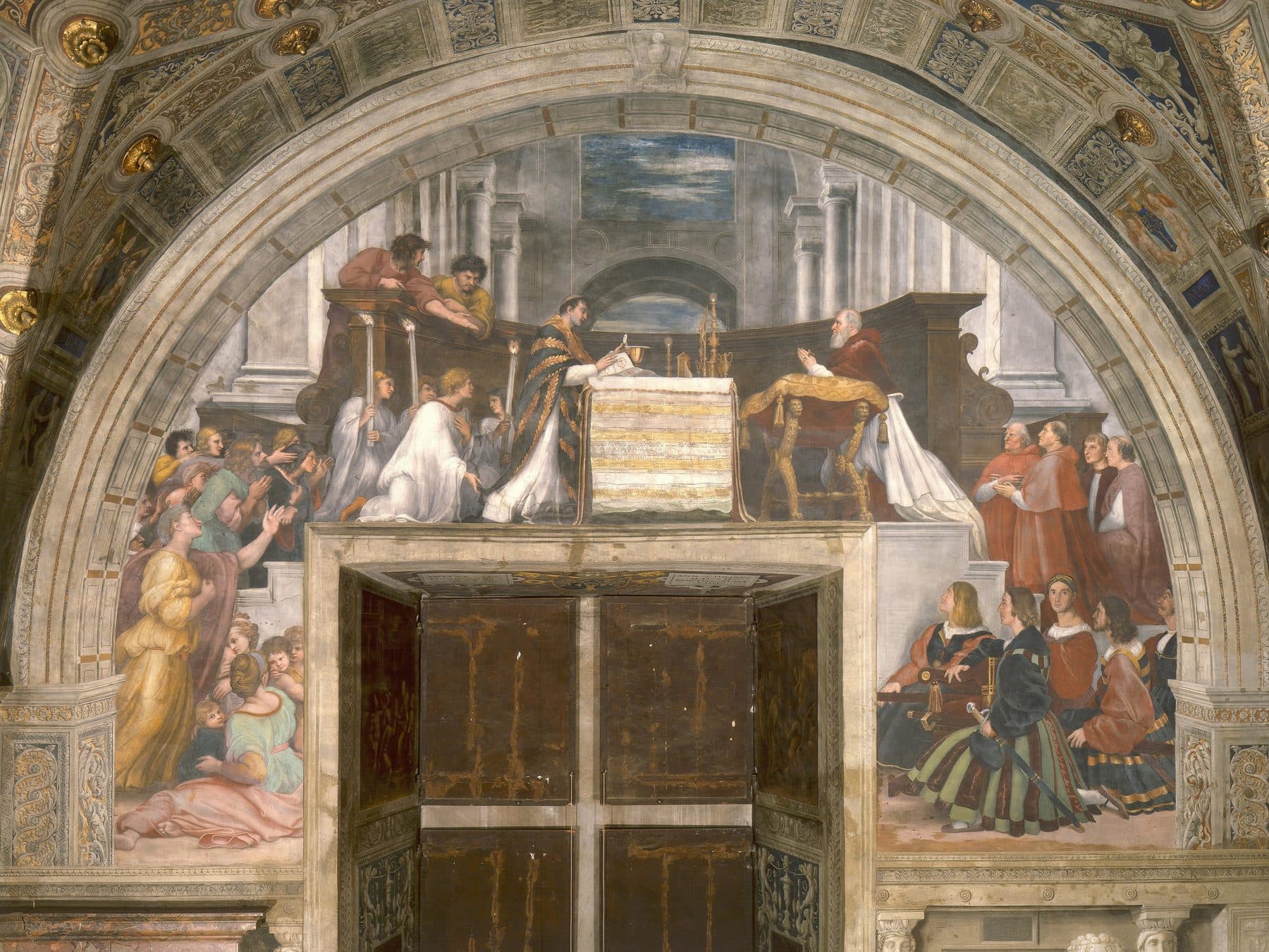
Eucharistic Miracle of Bolsena-Orvieto (1263)
The story
Skip to the verdict ↓A German priest celebrating Mass in Bolsena reportedly experienced a bleeding host that stained the corporal linen; the event allegedly prompted Pope Urban IV to institute the Feast of Corpus Christi.
In 1263, a German priest — traditionally identified as Fr. Peter of Prague, though this identification is uncertain — was traveling to Rome on pilgrimage and stopped in Bolsena to celebrate Mass. According to the account, he had doubts about the Real Presence of Christ in the Eucharist. Just after the words of consecration, blood reportedly began to flow from the Host and stained the corporal linen.
Papal Response and Corpus Christi
The priest took the relic to Pope Urban IV, who was residing in nearby Orvieto. Urban IV investigated and was reportedly convinced of the miracle's authenticity. In August 1264 he issued the bull *Transiturus de hoc mundo*, formally instituting the Feast of Corpus Christi — one of the most important additions to the Catholic liturgical calendar. He commissioned St. Thomas Aquinas to write the liturgical texts. The Orvieto Cathedral was subsequently built specifically to house the bloodstained corporal.
The Relic
The Corporal of Bolsena remains in the Cathedral of Orvieto in a bejeweled reliquary. It is a major pilgrimage destination and is displayed to the public. No published chemical or DNA analysis of the staining has been conducted to determine whether the discoloration is blood, the age of any biological material, or its species of origin.
Too thin a record to say either way.
Reviewer Notes
Miracles Jar weighs each claim two ways — how extraordinary it would be, and how strong the evidence is.
Assessed by Miracles Jar AI
Historically influential but evidence is thin: medieval narrative, no scientific analysis of the relic.
The institutional impact of this miracle is historically undeniable — it helped give rise to Corpus Christi, one of the most important Catholic solemnities. But institutional impact is not the same as evidentiary support. The bleeding-host narrative was widespread in 13th-century Europe, documentation is thin, and the relic has never been scientifically analyzed. This case is historically fascinating but evidentially among the weakest.
Weighing the evidence: the primary support is the bloodstained Corporal of Bolsena, preserved in Orvieto Cathedral, and the subsequent papal bull *Transiturus de hoc mundo* (1264) by Urban IV instituting Corpus Christi — strongly suggesting the Pope believed the miracle had occurred. The bull referencing the Bolsena event is strong circumstantial evidence that contemporaries believed the miracle occurred.
Against authenticity: the earliest written accounts postdate the event, the priest's identity ("Fr. Peter of Prague") is uncertain, no contemporaneous investigation record survives, and the relic has never been subjected to modern chemical or DNA analysis. The thin document trail means the miracle may have been a post-hoc justification for the new feast. The bleeding-host motif was common in 13th-century Europe, and the cultural context makes independent authentication impossible without physical analysis. The physical relic exists but its staining has not been scientifically analyzed for blood or date. The correlation between the miracle and the Corpus Christi institution is suggestive but does not establish causation, as Urban IV had other theological motivations.
Evidence ledger — what the verdict rests on
The bloodstained corporal linen is preserved and displayed in Orvieto Cathedral
Physical relic exists; staining has not been scientifically analyzed for blood or date
Pope Urban IV's 1264 papal bull Transiturus instituting Corpus Christi references the Bolsena event
Strong circumstantial evidence that contemporaries believed the miracle occurred
No contemporaneous investigation record; earliest accounts postdate the event
Document trail is thin; miracle may have been post-hoc justification for the new feast
Bleeding-host narratives were extremely common in 13th-century Europe; no modern analysis of the relic
Cultural context makes independent authentication impossible without physical analysis
What would raise the meter: Adversarial scrutiny with real power to expose deception — hostile investigators, controlled conditions — coming back clean would raise the evidence bar.
What would lower it: A confession, an exposed method, or a documented financial motive would drive the evidence bar toward zero.
How we weigh every claim — the full method, deductions and all →
The natural explanation
The leading natural account for this case is deception: hoaxes, cold reading & stagecraft. Read what it explains — and where it stops.
The same wonder, across traditions
This claim is one of many that make the same assertion across faiths. See it side by side in Images That Weep, Bleed, and Stir.
Sources
Tagged by proximity to the event. Primary sources are direct or contemporaneous; tertiary are downstream retellings.
- 1.Tertiaryother
"Corporal of Bolsena — Wikipedia", 2024· no public link
History, preservation, and connection to Corpus Christi; en.wikipedia.org/wiki/Corporal_of_Bolsena
- 2.Tertiarynews
"How This Eucharistic Miracle Helped Spark Corpus Christi", 2023· no public link
National Catholic Register; discusses the connection between the miracle and Urban IV's papal bull; ncregister.com
Cases like this
Nearest on the map — similar in how miraculous they’d be, and how strong the evidence is.