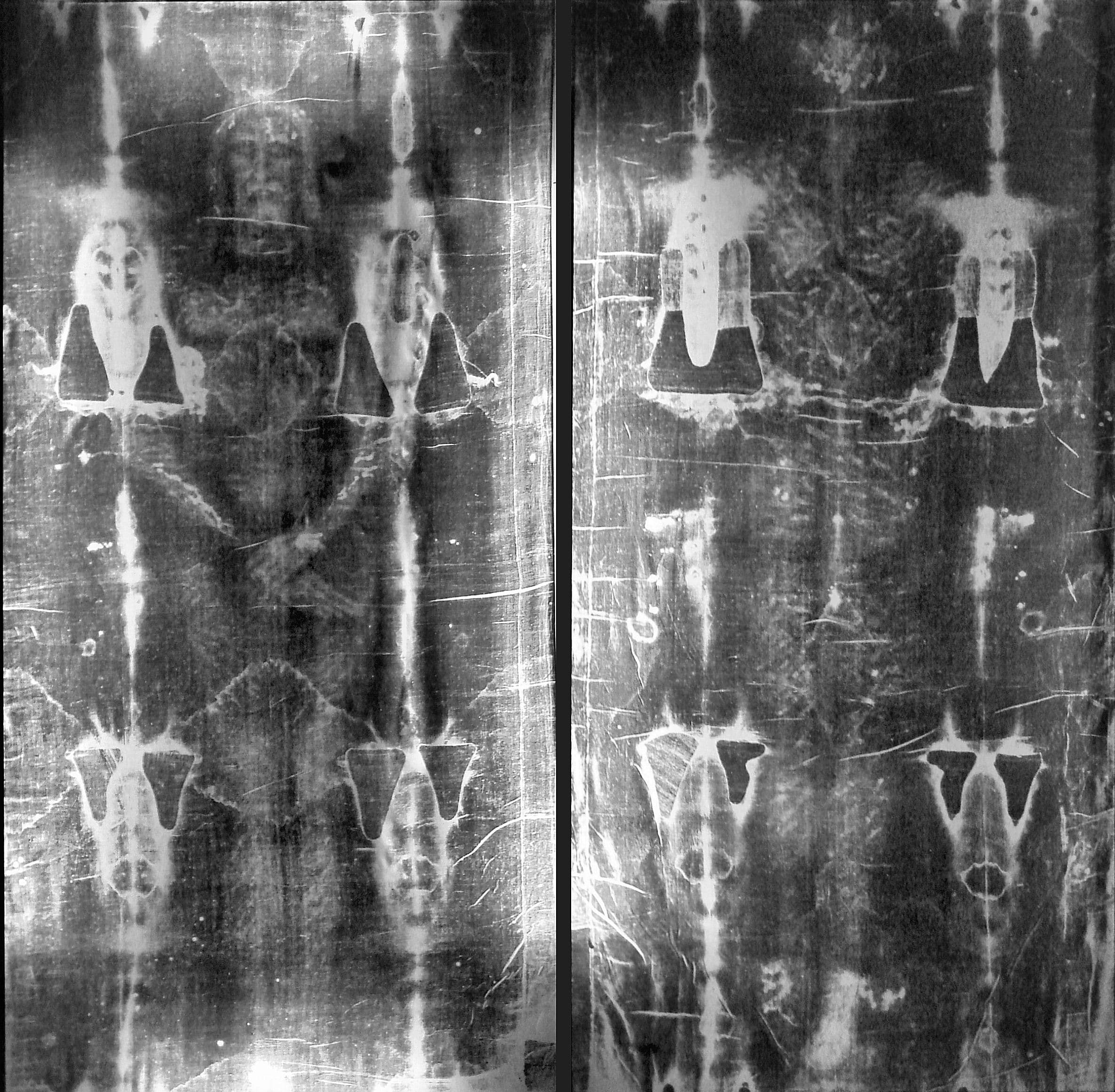
The Shroud of Turin
The story
Skip to the verdict ↓In 1898 a lawyer named Secondo Pia was permitted to photograph the long linen cloth kept in Turin cathedral — a faint, ghostly outline of a scourged and crucified man, barely legible to the eye. That night he developed the glass plate in his darkroom, and the negative in his hands resolved into something the cloth itself does not show: a detailed, lifelike face, looking back at him.
The cloth Pia had photographed — the Shroud of Turin — is about fourteen feet of linen, and the faint image runs front-and-back: a man who was scourged, crowned with thorns, nailed through the wrists, and pierced in the side. For believers it is the burial cloth of Christ; for skeptics it is a medieval work.
Its undisputed history begins around 1354 in Lirey, France. Until that 1898 negative, the strangeness of the image had never been fully appreciated — the glass plate resolved a far more detailed, lifelike figure than the cloth shows the naked eye. The image behaves like a photographic negative — a property no one had reason to build into a medieval forgery, because photography did not yet exist.
The Image
In 1978, a team of roughly thirty scientists, the Shroud of Turin Research Project (STURP), had five days of direct access to the cloth. They found the image confined to the topmost fibrils of the threads — microns deep — with no pigment, no binder, no brushstrokes, and no directionality. It carries three-dimensional, distance-encoded information: the closer the body would have been to the cloth, the darker the mark. The bloodstains are real blood, with heme and bilirubin present, and they were laid down before the image formed rather than painted over a drawing. STURP's conclusion was narrow: this is not a painting, and the mechanism that formed it is unknown.
The dissent on the record belongs to microscopist Walter McCrone, who worked from STURP's tape-lift samples and reported iron oxide and vermilion he read as evidence of a painting. Most of STURP's chemists rejected his interpretation, and the dispute was never fully resolved.
The 1988 Date
In 1988, samples cut from one corner went to three independent laboratories — Oxford, Arizona, and Zurich — which agreed on a date of roughly 1260 to 1390 AD. The result was published in *Nature* in 1989: medieval, consistent with the cloth's first appearance in Lirey.
The Date in Dispute
The sample was a single corner, a spot handled for centuries. Raymond Rogers, originally a STURP chemist, argued in 2005 that the dated region was chemically unlike the main cloth and likely an interwoven medieval repair — an "invisible reweave." When the laboratories' raw measurements were later released, statistical reanalyses found inter-laboratory inconsistency and a spatial gradient in the dates across the sample, a sign the sub-samples were not homogeneous.
Newer Dating
Other methods have pointed back the other way. A 2022 study from Italy's Institute of Crystallography used Wide-Angle X-ray Scattering to read cellulose degradation and reported aging consistent with a cloth around 2,000 years old — though the method depends on assumptions about the cloth's storage temperature and humidity. A 2024 analysis of the flax pointed toward a Levantine origin. Earlier strands — pollen reported from Palestine (methodologically contested), travertine aragonite dust said to match Jerusalem limestone, and a weave resembling first-century textiles from Masada — each carry their own disputes.
What Followed
Researchers have been pressing for a new STURP-style examination campaign, ideally including fresh radiocarbon samples taken from several non-corner locations at once.
A Note on the Sequence
The bloodstain patterns and the position of rigor have been analyzed against Jewish Passover burial customs — the haste described in John's account, a body wrapped unwashed — and the serum separation visible at the side wound is consistent with a piercing made after death.
- What's claimed
- A linen cloth in Turin bears the faint front-and-back image of a crucified man — venerated by many as the burial cloth of Jesus.
- What the evidence shows
- The image is superficial, pigment-free, 3-D-encoded, and unreproduced after nearly fifty years. A 1988 radiocarbon test dated a corner to medieval times — but that sample's validity is now contested in peer-reviewed work.
A genuine stalemate: extraordinary if authentic, yet neither the medieval date nor the unexplained image has closed the other out.
What we’re actually weighing
This entry bundles several separable claims. We grade them apart so the verdict can’t blur.
- 1Not in dispute
The cloth bears the image of a crucified man
Visible to anyone; no one disputes what is depicted.
- 2Open · unexplained
The image encodes 3-D depth and has never been reproduced
Superficial, no pigment, 3-D-readable — unmatched by any known method in fifty years.
- 3Contested
The cloth dates to roughly AD 30
A 1988 radiocarbon test says medieval; the sampling is genuinely questioned in peer review.
- 4Beyond evidence
It is the actual burial cloth of Jesus
Even a first-century date couldn't name the man; identity is beyond what evidence can settle.
What the dials score: the Miracle Meter weighs claim 2 — could nature make that image? The Evidence Meter weighs claims 3–4 — is it an authentic first-century cloth? Claim 1 isn't scored: the picture isn't in question, only its origin is.
Reviewer Notes
Miracles Jar weighs each claim two ways — how extraordinary it would be, and how strong the evidence is.
Assessed by Miracles Jar AI
The most-examined relic in the world. The 1988 medieval date is the strongest single datum against a first-century origin — and its sampling has been questioned in peer-reviewed literature, while the image's formation remains unreplicated after nearly fifty years. A genuine stalemate, not a settled case either way.
Why this sits where it does. The Shroud is, by a wide margin, the most intensively examined object in the history of religious relics — and the examinations have not closed the question. The two halves of the case point in opposite directions and neither has closed the other out.
The image keeps it open. The 1978 STURP examination is what keeps the case scientifically alive. STURP's conclusion was honest as well as narrow: not a painting, mechanism unknown. The body image is superficial, pigment-free, three-dimensionally encoded, and has not been fully reproduced by any known method in nearly fifty years of trying. In that sense it is a strong point toward authenticity.
The 1988 date is the strongest datum against. The radiocarbon result (roughly 1260–1390, three labs, published in *Nature*) is the single strongest piece of evidence against a first-century origin, and for most observers it settled the matter — medieval, consistent with the Lirey appearance. The McCrone iron-oxide/vermilion dissent, while rejected by most STURP chemists, belongs in the ledger on the natural side.
But the date is now genuinely contested. The doubt comes from inside the peer-reviewed literature rather than only from apologists. Rogers' 2005 reweave-repair hypothesis with supporting chemistry, and the statistical reanalyses showing the sub-samples were not homogeneous, technically undermine the averaged date. A non-homogeneous sample technically invalidates the averaged date. That does not make the cloth ancient; it means the single strongest datum for a medieval origin is less secure than the 1989 headline implied. The newer dating (2022 WAXS ~2,000 years, 2024 flax, pollen, aragonite, Masada weave) is suggestive rather than decisive — sensitive to assumed temperature/humidity history and each carrying its own disputes; no single one establishes antiquity, but together they keep the question genuinely open.
The stalemate. The honest position is a deadlock. A contested medieval date sits against an unexplained image, and neither has broken the other. What would break it is not more argument but more access — a new STURP-style campaign with fresh radiocarbon samples from several non-corner locations at once. Until then the cloth stays where the evidence leaves it: extraordinary if genuine, unproven either way, and not honestly reducible to a single confident verdict. This is a genuine stalemate, not a settled case either way.
On balance we lean toward a natural account, but only just — this is close to a genuine toss-up. It would be extraordinary if the cloth were a real first-century burial shroud, and the evidence has simply not closed the question either way.
On the burial sequence. If the cloth is authentic, the agreement of the bloodstains and rigor with Jewish Passover burial customs, and the post-mortem serum separation at the side wound, are small internal corroborations of the Gospel sequence. If it is not, they are details a careful maker got right. The cloth does not settle which.
Evidence ledger — what the verdict rests on
The body image is confined to the topmost fibrils (microns deep), contains no pigment or brushstrokes, encodes 3D distance information, and has not been fully reproduced by any known method.
STURP found the bloodstains to be real blood (heme, bilirubin), laid down on the cloth before the image formed — not painted over a drawing.
Three laboratories radiocarbon-dated a corner sample to roughly 1260–1390 AD, published in Nature — consistent with the cloth's first documented appearance in 14th-century France.
The 1988 sample was a single corner, a centuries-handled area; reweave chemistry and statistical non-homogeneity in the released raw data have put its validity in genuine peer-reviewed dispute.
The cloth has no undisputed history before the 14th century, and microscopist Walter McCrone reported iron oxide and vermilion consistent with a painting (rejected by most STURP chemists, never fully resolved).
What would raise the meter: Adversarial scrutiny with real power to expose deception — hostile investigators, controlled conditions — coming back clean would raise the evidence bar.
What would lower it: A confession, an exposed method, or a documented financial motive would drive the evidence bar toward zero.
How we weigh every claim — the full method, deductions and all →
The natural explanation
The leading natural account for this case is deception: hoaxes, cold reading & stagecraft. Read what it explains — and where it stops.
The same wonder, across traditions
This claim is one of many that make the same assertion across faiths. See it side by side in Images That Weep, Bleed, and Stir.
Sources
Tagged by proximity to the event. Primary sources are direct or contemporaneous; tertiary are downstream retellings.
- 1.Primaryacademic
Damon et al., "Radiocarbon Dating of the Shroud of Turin", Nature, 1989· no public link
Oxford, Arizona, and Zurich independently dated a single corner sample to roughly 1260–1390 AD.
- 2.Primaryinvestigation
"Shroud of Turin Research Project (STURP): 1978 direct examination", 1981· no public link
~30 scientists, five days of access: image confined to the topmost fibrils, no pigment or brushstrokes, 3D distance-encoded, real blood (heme, bilirubin) laid down before the image; conclusion — not a painting, mechanism unknown.
- 3.Secondaryacademic
Raymond N. Rogers, "Studies on the radiocarbon sample from the Shroud of Turin", Thermochimica Acta, 2005· no public link
Vanillin and chemical analysis arguing the dated corner was a later interwoven repair, chemically unlike the main cloth — disputed by other researchers.
- 4.Secondaryacademic
De Caro et al., "X-ray dating of a Turin Shroud linen sample (Wide-Angle X-ray Scattering)", Heritage (Italian Institute of Crystallography), 2022· no public link
Cellulose-degradation profile reported as consistent with a ~2,000-year-old cloth; sensitive to assumed temperature/humidity history, so treated as suggestive rather than decisive.
- 5.Secondaryacademic
"Statistical reanalysis of the 1988 raw radiocarbon data", 2019· no public link
The released raw measurements show inter-laboratory inconsistency and a spatial gradient across the sample — evidence the sub-samples were not homogeneous, which undermines the averaged date.
Further reading
- The Shroud of Turin: A Critical Summary of Observations, Data and Hypotheses — Robert W. Rucker
- Inquest on the Shroud of Turin — Joe Nickell
Cases like this
Nearest on the map — similar in how miraculous they’d be, and how strong the evidence is.