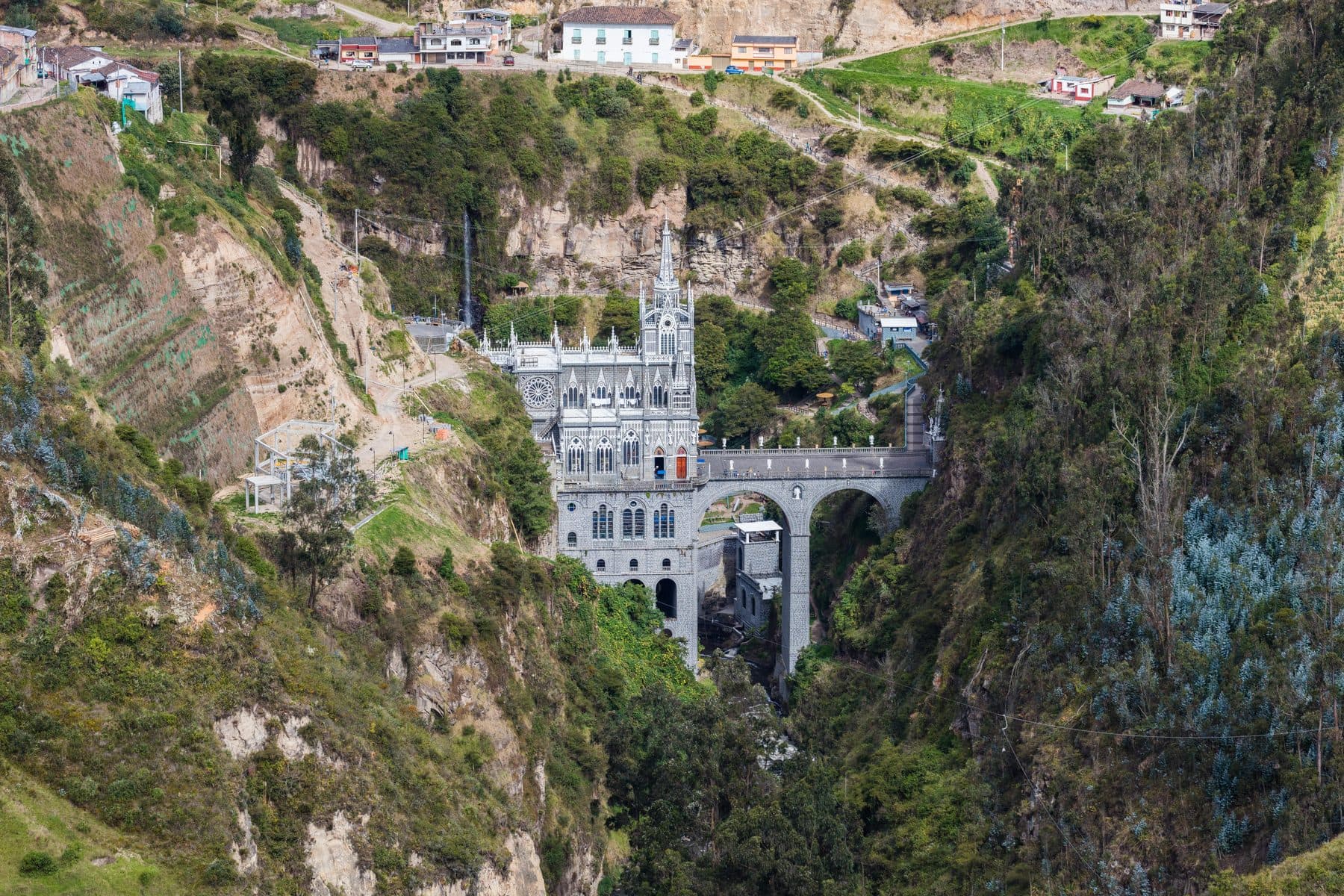
Our Lady of Las Lajas (Miraculous Image in Stone)
Photo: Diego Delso (delso.photo) · CC BY-SA 4.0
The story
Skip to the verdict ↓A devotional image of the Virgin Mary is embedded in a rock face in the Guaitara River canyon in Colombia, reportedly appearing miraculously in 1754; geological analysis claims the pigment penetrates meters into the stone.
The image of Las Lajas appears on the sheer rock wall of a gorge carved by the Guaitara River between what are now the Colombian towns of Ipiales and Potosí. It shows a crowned Virgin Mary holding the Christ child, attended by Saints Francis and Dominic, in a style consistent with 18th-century Andean colonial religious art. The image is partially integrated into the rock surface — it is not a painting hung on a wall, but appears to emerge from the stone itself.
The Origin Story
Devotional tradition holds that in 1754, an indigenous woman named María Mueses de Quiñones and her deaf-mute daughter Rosa passed through the canyon. The girl reportedly said 'Mommy, there is a woman in here with a boy in her arms' — the first words she had ever spoken. María later returned and found the image glowing on the canyon wall. Pilgrimages began, and a chapel was eventually built on the site. The current basilica, in Gothic Revival style, was constructed 1916–1949 and rises dramatically from the canyon floor.
The Image in Stone
The image is described not as paint but as a formation within the rock itself, with pigment reportedly penetrating meters into the stone. Catholic sources state that 'geologists' have taken core samples, and devotional accounts report that the image's color penetrates 'over two feet' into the rock with no external pigment applied.
Church Recognition
Pope Pius XII granted a canonical crowning of the shrine in 1952. The crowns on the image were added by human hands. The image has been venerated continuously since at least the late 18th century.
Too thin a record to say either way.
Reviewer Notes
Miracles Jar weighs each claim two ways — how extraordinary it would be, and how strong the evidence is.
Assessed by Miracles Jar AI
Geological penetration claim unverified in scientific literature; natural mineral staining with iconographic interpretation is the most parsimonious explanation.
On the geological penetration claim. The most striking evidential claim is that the coloration penetrates meters into the stone — up to three meters, or 'over two feet' — with no external pigment applied. No publication in a geological or materials science journal documenting these core samples, the institution conducting them, or the methodology used has been identified in any research database. The claim appears exclusively in devotional literature; core samples described in religious accounts are not cited with methodology, institution, or date. This is not proof the claim is false — the tests may simply not have been formally published — but it means the geological evidence cannot currently be evaluated.
On the founding legend. The foundational story of a deaf-mute girl speaking for the first time upon seeing the image is charming but unverifiable 270 years later, and it exhibits structural similarities to founding legends at other pilgrimage sites. Founding legends that include miraculous cures are common in pilgrimage site historiography; this does not make them false, but it reduces their independent evidential weight.
On natural formation. A naturally occurring mineral stain subsequently interpreted through Catholic iconography is a documented process at other pilgrimage sites worldwide, and it is consistent with what is visible at Las Lajas. Natural mineral staining and pareidolia (the human tendency to see faces and figures in random natural patterns) can produce image-like formations in rock faces, particularly in canyon walls with complex mineral deposits. The Guaitara canyon context — a river gorge with complex mineral geology — is precisely the environment where natural image formation occurs. The image may plausibly be a naturally occurring mineral stain in a rock face that was subsequently elaborated through iconographic interpretation and possibly enhanced by devotional artists.
On longevity of veneration. The image has been venerated continuously since at least the late 18th century, providing a long evidentiary chain of historical existence. Longevity of veneration confirms the image exists but says nothing about its origin.
On Church recognition. The 1952 papal canonical crowning by Pope Pius XII is a recognition of the shrine's importance to Colombian Catholics — its devotional status — not an assessment of geological origins. Catholic Exchange's 2019 summary acknowledges only that the crowns were added by human hands.
Evidence ledger — what the verdict rests on
Multiple devotional sources report that geological core samples found the image's color penetrates 'over two feet' into the rock with no external pigment applied
No peer-reviewed geological study documenting this claim has been identified; all citations trace back to devotional sources without methodology
The image has been venerated continuously since at least the late 18th century, providing a long evidentiary chain of historical existence
Longevity of veneration confirms the image exists but says nothing about its origin
Natural mineral staining and pareidolia (the human tendency to see faces and figures in random natural patterns) can produce image-like formations in rock faces, particularly in canyon walls with complex mineral deposits
The Guaitara canyon context — a river gorge with complex mineral geology — is precisely the environment where natural image formation occurs
The foundational story (deaf-mute child speaking for first time upon seeing the image) cannot be verified 270 years later and exhibits structural similarities to founding legends at other pilgrimage sites
Founding legends that include miraculous cures are common in pilgrimage site historiography; this does not make them false, but it reduces their independent evidential weight
What would raise the meter: Instrumented or physical evidence — measurements, samples, footage that survives analysis — would raise this.
What would lower it: A controlled observation reproducing the experience naturally (lighting, suggestion, pareidolia) would move it down.
How we weigh every claim — the full method, deductions and all →
The natural explanation
The leading natural account for this case is misperception: how honest witnesses get it wrong. Read what it explains — and where it stops.
The same wonder, across traditions
This claim is one of many that make the same assertion across faiths. See it side by side in Images That Weep, Bleed, and Stir and When a Figure Appears.
Sources
Tagged by proximity to the event. Primary sources are direct or contemporaneous; tertiary are downstream retellings.
- 1.Primarychurch document
"Canonical Crowning by Pope Pius XII", 1952· no public link
Establishes canonical recognition of the shrine; does not constitute investigation of geological claims
- 2.Tertiaryother
"Our Lady of Las Lajas, Colombia, 1754", 2023· no public link
Divinemysteries.info overview; repeats geological penetration claim with no citation to primary scientific source
- 3.Tertiaryother
"Miraculous Image of Our Lady of Las Lajas — Catholic Exchange", 2019· no public link
Summarizes devotional tradition and geological claims; acknowledges only the crowns were added by human hands
Cases like this
Nearest on the map — similar in how miraculous they’d be, and how strong the evidence is.