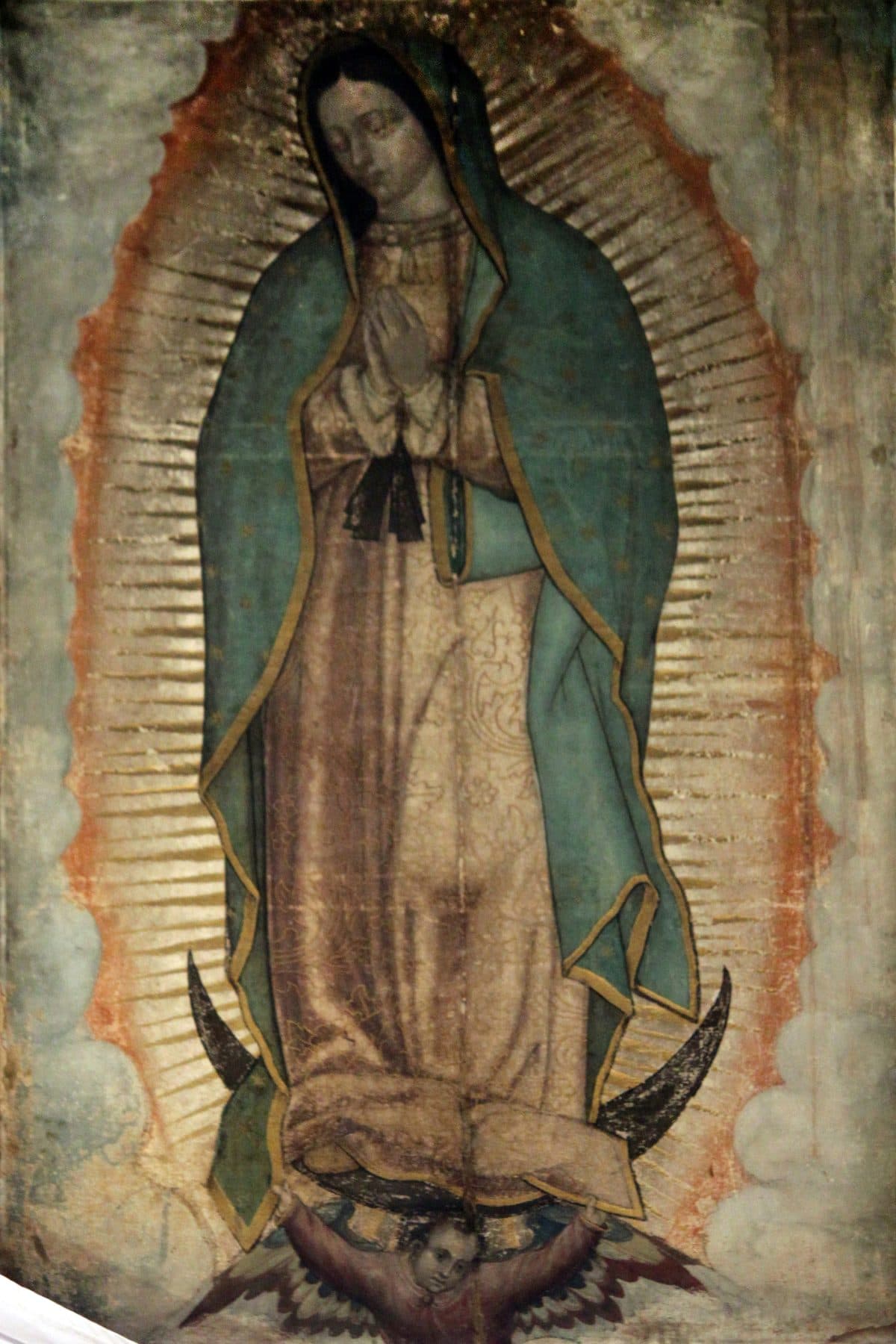
Our Lady of Guadalupe (The Tilma of Juan Diego)
The story
Skip to the verdict ↓In December 1531, by the account handed down, a recently baptized indigenous man named Juan Diego came before the bishop of Mexico with his rough maguey-fibre cloak gathered full of roses that had no business blooming in the cold. He let the cloak fall open and the roses spilled to the floor. The bishop, the account says, was no longer looking at the roses.
The tilma of Juan Diego is the most venerated image in the Americas: a cloak about 170 by 105 centimeters, of coarse agave fiber, bearing the figure of a dark-skinned woman in a blue-green mantle, ringed with golden rays, standing on a crescent moon held up by an angel.
Behind that scene stands the traditional account: the Virgin had appeared to Juan Diego four times that December, asked for a church on Tepeyac hill, and — when the bishop wanted a sign — sent him back with the out-of-season roses. When the cloak opened before Bishop Zumárraga, the image was on the cloth. For nearly five centuries it has been at the heart of Mexican Catholic identity.
The documentary record
Juan de Zumárraga, first bishop of Mexico, is the man the story places at the center of the events: he is said to have received the cloak and seen the roses fall. Zumárraga left a large body of letters and reports — he wrote constantly about the evangelization of New Spain, about the indigenous converts, and about his own work — and never once mentions the image. No Spanish document describes the apparition until decades after the fact.
The earliest full narrative is the Nican Mopohua, the Nahuatl account traditionally attributed to Antonio Valeriano. Its manuscript is dated to roughly the mid-1550s, and it was not printed until 1648 — more than a hundred years after 1531. Working through the sources, the historians Stafford Poole and D.A. Brading conclude that the apparition story took shape gradually over the intervening century, growing up around a devotional image that already existed at Tepeyac.
What the image is made of
The cloth has been examined more than once. In 1982 José Sol Rosales, a restorer at Mexico's national institute of fine arts (Instituto Nacional de Bellas Artes), was given access to study the tilma. He reported a prepared white ground beneath the image and ordinary pigments of the period worked in tempera — soot from burned ocote, calcium sulfate, cochineal red, copper and iron oxides — along with areas of touch-up and repainting. His conclusion was that the image is a human-made painting in a recognizable style. Catholic commentators dispute the report.
Philip Callahan — a USDA entomologist and University of Florida professor — photographed the tilma under infrared light in 1981. He reported that he could find no underdrawing or sizing beneath the central figure. In the same work, Callahan identified the gold rays, the stars on the mantle, the moon, the angel, and the decorative border as later additions, painted on by human hands. Joe Nickell notes that Callahan also found no sketch lines under the parts he judged to be retouched.
One claim that recurs in devotional literature holds that the Nobel chemist Richard Kuhn analyzed the tilma and pronounced its colors made of no known pigment. No such study exists. Kuhn won his Nobel Prize in 1938 and died in 1967, and no record places him or his samples anywhere near the cloth.
The figures in the eyes
A separate strand of the case concerns the Virgin's eyes. In 1979 José Aste Tönsmann, an IBM engineer with a doctorate from Cornell, magnified photographs of the eyes and reported seeing reflected human figures in them — eventually a whole scene of some thirteen people, which he interpreted as the moment the cloak was opened before the bishop. The claim depends on extreme magnification and image processing of a coarse, much-handled weave, and it has not been independently reproduced. The investigators Joe Nickell and John Fischer examined it in 1985 and concluded that the "figures" are the mind finding shapes in random texture.
The cloth's survival
The cloth itself has lasted close to five centuries — roughly 490 years — much of that time unglassed and exposed to candle smoke, incense, and handling, which is unusual for an agave-fiber cloak that would ordinarily decay in decades. That longevity has no settled explanation.
Too thin a record to say either way.
Reviewer Notes
Miracles Jar weighs each claim two ways — how extraordinary it would be, and how strong the evidence is.
Assessed by Miracles Jar AI
An undocumented apparition and a closely examined painting. The bishop's documentary silence and the century-long gap to the first narrative leave the 1531 events unestablished, while restorers describe conventional period pigments and technique on the cloth.
Why the case is unconvincing — two problems:
1. *Documentary provenance.* A miracle whose principal witness was a literate, prolific bishop — and whose archive is silent — is missing the testimony that should have been easiest to produce. This is the central provenance problem; it "is not in any laboratory" and "is not a gap a careful reader can wave away." Poole and Brading read the narrative as elaborated gradually around an existing devotional image rather than recorded by the people who supposedly witnessed it. The cloth may be old; the story attached to it is demonstrably later.
2. *Material examination.* "Where people have looked closely, they have found painting." The Sol Rosales finding is specific and material, not an impression.
On the Callahan study — it "cuts both ways." The no-underdrawing result is "the line believers quote," but in the same work Callahan identified the rays, stars, moon, angel, and border as admitted human painting — so "even on the most favorable scientific reading, much of what people see when they look at the tilma is admitted human painting." Nickell presses further: because Callahan found no sketch lines under retouched areas either, the absence of sketch lines under the figure "cannot by itself show the figure was not painted."
On the Kuhn claim — "simply false." It is "a legend that has been repeated until it sounds like data; it is not evidence and should not be treated as any."
On the eye-reflections. Nickell and Fischer compared the perception to "the same faculty that finds faces in clouds" / "the imagination perceiving images in random shapes" / "pattern-finding in random weave." As evidence the eye-reflections are the weakest part of the case, not the strongest.
On the cloth's survival — the one durable anomaly. It is "worth recording honestly," but "it is the durability of a textile, not proof of an event" — "longevity of a cloth does not by itself establish that an apparition occurred in 1531." This is the single anomaly that points toward authenticity.
Reviewer's summing-up: The devotion "deserves to be taken seriously on its own terms," and "the tilma is a profound object of devotion and a real historical puzzle in its preservation." But "the historical and physical record, taken on its terms, is harder to square with the account." Against the survival anomaly "stands a bishop's complete silence, a narrative that appears only generations later, and repeated material examinations that describe ordinary painting on a prepared ground." As an account of a 1531 apparition, "the documentary chain that would carry it is missing at exactly the point where it should be strongest."
Evidence ledger — what the verdict rests on
Bishop Zumárraga, the man the story says received the cloak, was a prolific correspondent and left nothing about a miraculous image; no Spanish document describes the apparition until decades later, and the full narrative appears only in the Nican Mopohua, over a century after 1531.
A miracle witnessed by a bishop that the bishop never mentions is the central provenance problem. Historians Poole and Brading read the narrative as elaborated gradually around an existing devotional image.
When the image was examined closely, conventional painting kept appearing: in 1982 restorer José Sol Rosales described a prepared white ground and ordinary period pigments applied as tempera, with touch-ups, and concluded a human-made work.
Catholic analysts dispute it, but the finding is specific — soot, calcium sulfate, cochineal, copper and iron oxides — not a vague impression.
Philip Callahan's 1981 infrared images, often cited for the figure, also showed that the gold rays, stars, moon, angel, and border were added later by human hands — so the cloth carries admitted human painting either way.
Skeptics add that Callahan reported no sketch lines under the areas he judged retouched either, which weakens the inference that the absence of sketch lines under the figure means it is not painted.
The figures-reflected-in-the-eyes claim (José Aste Tönsmann, 1979) relies on heavily magnified and processed images and has not been independently reproduced; skeptical investigators read it as pattern-finding in random weave.
Nickell and Fischer (1985) characterized the reflected-figures reading as the imagination perceiving images in random shapes.
The cloth's survival for roughly 490 years, much of it unglassed and exposed to smoke and handling, is genuinely unusual for an agave-fiber cloak and has no settled explanation.
The one durable anomaly — but longevity of a cloth does not by itself establish that an apparition occurred in 1531.
What would raise the meter: Instrumented or physical evidence — measurements, samples, footage that survives analysis — would raise this.
What would lower it: A controlled observation reproducing the experience naturally (lighting, suggestion, pareidolia) would move it down.
How we weigh every claim — the full method, deductions and all →
The natural explanation
The leading natural account for this case is misperception: how honest witnesses get it wrong. Read what it explains — and where it stops.
The same wonder, across traditions
This claim is one of many that make the same assertion across faiths. See it side by side in Images That Weep, Bleed, and Stir and When a Figure Appears.
Sources
Tagged by proximity to the event. Primary sources are direct or contemporaneous; tertiary are downstream retellings.
- 1.Secondarytestimony
Antonio Valeriano (attributed), "Nican Mopohua (Nahuatl apparition narrative)", 1556· no public link
Earliest detailed account of the apparitions, the manuscript dated to roughly the mid-1550s and first printed in 1648 — more than a century after the event it describes. No contemporaneous bishop's account survives.
- 2.Secondaryinvestigation
Philip S. Callahan, "The Tilma Under Infra-Red Radiation", 1981· no public link
USDA entomologist and University of Florida professor. Reported no sizing or sketch under the original figure, but identified the gold rays, stars, moon, angel, and border as later additions painted by human hands.
- 3.Secondaryinvestigation
José Sol Rosales, "Examination of the tilma for the Basilica (Sol Rosales report)", 1982· no public link
Restorer at Mexico's Instituto Nacional de Bellas Artes. Described a white prepared ground and ordinary period pigments — soot, calcium sulfate, cochineal, copper and iron oxides — in tempera, with touch-ups; concluded a human-made painting.
- 4.Secondaryinvestigation
José Aste Tönsmann, "El Secreto de sus Ojos (eye-reflection claim)", 1979· no public link
IBM engineer with a Cornell doctorate; magnified the eyes and reported up to thirteen human figures reflected in them. Rests on heavily processed images and has not been independently reproduced.
- 5.Secondaryacademic
Joe Nickell and John F. Fischer, "The Image of Guadalupe: A Folkloristic and Iconographic Investigation", 1985· no public link
Skeptical Inquirer. Called the figures-in-the-eyes claim pattern-finding in random shapes, and noted Callahan found no sketch lines in the areas he judged retouched either.
- 6.Secondarybook
Stafford Poole, "Our Lady of Guadalupe: The Origins and Sources of a Mexican National Symbol", 1995· no public link
Historical-critical account documenting Zumárraga's silence and the late emergence of the narrative; alongside D.A. Brading's Mexican Phoenix (2001).
Cases like this
Nearest on the map — similar in how miraculous they’d be, and how strong the evidence is.