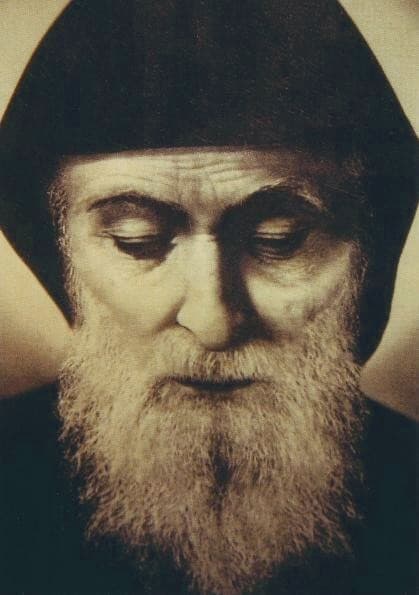
Charbel Makhlouf — The Fluid-Exuding Monk of Lebanon
Photo: Pre-1898 likeness of St Charbel / Wikimedia Commons · Public domain
The story
Skip to the verdict ↓Lebanese Maronite monk Charbel Makhlouf died in 1898; his body was found incorrupt in a flooded grave in 1899 and reportedly exuded a blood-like fluid for 67 years until beatification in 1965, when it was found finally decomposed.
The Hermit of Annaya
Charbel Makhlouf was born in 1828 in a Lebanese mountain village and became a Maronite monk. He spent the last 23 years of his life as a hermit at the Hermitage of Saints Peter and Paul near the Monastery of Saint Maron in Annaya. He died on Christmas Eve, 1898, while celebrating Mass. He was buried in the monastery cemetery without ceremony.
The 1899 Discovery
On April 15, 1899, four months after his death, the monastery opened the grave. They found it completely flooded. Despite the waterlogged conditions, the body was reportedly found floating intact: flesh preserved, muscles flexible, no loss of hair.
The Reported Fluid Exudation
For nearly seven decades following the first exhumation, Charbel's body reportedly exuded a continuous reddish fluid described as a mixture of perspiration and blood. Monastery records indicate clothing was changed twice weekly to manage this. The phenomenon was attested to by multiple monastery witnesses over time but was never independently investigated by secular scientists or forensic pathologists.
Decomposition and Canonization
When the body was examined again for the beatification process in 1965, it had finally decomposed — 67 years after death. Charbel was beatified in 1965 and canonized by Pope Paul VI in 1977.
Too thin a record to say either way.
Reviewer Notes
Miracles Jar weighs each claim two ways — how extraordinary it would be, and how strong the evidence is.
Assessed by Miracles Jar AI
Unusual conditions noted; fluid exudation claim is striking but undocumented forensically; body decomposed by 1965.
The verdict: Unusual preservation was noted, but the fluid-exudation claim was never forensically documented, and the body had decomposed by 1965.
The case rests on multiple-witness observations of a body found intact, floating in a flooded grave in 1899 — and wet conditions are actually unfavorable to natural preservation, which is part of what drew attention. Witnesses also reported a reddish fluid said to exude continuously for some 67 years, requiring the clothing to be changed about twice a week.
What keeps the case from rising is documentation. No independent forensic investigation was conducted during the period of the claimed exudation; all records come from the Maronite Church or devotional sources; and the body was fully decomposed by the 1965 beatification, so the key physical evidence is no longer available to examine. Striking as the reports are, there is no way left to test them.
Evidence ledger — what the verdict rests on
Body found intact floating in flooded grave in 1899 — wet conditions are unfavorable to natural preservation
Typical mummification requires dry conditions; this context partially undermines natural explanation
Reddish fluid reportedly exuded continuously for 67 years, requiring clothing changes twice weekly
If accurate, this exceeds any documented natural post-mortem fluid production
No independent forensic investigation conducted during the period of claimed exudation
All documentation comes from Maronite Church sources; no secular scientific examination
Body fully decomposed by 1965 beatification — key physical evidence no longer available
Ultimate decomposition is consistent with natural processes resuming; evidence window closed
What would raise the meter: Long-term follow-up documenting permanence, in a condition with a near-zero spontaneous-resolution base rate, would raise the meter.
What would lower it: A documented relapse, or case literature showing the condition fluctuates or remits on its own, would move it down.
How we weigh every claim — the full method, deductions and all →
The natural explanation
The leading natural account for this case is spontaneous remission & the body's own recovery. Read what it explains — and where it stops.
Sources
Tagged by proximity to the event. Primary sources are direct or contemporaneous; tertiary are downstream retellings.
- 1.Tertiaryother
"Charbel Makhlouf — Wikipedia", 2024· no public link
Overview of life, death, exhumation accounts, beatification, and canonization
- 2.Tertiaryother
"The Miracle Monk of Lebanon: Inside the 1950 Exhumation of Saint Charbel (Saint Charbel Shop)", 2023· no public link
Describes fluid exudation details; relies on Maronite Church records
- 3.Tertiarynews
"Can a Dead Body Ooze Blood? The Story of St. Sharbel's Incorruptible Body (RVA, 2022)", 2022· no public link
Reviews biological implausibility of post-mortem fluid production
Cases like this
Nearest on the map — similar in how miraculous they’d be, and how strong the evidence is.