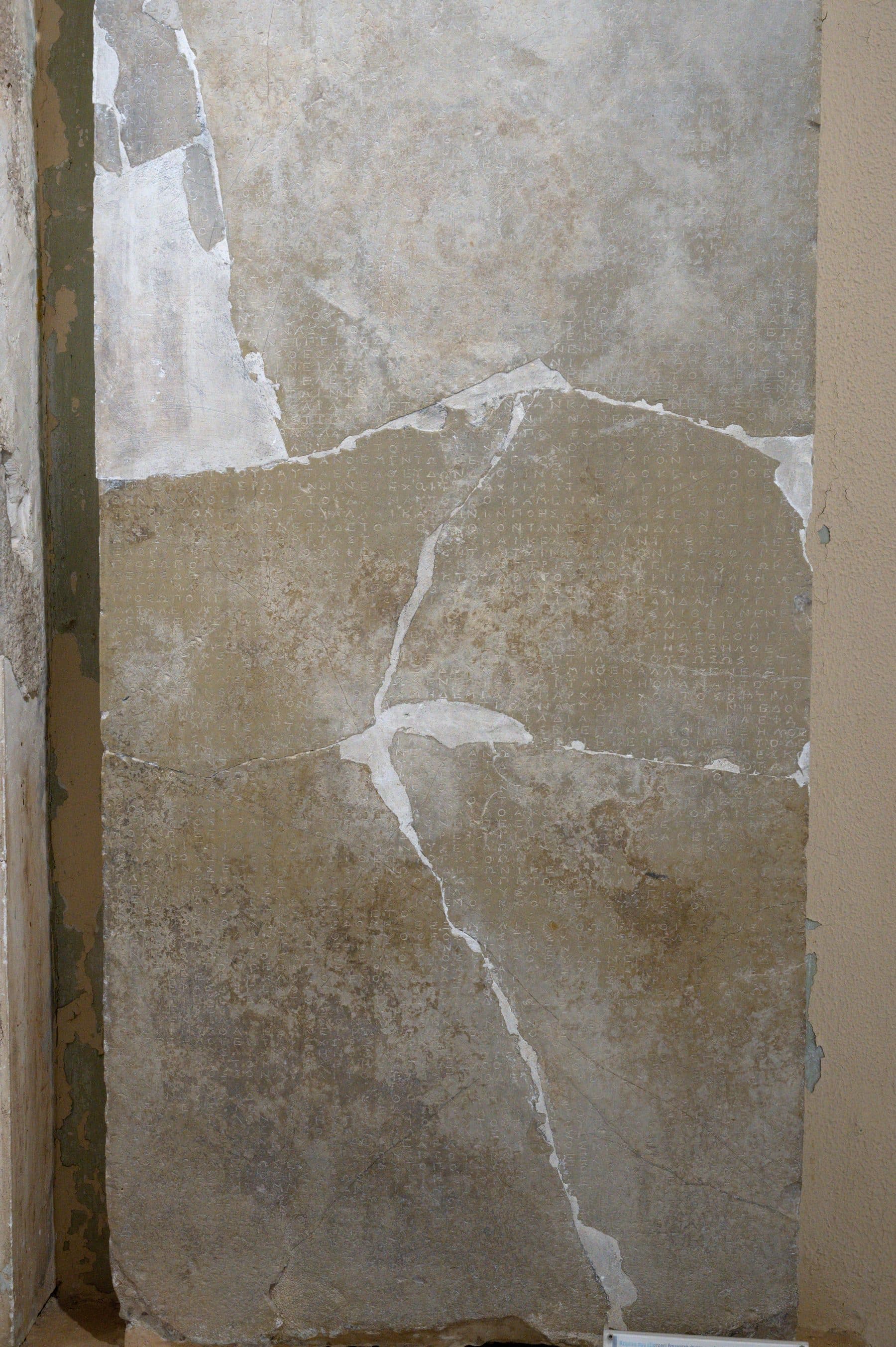
The Epidaurus Cure Inscriptions — The Iamata of Asclepius (4th Century BCE)
Photo: Zde / Wikimedia Commons · CC BY-SA 4.0
The story
Skip to the verdict ↓Four stone stelae erected at the sanctuary of Asclepius at Epidaurus in the fourth century BCE record roughly seventy cures — blindness, paralysis, muteness, a five-year pregnancy — reported by pilgrims who slept in the sanctuary's dormitory and dreamed of the god. The inscriptions are the largest surviving body of healing claims from the ancient world, and they were composed and displayed by the sanctuary whose reputation they served.
Four stone stelae stood at the sanctuary of Asclepius at Epidaurus in the fourth century BCE, inscribed with roughly seventy accounts of the god healing the sick. They are the largest surviving body of healing claims from the ancient world. Two of the stones survive well enough to read about 44 of the cures, and they have been translated twice over by modern scholars.
The accounts follow a fixed shape. The pilgrim arrives sick, performs the rites, and sleeps in the abaton — the sanctuary's incubation dormitory. The god comes in a dream. The pilgrim wakes healed. Cleo 'was with child for five years' before she slept in the abaton; she bore a son 'who, as soon as he was born, washed himself at the fountain and walked about with his mother.' A voiceless boy, asked by the temple servant to promise his thank-offering within a year, 'suddenly said, I promise.' The blind see, the lame walk, and in one case the god reaches into the story to deal with doubt directly: a man whose fingers were paralyzed had mocked the inscriptions, and in his dream the god healed him and told him 'your name shall be Unbeliever.'
The most famous cure is Ambrosia of Athens, blind in one eye. Walking through the sanctuary, she 'laughed at some of the cures as incredible and impossible, that the lame and the blind should be healed by merely seeing a dream.' That night the god healed her eye and named his fee: a silver pig, dedicated as a memorial of her ignorance.
What the Stones Are
The stelae were erected by the sanctuary authorities during its great building phase, from about 370 BCE. The epigraphical study by Gaia Gregis (Axon, 2017) describes their function: the accounts existed 'to glorify the healing power of Asclepios and encourage the patients to trust his treatments,' written to speak to a growing pilgrim public from across the Greek world. They were displayed where arriving patients would read them before sleeping in the abaton. No stele records a pilgrim who left as sick as he came.
The Sanctuary and Its Records
The institution behind the stones was real and durable. The four stelae carry about seventy tales, many fragmentary, with lacunae in the last two stones. The two best-preserved are catalogued as IG IV²,1 121 and 122 and carry roughly 44 readable accounts in the standard translations — Emma J. and Ludwig Edelstein's 1945 collection and L.R. LiDonnici's 1995 edition.
Medical historians describe the Asclepieia as a functioning system of care: ritual purification, the incubation sleep called enkoimesis — 'the sleep that ideally led to the miraculous healing' — dream-prescriptions applied under priestly guidance, internal and external prescriptions, baths and regimens. Pavli and Maltezou (2024) document a network of healing sanctuaries that operated for the better part of a thousand years. Epidaurus was its center. The sick came because people they trusted said it worked.
No credible record that it happened as told.
Reviewer Notes
Miracles Jar weighs each claim two ways — how extraordinary it would be, and how strong the evidence is.
Assessed by Miracles Jar AI
The stelae are genuine fourth-century BCE records of what the sanctuary said its god did; they were written by the institution they advertise, the recoverable conditions cluster where expectation works, and the unrecoverable ones read as stories — what no stone can carry is independent confirmation that any cure happened as inscribed.
The central problem. The cures recorded at Epidaurus — instantaneous restoration of blindness, paralysis and muteness, and a five-year pregnancy delivering a child who walks — would exceed natural law as written. But every account comes from inscriptions the sanctuary composed about itself, so the case turns on the reliability of a single self-interested source. The stones are real and the cures are unverifiable; the gap between those two facts is the whole assessment.
The natural account, in three layers. (1) The author is the beneficiary: the sanctuary wrote, selected and displayed its own successes, and Gregis concludes the accounts served "to glorify the healing power of Asclepios and encourage the patients to trust his treatments," written to communicate with a growing panhellenic pilgrim public — the sanctuary's own advertising, in modern terms, whose income and prestige depended on them. (2) The skeptic-conversion stories make the function visible: a corpus that builds doubters into its narratives — Ambrosia who laughed, the man named Unbeliever — and cures them all is anticipating its readers' objections and answering them with stories. Persuasion built into the text is evidence about the text's purpose, not about the cures. (3) Selection runs the same direction — a sanctuary records its successes, and no stele lists the pilgrims who left as sick as they came.
Where the cures cluster. The recoverable conditions — blindness, muteness, paralysis, lameness — are exactly the complaints in which functional and expectation-responsive cases concentrate, and a regimen of journey, ritual, sleep and authoritative suggestion is well designed to move them. The medical-history reading (Pavli and Maltezou, 2024) places the iamata inside a real and durable institution that modern authors describe as an early form of holistic care; that institutional reality is the natural account in miniature. What it cannot move is a five-year pregnancy delivering a child who walks; the corpus's wonder-tales of that order mark the narratives as shaped in transmission — whether grown from a votive in the retelling or composed at the priests' table.
What the inscriptions are evidence of. They are not patient records. Gregis frames them as written to communicate with a growing panhellenic pilgrim public. They are physically extant fourth-century BCE official inscriptions, excavated at the sanctuary and published in the standard epigraphical corpora — documented at their source, which almost no ancient healing tradition can say; a neutral, strong fact about the corpus. The function (glorification, encouragement of trust) is a strong mark on the natural side; the skeptic-conversion structure is a moderate mark, and the clustering of recoverable conditions inside the institution of journey, purification, incubation and authoritative dream-prescription is another moderate mark on the same side. On the authentic side stands only the weak but real fact that needs explaining: a healing sanctuary that drew the sick of the Greek world for centuries and accumulated votive testimony at a scale that justified carving it in official stone. Real pilgrims left real testimony; what cannot be recovered is whether any cure exceeded what the institution's own machinery produces.
The verdict. The factual bar is split. That pilgrims came, slept, believed themselves healed, and left votive testimony is about as well documented as anything from the fourth century BCE; that the cures happened as inscribed is supported by nothing outside the stones the sanctuary wrote itself. Conditional on the cures as written, no natural account would cover them — the case for inexplicability is strong. The probability the events happened as written is very low. As the verdict puts it, the stelae are genuine fourth-century BCE records of what the sanctuary said its god did; they were written by the institution they advertise, the recoverable conditions cluster where expectation works, and the unrecoverable ones read as stories — what no stone can carry is independent confirmation that any cure happened as inscribed. For a 2,400-year-old corpus this is where the evidence runs out rather than a verdict on what pilgrims experienced. The stones tell us with certainty what the sanctuary said its god did; for what actually happened in the abaton, the stones are the only witness, and they were carved by the house. The honest concession remains: some pilgrims surely woke better than they came.
Evidence ledger — what the verdict rests on
The stelae are physically extant fourth-century BCE official inscriptions, excavated at the sanctuary and published in the standard epigraphical corpora — the claims themselves are documented at their source, which almost no ancient healing tradition can say
IG IV²,1 121–122; about seventy tales across four stones, roughly 44 readable on the best two
The inscriptions were composed and displayed by the sanctuary whose income and prestige depended on them, and scholarship identifies their function as glorification and encouragement of trust in the god's treatments
Gregis 2017; selection runs the same way — no failures are recorded
The corpus writes skeptics into its own narratives and cures them — Ambrosia who laughed, the man renamed Unbeliever — a rhetorical structure that anticipates doubt and answers it with stories
Persuasion built into the text is evidence about the text's purpose, not about the cures
The recoverable conditions cluster where expectation and ritual genuinely move outcomes — blindness, muteness, paralysis, lameness — inside a real institution of journey, purification, incubation and authoritative dream-prescription
Pavli and Maltezou 2024 on enkoimesis; the wonder-tales beyond that class read as narrative growth
Behind the inscriptions stands the fact that needs explaining: a healing sanctuary that drew the sick of the Greek world for centuries and accumulated votive testimony at a scale that justified carving it in official stone
Real pilgrims left real testimony; what cannot be recovered is whether any cure exceeded what the institution's own machinery produces
What would raise the meter: Documented recurrence in cases with no expectancy pathway — or records ruling out functional overlay — would raise the meter.
What would lower it: Evidence of symptom relapse, revised diagnosis, or undisclosed treatment would lower the evidence bar.
How we weigh every claim — the full method, deductions and all →
The natural explanation
The leading natural account for this case is expectation, suggestion & the placebo response. Read what it explains — and where it stops.
Sources
Tagged by proximity to the event. Primary sources are direct or contemporaneous; tertiary are downstream retellings.
- 1.Primaryother
The full English text of the two best-preserved stelae: Cleo's five-year pregnancy, Ambrosia of Athens who 'laughed at some of the cures as incredible and impossible,' the man renamed Unbeliever, and the voiceless boy's 'I promise' — roughly 44 readable cures
- 2.Primaryother
Independent scholarly translation of the same late-4th-century BCE texts, confirming the cures of Kleo and Ambrosia and the god's 'your name shall be Unbeliever' — the standard modern edition of the corpus
- 3.Primaryacademic
Peer-reviewed epigraphical study: the four stelae, the roughly seventy tales with lacunae in the last two stones, the sanctuary's monumentalization from c. 370 BCE, and the conclusion that the accounts served 'to glorify the healing power of Asclepios and encourage the patients to trust his treatments'
- 4.Secondaryacademic
The medical-history frame: patients slept in the abaton under priestly guidance through purification and enkoimesis, 'the sleep that ideally led to the miraculous healing,' with internal and external prescriptions — the institutional system the iamata advertised
Cases like this
Nearest on the map — similar in how miraculous they’d be, and how strong the evidence is.