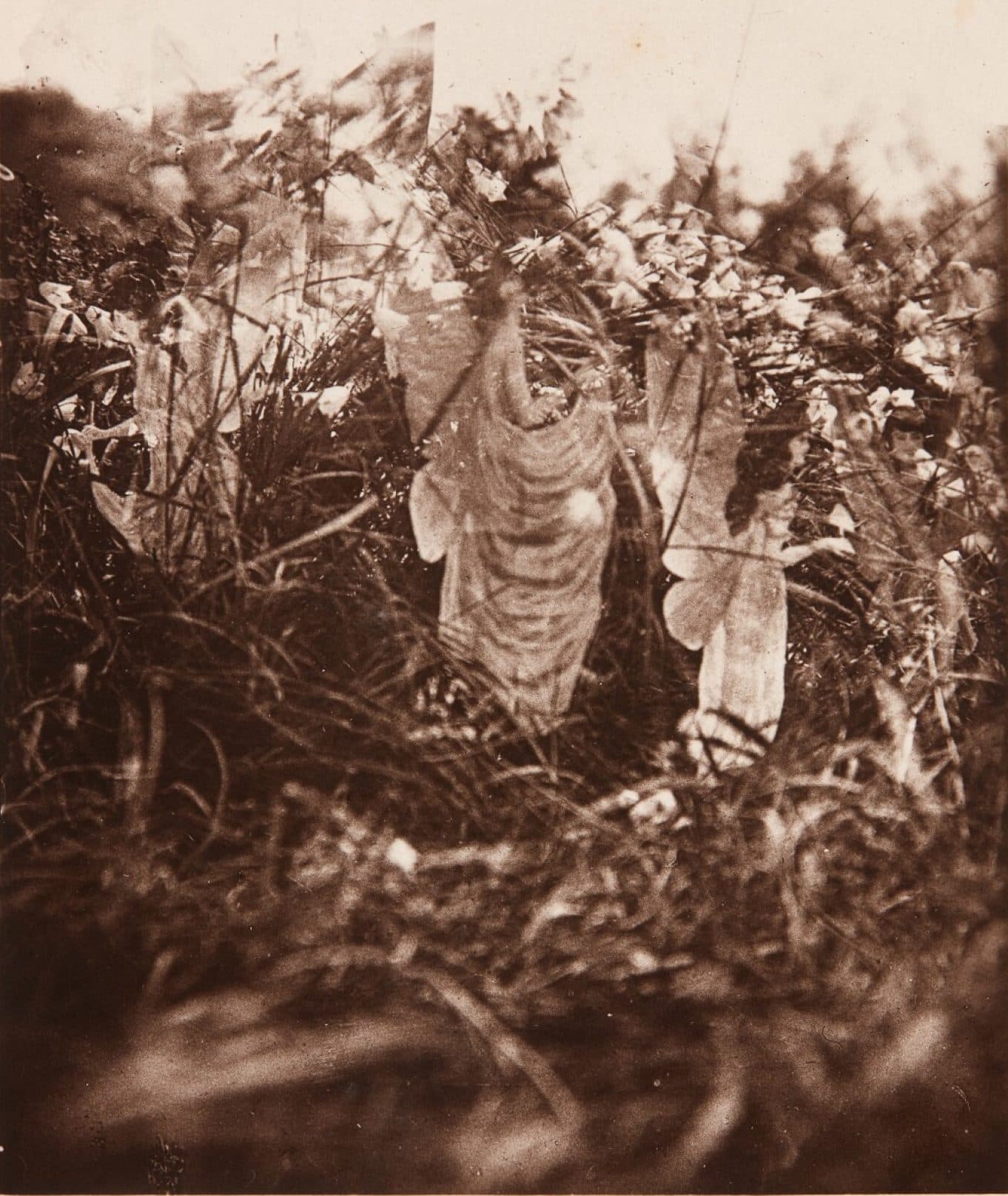
The Cottingley Fairies: A Photographic Hoax Confessed 66 Years Later
Photo: Frances Griffiths and Elsie Wright · Public domain
The story
Skip to the verdict ↓In the summer of 1917, two girls borrowed a camera and came back from the beck at the foot of the garden with a photograph of fairies. Elsie Wright was sixteen; her cousin Frances was nine. Elsie's father developed the glass plate himself in his own darkroom — and thought he knew exactly what he was looking at.
He did — very nearly. Arthur Wright was an experienced amateur photographer, and the camera his daughter Elsie and her cousin Frances Griffiths had borrowed was his own. What he immediately suspected as he developed the plates was cardboard cutouts: he knew Elsie's artistic ability, and her time working at a photographer's studio. The garden where the fairies appeared to be dancing was in Cottingley, Yorkshire.
His skepticism did not travel with the photographs. The images reached the Theosophy Society and then Arthur Conan Doyle, creator of Sherlock Holmes and a committed spiritualist. Conan Doyle accepted the photographs as genuine after expert analysis by Kodak photographic technicians, who could not find evidence of double exposure but declined to certify authenticity. He published them in the Strand Magazine in 1920 with an article proclaiming proof of fairy existence. The case became an international sensation.
Three more photographs followed over subsequent years, but no controlled verification was ever attempted. The photographs were subject to various expert analyses over the decades; some analysts raised doubts, none could produce definitive technical proof of fakery from the prints alone.
In 1983, both women gave interviews to magazines and newspapers in which they described the full method: they had cut fairy figures from Princess Mary's Gift Book (published 1914), propped them with hatpins, and photographed them in the beck. Elsie said they had been too embarrassed to confess after fooling Conan Doyle. Frances, while admitting the photographs were faked, maintained to her death that she and Elsie did genuinely see fairies.
Would be extraordinary if real — but it has been positively shown false.
Reviewer Notes
Miracles Jar weighs each claim two ways — how extraordinary it would be, and how strong the evidence is.
Assessed by Miracles Jar AI
Not “low evidence” — positive proof it’s false: those responsible admitted it.
Confirmed hoax; cardboard cutouts on hatpins; both photographers confessed in 1983.
The Case
This is a confirmed hoax: cardboard cutouts on hatpins, with both photographers confessing in 1983.
In 1983, both Elsie Wright and Frances Griffiths — by then elderly women — independently confirmed in magazine and newspaper interviews that the photographs had been staged using cardboard cutouts of fairy illustrations (taken from Princess Mary's Gift Book), supported by hatpins. Their father Arthur Wright had suspected cardboard cutouts from the beginning based on his darkroom experience. The confession is unambiguous and corroborated by both participants.
The case is significant primarily as a study in motivated credence: expert photographic analysis and spiritualist enthusiasm overrode what Arthur Wright spotted immediately. The Kodak technicians could not find evidence of double exposure but declined to certify authenticity — a non-finding that Conan Doyle treated as support. Arthur Wright's skepticism was ignored by Conan Doyle and the Theosophy Society investigators.
The supporting evidence all points to a natural explanation. Both Elsie Wright and Frances Griffiths independently confessed in 1983 that the fairies were cardboard cutouts (strong; corroborated by both participants, who described hatpins as supports). Arthur Wright, an experienced amateur photographer, immediately suspected cardboard cutouts when he developed the first plate (strong). The fairy figures match illustrations in Princess Mary's Gift Book (1914), published three years before the photos (strong; source material identified by later analysis). And no fairy photographs were produced under controlled conditions despite years of opportunity (moderate).
Frances's lifelong insistence that she and Elsie did genuinely see fairies — even while admitting the photographs were faked — is an addendum that shows how thoroughly the experience had been internalized.
Evidence ledger — what the verdict rests on
Both Elsie Wright and Frances Griffiths independently confessed in 1983 that the fairies were cardboard cutouts
Corroborated by both participants; described hatpins as supports
Arthur Wright (Elsie's father, an experienced amateur photographer) immediately suspected cardboard cutouts when he developed the first plate
His skepticism was ignored by Conan Doyle and Theosophy Society investigators
Fairy figures match illustrations in Princess Mary's Gift Book (1914), published three years before the photos
Source material identified by later analysis
No fairy photographs were produced under controlled conditions despite years of opportunity
What would raise the meter: Adversarial scrutiny with real power to expose deception — hostile investigators, controlled conditions — coming back clean would raise the evidence bar.
What would lower it: A confession, an exposed method, or a documented financial motive would drive the evidence bar toward zero.
How we weigh every claim — the full method, deductions and all →
The natural explanation
The leading natural account for this case is deception: hoaxes, cold reading & stagecraft. Read what it explains — and where it stops.
Sources
Tagged by proximity to the event. Primary sources are direct or contemporaneous; tertiary are downstream retellings.
- 1.Secondaryother
"Cottingley Fairies — Wikipedia", 2024· no public link
Comprehensive account of hoax, investigations, and 1983 confession
- 2.Secondaryother
"The Cottingley Fairies: A Study in Deception — University of Leeds", 2020· no public link
Academic analysis of the photographs and cultural context
- 3.Primarynews
"Elsie Wright and Frances Griffiths — confessional interviews", 1983· no public link
Both women confirmed the cardboard cutout method independently
Cases like this
Nearest on the map — similar in how miraculous they’d be, and how strong the evidence is.