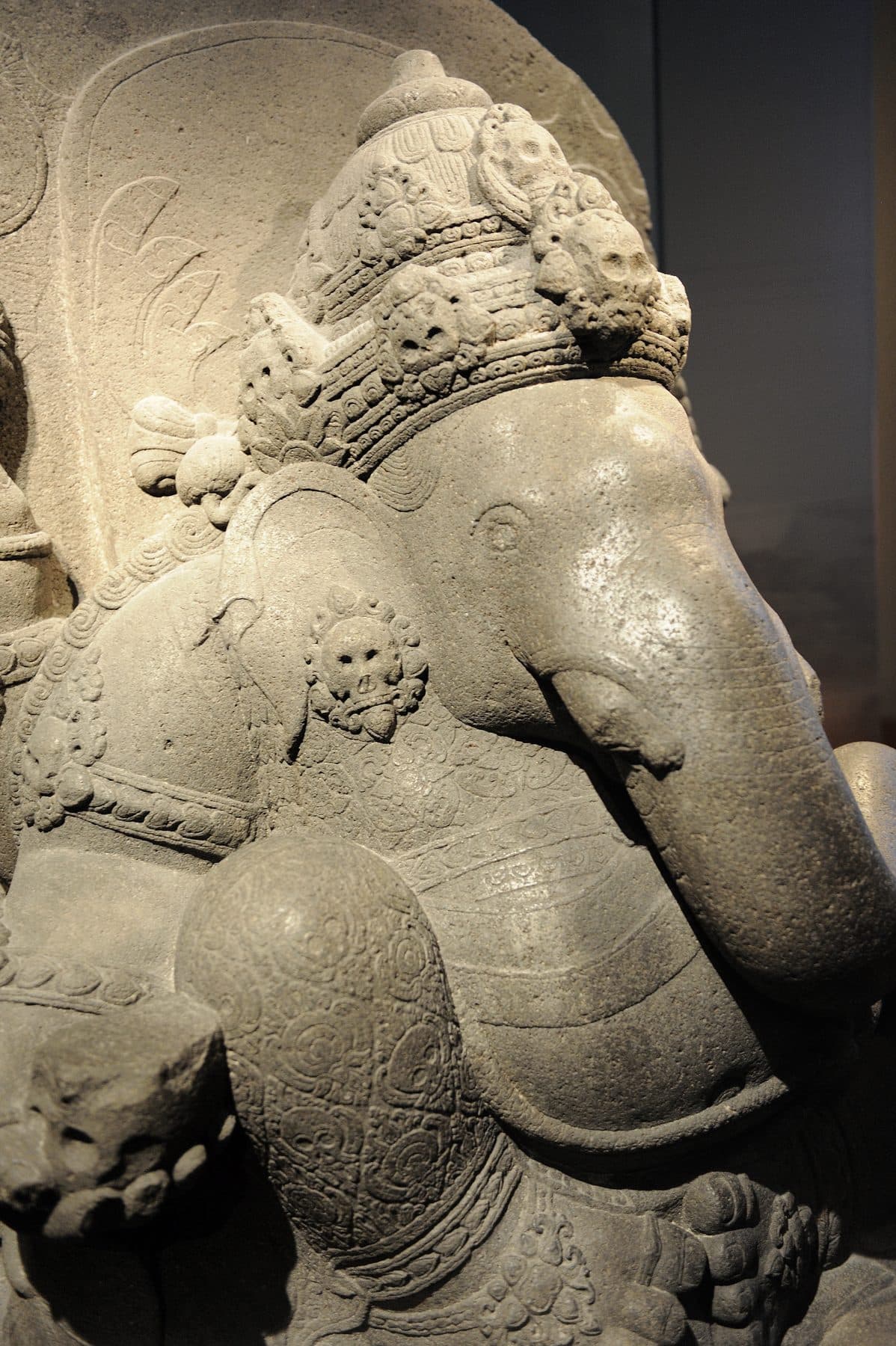
The 1995 Ganesha Milk Miracle
Photo: ErikvanB · CC BY-SA 4.0
The story
Skip to the verdict ↓Before dawn on 21 September 1995, a man at a temple in New Delhi lifted a spoonful of milk to the stone trunk of a statue of Ganesha, the elephant-headed god — and the milk vanished from the spoon. Word ran ahead of the telephones. By noon, from Delhi to London to Dubai, Hindus were holding spoons to their household idols and watching the milk disappear, and the queues outside the temples ran for hours.
By mid-morning the claim had spread across India and into Nepal, and among the Hindu temples reporting the same phenomenon by noon, Toronto joined London and Dubai. Tens of thousands of believers stood in the hours-long queues, offering milk not only to Ganesha but to statues of Shiva, Parvati, and Nandi.
Scientists from India's Ministry of Science and Technology responded within the day. Using milk dyed with food coloring, they reported that the liquid was not consumed — it wicked upward into the porous stone surface at the point of spoon contact, then ran down the statue and pooled beneath. They described the mechanism as capillary action: the narrow spaces between stone grains create suction that draws liquid against gravity, as a paper towel absorbs water.
According to their account, the effect was reproducible and worked best on unglazed marble, granite, and sandstone — the same materials used for most traditional Hindu statuary. Glazed or metal statues showed no effect.
The phenomenon lasted roughly 24 hours before stopping. Some devout witnesses reported the milk vanishing with no visible residue.
It happened — and nature accounts for it.
Reviewer Notes
Miracles Jar weighs each claim two ways — how extraordinary it would be, and how strong the evidence is.
Assessed by Miracles Jar AI
Capillary action in porous stone; conclusively demonstrated by government scientists.
Government scientists reproduced the effect using milk mixed with food coloring, confirming capillary action — porous stone drew liquid upward from the spoon by surface tension, then let it run down the statue's surface. The phenomenon worked best with unglazed marble, stone, and terracotta, all porous materials. On glazed or metal statues, the effect was absent or weak — exactly what capillary mechanics predict. Skeptics note the effect required a spoon held at close contact with the statue, not a bowl poured from a distance.
The speed of global spread illustrates how religious expectation and social contagion can turn a physics demonstration into a mass phenomenon. The abrupt stop within 24 hours closely tracks debunking reaching media saturation rather than a miraculous withdrawal. The event is one of the most thoroughly investigated and clearly explained apparent miracles of the 20th century.
Devout witnesses reported the milk vanishing with no visible residue, which most likely reflects observers not looking below the spoon contact point — the liquid ran down the statue and pooled beneath. The Indian Ministry of Science and Technology investigation established the capillary mechanism; the food-colored milk made the liquid's path visible and traceable.
Evidence ledger — what the verdict rests on
Government scientists reproduced the effect with food-colored milk, showing liquid traveled down the statue via capillary wicking
Indian Ministry of Science and Technology investigation
Effect strongest on porous, unglazed stone statues and absent or weak on glazed or metal ones
Consistent with capillary action physics
Phenomenon spread globally within hours via phone and media — suggests social contagion rather than coordinated miracle
Devout witnesses reported the milk vanishing with no visible residue, which is difficult to explain purely by capillary action on open surfaces
Most likely observers did not look below the spoon contact point
What would raise the meter: Long-term follow-up documenting permanence, in a condition with a near-zero spontaneous-resolution base rate, would raise the meter.
What would lower it: A documented relapse, or case literature showing the condition fluctuates or remits on its own, would move it down.
How we weigh every claim — the full method, deductions and all →
The natural explanation
The leading natural account for this case is spontaneous remission & the body's own recovery. Read what it explains — and where it stops.
The same wonder, across traditions
This claim is one of many that make the same assertion across faiths. See it side by side in Images That Weep, Bleed, and Stir.
Sources
Tagged by proximity to the event. Primary sources are direct or contemporaneous; tertiary are downstream retellings.
- 1.Secondaryother
"Ganesha Drinking Milk Miracle", 2024· no public link
Wikipedia summary with scientific and media sourcing
- 2.Primarynews
Hinduism Today, "The Milk Miracle", 1995· no public link
Contemporary devotional and journalistic coverage from December 1995 issue
- 3.Secondaryother
Learn Religions, "What Was the Ganesha Milk Miracle?", 2019· no public link
Summary of scientific explanation and cultural context
Cases like this
Nearest on the map — similar in how miraculous they’d be, and how strong the evidence is.