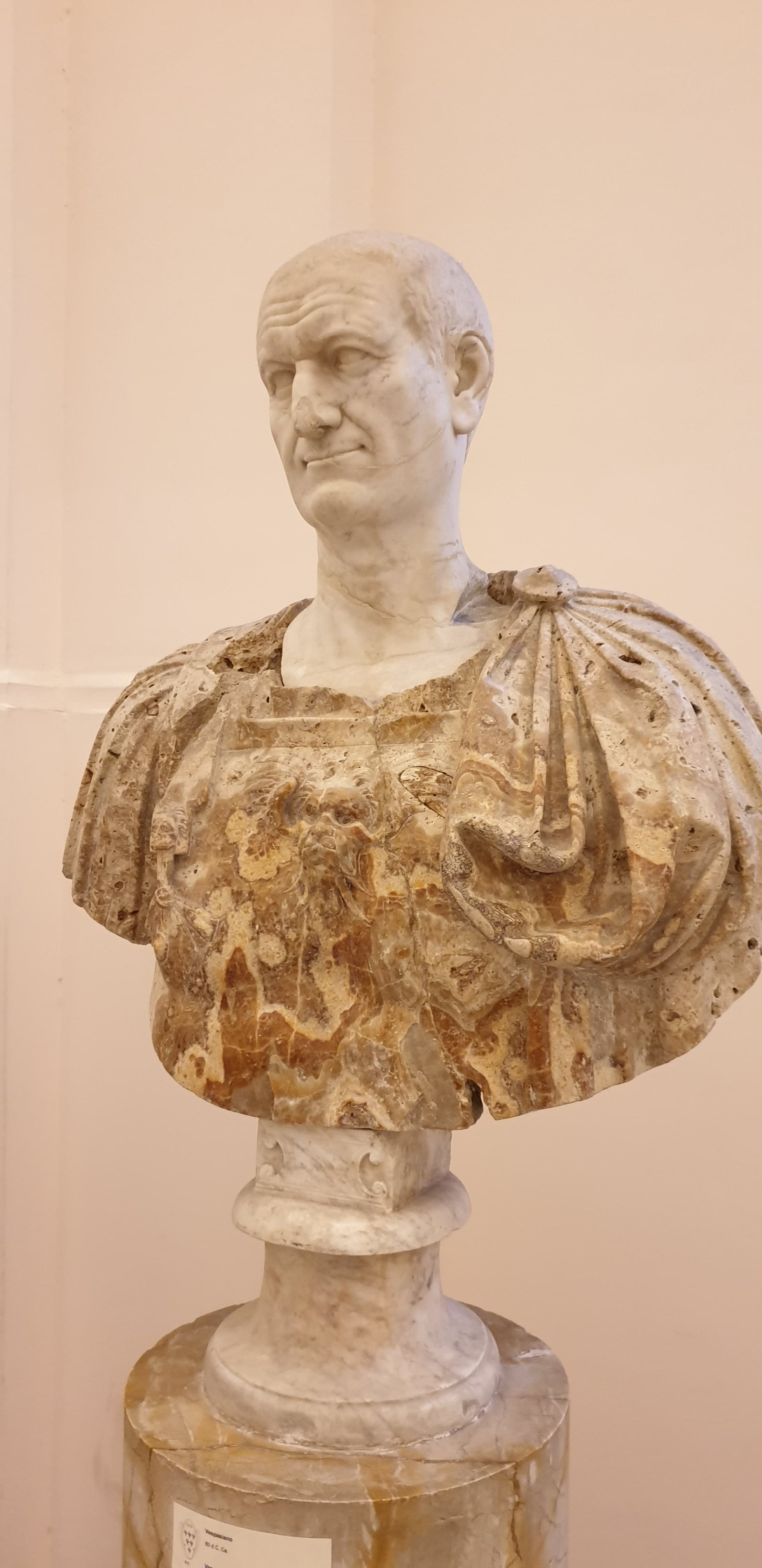
Vespasian's Healing Miracles in Alexandria
Photo: Jamie Heath / Wikimedia Commons · CC BY-SA 2.0
The story
Skip to the verdict ↓Roman Emperor Vespasian reportedly healed a blind man and a man with a withered limb in Alexandria c. 69 CE, as recorded by Tacitus, Suetonius, and Cassius Dio.
In the summer of 69 CE, Vespasian was waiting in Alexandria for favorable winds before sailing to Rome to consolidate his newly won imperial power. Two men approached him: one blind, one with a withered hand. Both claimed the god Serapis had directed them to seek the emperor's touch. Physicians examined the men and opined that a cure was within the range of possibility. Vespasian complied — anointing the blind man's eyes with his spittle and treading on the other's hand. Both were said to be immediately healed.
Tacitus provides the most detailed account (Histories 4.81). He writes that "those who were present still attest to both facts, even now when there is nothing to be gained by lying." The episode also appears in Suetonius (Life of Vespasian 7) and later in Cassius Dio.
Vespasian was the first emperor from outside the traditional aristocracy and had seized power through civil war. The healing was set within the cult of Serapis, whose oracle was said to have sent both petitioners. According to the accounts, the suppliants had spent nights in the sanctuary until the god revealed a cure — the pattern of Egyptian incubation-temple miracles.
Too thin a record to say either way.
Reviewer Notes
Miracles Jar weighs each claim two ways — how extraordinary it would be, and how strong the evidence is.
Assessed by Miracles Jar AI
Probable propaganda; independently attested but politically motivated legend.
Three separate Roman historians — Tacitus, Suetonius, and Cassius Dio — independently record the same episode, making this one of the best-attested ancient miracle claims outside the Christian tradition. Tacitus writes with deliberate ambiguity, a hedge that signals contemporaries already thought the claim required justification. Suetonius corroborates with minor variation in detail, and Cassius Dio provides a third attestation, though writing over 150 years after the event. All three sources post-date the healings by decades.
The political context is unavoidable. Vespasian needed divine legitimation as a newly proclaimed emperor of non-aristocratic origin, and divine legitimation — especially via the oracle of Serapis — was a recognized strategic asset. Roman historians routinely linked new dynasties to prodigies. The healing also follows the exact pattern of Egyptian incubation-temple miracles common in the ancient Mediterranean world, with both petitioners reportedly directed to Vespasian by the oracle of Serapis. Tacitus notes that physicians gave conditional medical endorsement before the cure, an unusually naturalistic framing that could reflect genuine caution in the source tradition or serve to make the narrative more credible.
Most historians read the Vespasian healings as consciously crafted imperial mythology, possibly built on actual events — psychosomatic recoveries, or patients coached to perform — but shaped into a politically useful legend. The episode is nonetheless valuable as a non-Christian parallel to Gospel healing narratives from the same era.
The primary ancient sources are: Tacitus, *Histories*, Book 4, chapters 81–82, written around 105 CE, roughly 35 years after the event; Suetonius, *Life of Vespasian*, Chapter 7, around 121 CE; and Cassius Dio, *Roman History*, Book 65, around 229 CE.
Evidence ledger — what the verdict rests on
Three separate ancient historians independently record the same episode
Multi-source attestation is rare for ancient miracle claims
Strong political incentive: Vespasian needed divine legitimation as a new emperor of non-aristocratic origin
Imperial miracle stories were a recognized tool of Roman political propaganda
Both petitioners reportedly directed to Vespasian by the oracle of Serapis, following standard temple-healing narrative patterns
Mirrors Asclepius healing-temple tradition; formulaic structure suggests literary shaping
Tacitus notes physicians gave conditional medical endorsement before the cure -- an unusually naturalistic framing for a miracle story
Could reflect genuine caution in the source tradition, or serve to make the narrative more credible
What would raise the meter: Adversarial scrutiny with real power to expose deception — hostile investigators, controlled conditions — coming back clean would raise the evidence bar.
What would lower it: A confession, an exposed method, or a documented financial motive would drive the evidence bar toward zero.
How we weigh every claim — the full method, deductions and all →
The natural explanation
The leading natural account for this case is deception: hoaxes, cold reading & stagecraft. Read what it explains — and where it stops.
Sources
Tagged by proximity to the event. Primary sources are direct or contemporaneous; tertiary are downstream retellings.
- 1.Primarybook
Tacitus, "Histories", c. 105 CE· no public link
Book 4, chapters 81-82; the most detailed account, written roughly 35 years after the event
- 2.Primarybook
Suetonius, "Life of Vespasian", c. 121 CE· no public link
Chapter 7; corroborates Tacitus with minor variation in detail
- 3.Secondarybook
Cassius Dio, "Roman History", c. 229 CE· no public link
Book 65; third independent attestation but written over 150 years after the event
Cases like this
Nearest on the map — similar in how miraculous they’d be, and how strong the evidence is.