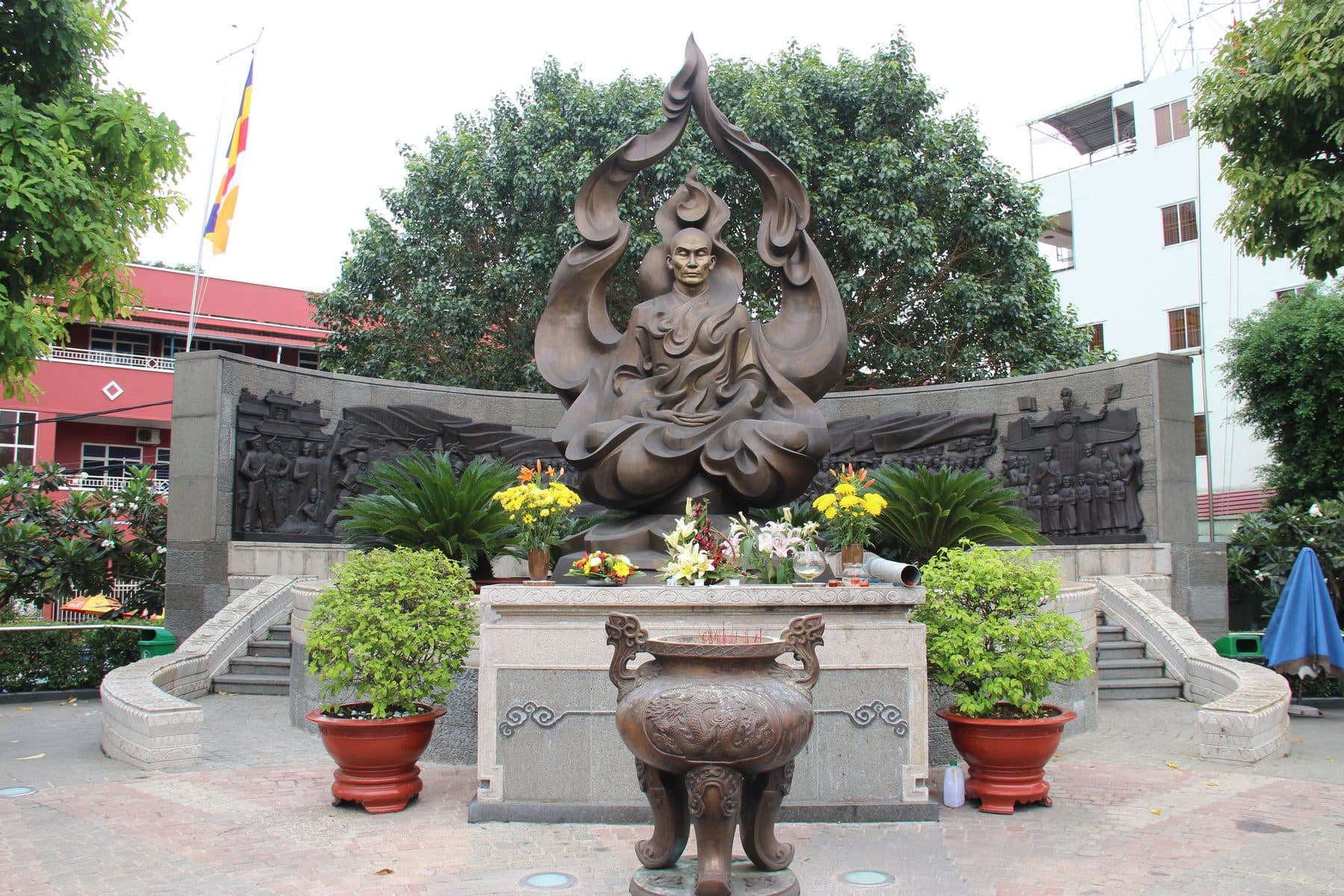
Thich Quang Duc's Unburnt Heart (1963)
Photo: Gary Todd / Wikimedia Commons · CC0
The story
Skip to the verdict ↓After Vietnamese Buddhist monk Thich Quang Duc self-immolated in 1963, his heart was reportedly found intact after cremation, re-burned, and still remained unconsumed — a relic now enshrined at Xa Loi Pagoda that has not been independently scientifically examined.
On June 11, 1963, the Venerable Thich Quang Duc sat down at a busy Saigon intersection, was doused with petrol by fellow monks, and set himself alight in protest of the Diem government's persecution of Buddhists. He remained motionless throughout. Malcolm Browne's photograph — taken for the Associated Press — became one of the most recognized images of the 20th century and is credited by some historians with accelerating U.S. disillusionment with the Diem regime.
When Quang Duc's body was cremated in the traditional Buddhist manner, devotees reported that his heart remained whole in the ashes. The organ was then — according to the account — subjected to a second, deliberate cremation and still did not burn. It was placed in a glass chalice at Xa Loi Pagoda, where it remains as a venerated relic.
The Heart and the Pagoda
A senior Vietnamese Buddhist leader responsible for the relic has acknowledged uncertainty about the heart's current condition and the lack of scientific verification, stating: "we don't know the science behind it, and we don't know whether the heart is still intact after being stored in the box for so many years."
The monks who handled the cremation were observers from within the tradition. The "second cremation" account is held within that tradition. To date, no independent scientific examination of the relic's composition or current state has been published.
Context in Buddhist Relic Tradition
The account sits within the broader sarira tradition, in which the remains of spiritually realized masters are held to manifest unusual properties. Within that framework, an unburnt heart stands as the most dramatic possible sarira.
Too thin a record to say either way.
Reviewer Notes
Miracles Jar weighs each claim two ways — how extraordinary it would be, and how strong the evidence is.
Assessed by Miracles Jar AI
Claimed but not independently verified; the relic has never been subjected to published scientific examination.
The historical fact of Thich Quang Duc's self-immolation on June 11, 1963, is one of the most thoroughly photographed and documented events of the 20th century. The relic claim is a separate question.
The claim rests entirely on testimony from Buddhist officials who handled the remains — monks who were deeply invested observers. No independent scientific examination of the relic has been published or, apparently, conducted. A senior Vietnamese Buddhist leader publicly acknowledged the lack of scientific verification, an unusual admission of uncertainty from within the tradition.
The "second cremation" claim — that a second attempt to destroy the heart likewise failed — has no documentation beyond internal tradition.
Cardiac muscle contains more connective tissue than skeletal muscle and could theoretically resist complete combustion in specific fire conditions. Its variable position in a body fire could produce differential resistance to combustion. But this has not been tested against this case, and the second-cremation claim, if true, would go beyond what that mechanism would predict — and it has no independent documentation.
The relic is enshrined at Xa Loi Pagoda in Ho Chi Minh City. Claimed but not independently verified; the relic has never been subjected to published scientific examination.
Evidence ledger — what the verdict rests on
The self-immolation itself is one of the most thoroughly photographed and documented historical events of the 20th century
Historical fact is not in question; the relic claim is
A senior Buddhist monk who oversees the relic publicly acknowledged: 'we don't know the science behind it, and we don't know whether the heart is still intact'
Admission of non-verification from within the tradition
No published scientific analysis of the relic's composition, current state, or verification of the 'second cremation' claim exists
Cardiac muscle's higher connective-tissue content and variable position in a fire could theoretically produce differential resistance to combustion
Plausible naturalistic mechanism but not tested against this specific case
What would raise the meter: Instrumented or physical evidence — measurements, samples, footage that survives analysis — would raise this.
What would lower it: A controlled observation reproducing the experience naturally (lighting, suggestion, pareidolia) would move it down.
How we weigh every claim — the full method, deductions and all →
The natural explanation
The leading natural account for this case is misperception: how honest witnesses get it wrong. Read what it explains — and where it stops.
Sources
Tagged by proximity to the event. Primary sources are direct or contemporaneous; tertiary are downstream retellings.
- 1.Secondaryother
"Thich Quang Duc", 2024· no public link
Wikipedia; documents the historical immolation and the heart relic tradition
- 2.Tertiaryother
Saigon on Motorbike, "The Mysterious Undestroyed Heart Relic of Venerable Thich Quang Duc", 2022· no public link
Includes direct quote from Buddhist monk acknowledging lack of scientific verification
- 3.Tertiaryother
Science and Nonduality (SAND), "The Unburnt Heart of Compassion", 2019· no public link
Devotional and contemplative treatment; documents the claim without scientific analysis
Cases like this
Nearest on the map — similar in how miraculous they’d be, and how strong the evidence is.