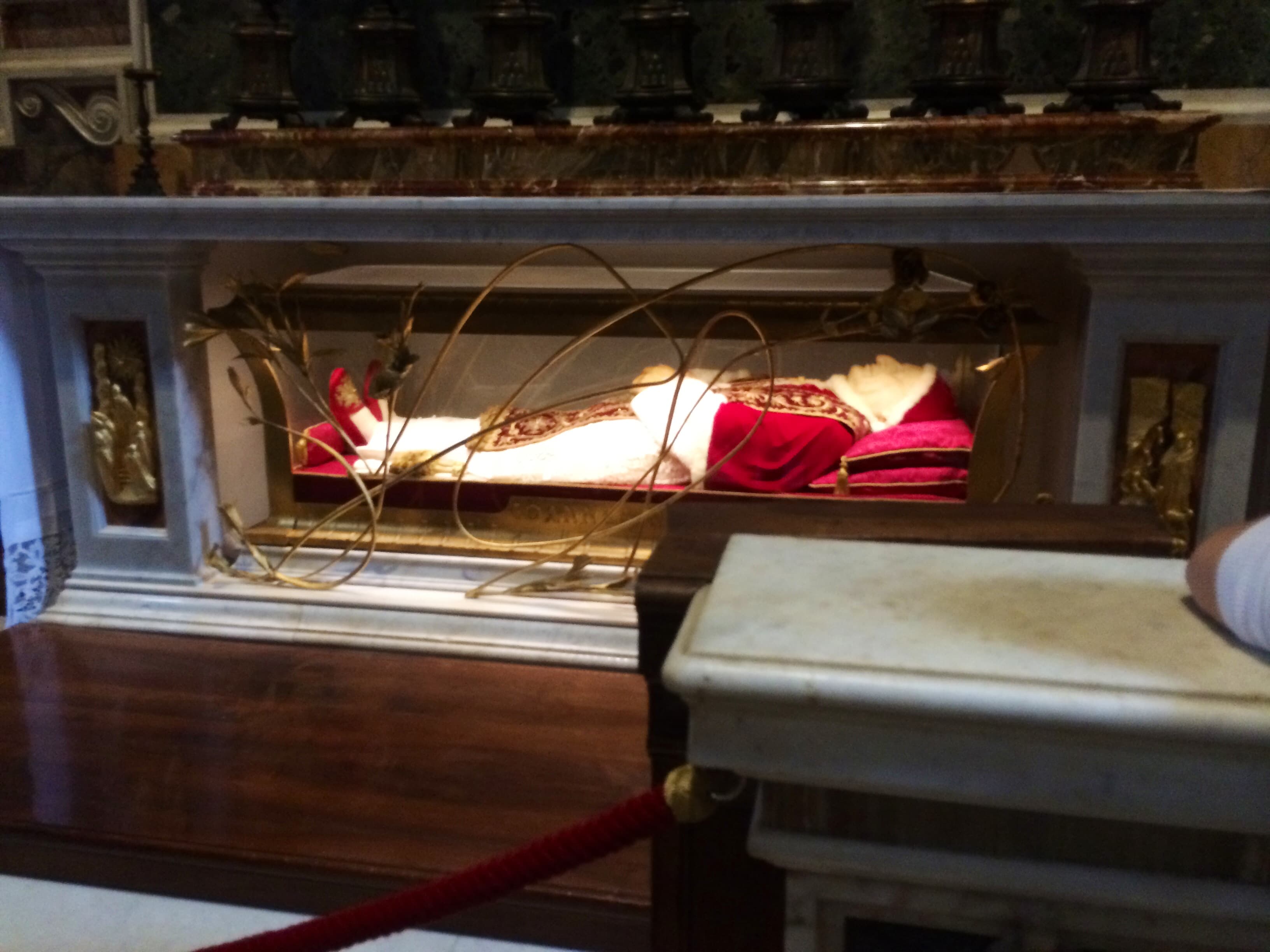
Pope John XXIII — 'Remarkably Well Preserved,' Not Miraculous
Photo: Steve Moses / Wikimedia Commons · CC BY 2.0
The story
Skip to the verdict ↓When John XXIII was exhumed in 2001 after 37 years, his face appeared intact and serene; the Vatican explicitly attributed this to embalming with formalin, hermetic sealing in multiple coffins, and Prof. Golia's proprietary preservation treatment — not to miracle.
Exhumation and First Impressions
Pope John XXIII died in June 1963 and was interred in the crypt of St. Peter's Basilica. In March 2001, Pope John Paul II ordered his exhumation to move the body to a more accessible location for pilgrims. When the inner casket was opened, Cardinal Noe described the face as "intact and serene," bearing features that "immediately called to mind that familiar appearance of the venerated pontiff."
The Vatican's Account
The Vatican Information Service did not use the words "miraculous" or "incorrupt" in its reporting. Its headline read: "Body of Blessed John XXIII is Remarkably Well Preserved." The Vatican noted that John XXIII's body had been treated with formalin for the extended public lying-in-state following his death in 1963, and that Prof. Gennaro Golia had subsequently applied his own proprietary preservation technique. The body was then hermetically sealed in multiple coffins.
The Preservation Measures
Formalin (formaldehyde solution) is a standard embalming agent. It was combined with hermetic sealing — which eliminates the oxygen and microbial exposure that drive decomposition — and a second proprietary treatment. At the 2001 exhumation, 37 years after death, the face was described as "intact and serene," with recognizable features.
It happened — and nature accounts for it.
Reviewer Notes
Miracles Jar weighs each claim two ways — how extraordinary it would be, and how strong the evidence is.
Assessed by Miracles Jar AI
Vatican explicitly denied miracle; embalming and hermetic coffins fully explain preservation.
The Vatican explicitly denied a miracle; embalming and hermetic coffins fully explain the preservation.
The Vatican's account, given at the time of exhumation in 2001, attributed the condition of the body to the embalming performed in 1963 and to the hermetically sealed triple coffin — cypress, lead, and elm — in which John XXIII was interred. The combined measures created near-ideal preservation conditions. The 37-year result falls within the range of outcomes documented under comparable conservation conditions.
This case illustrates how the incorruptibility narrative can grow in popular Catholic culture even when the institutional Church actively contradicts it. The Vatican's own statements are the strongest evidence against a supernatural explanation.
Evidence ledger — what the verdict rests on
Vatican denied miracle; headline: 'Body of Blessed John XXIII is Remarkably Well Preserved'
Institutional source of the miracle claim is the institution that denied it
Body was embalmed with formalin for 1963 public viewing and treated by Prof. Golia's proprietary technique
Chemical preservation is documented in Vatican records
Hermetically sealed in multiple coffins — controls oxygen and microbial access
Anaerobic environment strongly retards decomposition regardless of embalming
Face described as 'intact and serene' with recognizable features at 2001 exhumation
Visually impressive but fully explained by documented preservation methods
What would raise the meter: Long-term follow-up documenting permanence, in a condition with a near-zero spontaneous-resolution base rate, would raise the meter.
What would lower it: A documented relapse, or case literature showing the condition fluctuates or remits on its own, would move it down.
How we weigh every claim — the full method, deductions and all →
The natural explanation
The leading natural account for this case is spontaneous remission & the body's own recovery. Read what it explains — and where it stops.
Sources
Tagged by proximity to the event. Primary sources are direct or contemporaneous; tertiary are downstream retellings.
- 1.Secondarynews
"Pope John — Incorrupt? (Messenger of Saint Anthony)", 2001· no public link
Reviews Vatican Information Service statements; confirms 'remarkably well preserved' language only
- 2.Secondaryinvestigation
"Pope John XXIII was Embalmed (FishEaters.com)", 2001· no public link
Documents formalin treatment and Golia technique; cites Vatican sources
- 3.Secondaryinvestigation
"Is Pope John XXIII Incorrupt? (Unam Sanctam Catholicam, 2007)", 2007· no public link
Thorough analysis of official statements vs. popular incorruptibility claims
Cases like this
Nearest on the map — similar in how miraculous they’d be, and how strong the evidence is.