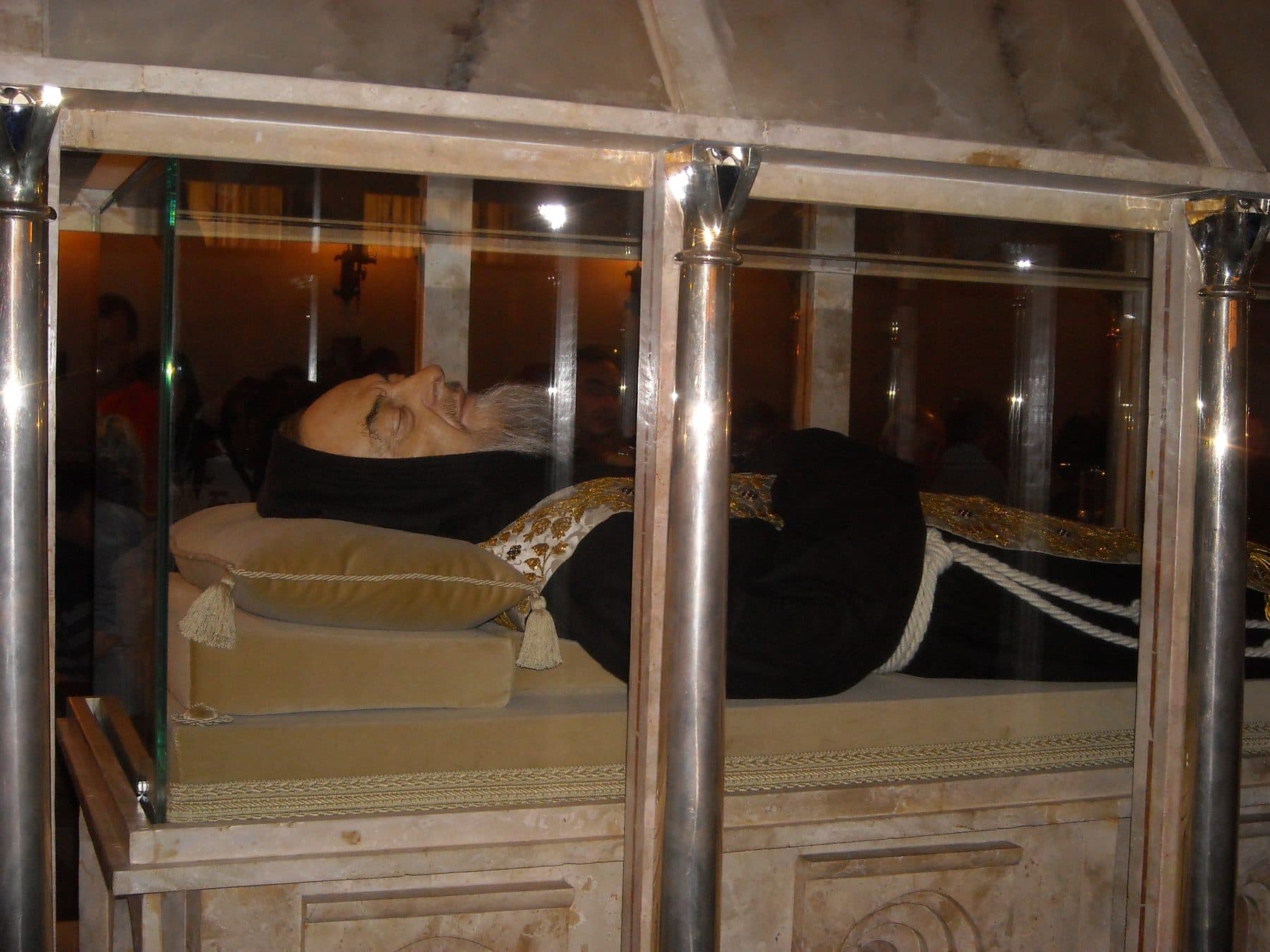
Padre Pio — Chemical Embalming, Not Incorruption
Photo: Vito Manzari / Wikimedia Commons · CC BY 2.0
The story
Skip to the verdict ↓Padre Pio's body was exhumed in 2008, found in good condition, but chemical analysis revealed it had been treated with high-concentration formalin, creosote, benzoic acid, and turpentine — deliberate embalming, not miraculous preservation.
The 2008 Exhumation
Padre Pio of Pietrelcina, the Capuchin friar canonized in 2002, died in 1968. In March 2008, forty years after his death, his body was exhumed by order of the Vatican for transfer to a new reliquary. Church officials reported the body was in good condition.
The Preservation
Analysis of the preservation found chemical treatment: a high-concentration formalin-alcohol solution, along with creosote, benzoic acid, and turpentine essence. The body was additionally wrapped in bands soaked in embalming chemicals, placed on a silica-gel mattress to absorb moisture, and sealed in a nitrogen-atmosphere coffin.
The Stigmata
The wounds of the stigmata — the defining feature of Padre Pio's public mystical reputation, maintained for fifty years during his life — were not visible at exhumation.
The Church's Position
The Catholic Church has never issued an official declaration that Padre Pio's body is miraculously incorrupt. Popular Catholic websites and social media have promoted the incorruptibility claim. The institutional source of that claim is absent.
It happened — and nature accounts for it.
Reviewer Notes
Miracles Jar weighs each claim two ways — how extraordinary it would be, and how strong the evidence is.
Assessed by Miracles Jar AI
Chemically embalmed; no official Church incorruptibility declaration; stigmata wounds absent at exhumation.
The case against authenticity is very strong.
The 2008 exhumation confirmed the body was chemically preserved with formalin, creosote, benzoic acid, and turpentine essence — not supernaturally incorrupt. The high concentration of formalin and the combination of preservatives confirm standard industrial embalming, which explains the preservation fully without supernatural intervention.
The stigmata wounds were not present at the 2008 exhumation. This is consistent with normal biological and healing processes, and it undermines narratives that his body was supernaturally preserved intact. The wounds had been maintained for fifty years during his life.
The Catholic Church never officially declared Padre Pio's body miraculously incorrupt. The absence of Church endorsement is significant given popular claims.
The body being in good condition 40 years after burial is expected with documented chemical embalming — it is what the chemistry predicts, not evidence against it.
This is a clear example of how popular religious narrative can run ahead of — and contradict — official Church positions: the chemical embalming evidence shows the preservation is natural, not miraculous.
Adjudicating headers in the body were neutralized: "Chemical Embalming Confirmed" → "The Preservation"; "Stigmata Absent" → "The Stigmata"; "No Official Church Declaration" → "The Church's Position." The title "Padre Pio — Chemical Embalming, Not Incorruption" is frontmatter and unchanged.
Frontmatter (unchanged): mode/category: incorruptibility. Summary, sources (The Catechist 2008 secondary/news; Padre Pio — Wikipedia 2024 tertiary/other; Saint's Body Exhumed After 40 Years, VOA News, 2008, secondary/news), evidence array, tags, location (Sanctuary of Santa Maria delle Grazie, San Giovanni Rotondo, Italy), occurred (Died 1968; exhumed 2008), published 2026-06-10, all retained as-is.
Evidence ledger — what the verdict rests on
Body treated with formalin (high concentration), creosote, benzoic acid, and turpentine — confirmed by analysis
Explains preservation fully without supernatural intervention
Stigmata wounds not present at 2008 exhumation
Consistent with natural healing; undermines miracle narrative around his wounds
Catholic Church never officially declared Padre Pio's body miraculously incorrupt
Absence of Church endorsement is significant given popular claims
Body was in good condition 40 years after burial
Good condition is expected with documented chemical embalming
What would raise the meter: Long-term follow-up documenting permanence, in a condition with a near-zero spontaneous-resolution base rate, would raise the meter.
What would lower it: A documented relapse, or case literature showing the condition fluctuates or remits on its own, would move it down.
How we weigh every claim — the full method, deductions and all →
The natural explanation
The leading natural account for this case is spontaneous remission & the body's own recovery. Read what it explains — and where it stops.
Sources
Tagged by proximity to the event. Primary sources are direct or contemporaneous; tertiary are downstream retellings.
- 1.Secondarynews
"The controversy over Padre Pio's 'incorrupt' body (The Catechist)", 2008· no public link
Describes formalin/creosote treatment; notes Church has not declared incorruptibility
- 2.Tertiaryother
"Padre Pio — Wikipedia", 2024· no public link
General biography, canonization details, stigmata documentation
- 3.Secondarynews
"Saint's Body Exhumed After 40 Years (VOA News, 2008)", 2008· no public link
Reports body condition and absence of stigmata wounds at 2008 exhumation
Cases like this
Nearest on the map — similar in how miraculous they’d be, and how strong the evidence is.