Saint Rita of Cascia — Six Centuries of Wax-Repaired Preservation
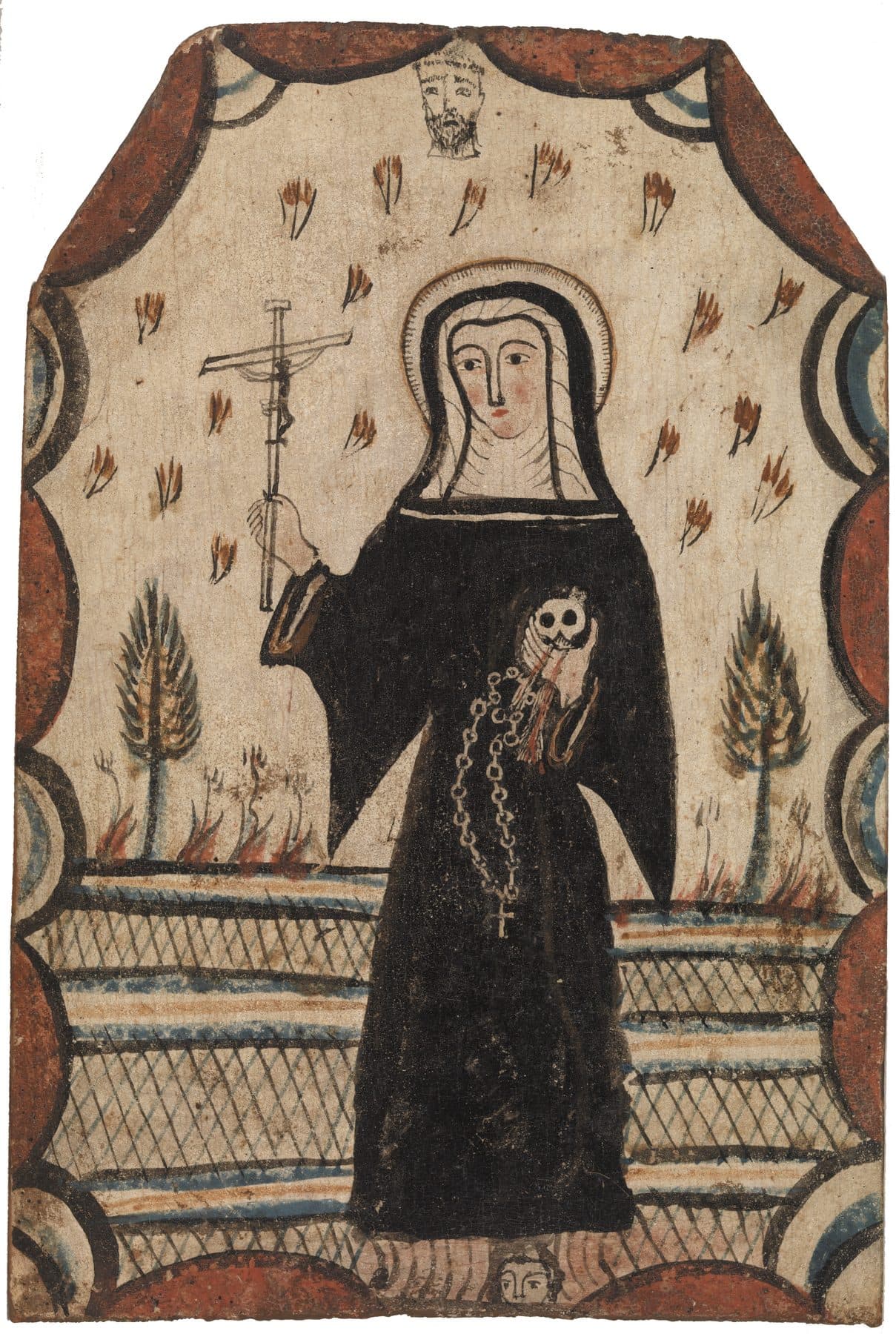
Photo: Pedro Antonio Fresquís (Barnes Foundation, open access) · Public domain
The story
Skip to the verdict ↓Rita of Cascia, patron of impossible causes, died in 1457; her body has been on display for nearly 600 years, with documented medical examinations in 1743 and 1892 noting repairs to the face using wax and string — indicating partial deterioration.
The Patron of Impossible Causes
Rita of Cascia was born around 1381 in Roccaporena, a small village near Cascia in Umbria. She reportedly wanted to enter religious life but married at her family's insistence, was widowed after a difficult marriage, and had both her sons die before they could commit violence in her husband's name. She eventually entered the Augustinian convent at Cascia, where she lived until her death on May 22, 1457. A wound on her forehead — reportedly inflicted by a thorn from a crown of thorns she had prayed to share — is visible on the body today.
Six Centuries of Display
Rita was canonized in 1900 by Pope Leo XIII, though her cult predated canonization by centuries. Her body has been on display in a glass case at the Basilica of Saint Rita in Cascia for nearly 600 years. The wound from the thorn remains visible on the forehead.
The 1743 and 1892 Examinations
Medical examinations in 1743 and 1892 found that portions of the face required structural repair using wax and string. This detail is typically omitted in devotional accounts.
Cascia and Its Climate
Cascia sits at 650 meters elevation in a dry region of Umbria. The stone basilica has a stable temperature and low humidity. Rita's remains have persisted for six centuries. Devotional literature describes the body as appearing to be "sleeping."
Would be extraordinary if real — but it has been positively shown false.
Reviewer Notes
Miracles Jar weighs each claim two ways — how extraordinary it would be, and how strong the evidence is.
Assessed by Miracles Jar AI
Not “low evidence” — positive proof it’s false: positive evidence shows the claimed facts are false.
Incorruption claim refuted by the custodians' own records: wax-and-string facial repairs in 1743 and 1892 document ongoing deterioration; natural desiccation in a dry mountain basilica is the mechanism.
Rita of Cascia died in 1457. That her body has persisted recognizably for nearly 600 years is a remarkable physical fact, unusual even among mummified remains.
But the 1743 and 1892 examinations are the critical documents. Both found that parts of the face required repair with wax and string. Active deterioration contradicts an incorruptibility claim; the repairs are evidence of decay, not its absence. "Incorruptibility" in Rita's case means better preserved than complete dissolution — not the supple, fresh-smelling preservation claimed for some others.
Cascia sits at high altitude in the dry Umbrian mountains. The stone basilica environment provides conditions well-suited to slow desiccation mummification, and six centuries of persistence in such conditions falls within the range of documented natural mummification cases, particularly given the ongoing repair work that confirms the process has not been entirely arrested.
Devotional literature describes the body as appearing to be "sleeping." That description comes from devotional sources, not forensic examination, and is not a reliable substitute for one.
The verdict word "incorrupt" is misleading. The body has survived, but it has not survived intact, and the custodians' own examination records are what establish that.
Evidence ledger — what the verdict rests on
Body has persisted recognizably for nearly 600 years
Multi-century survival is the genuine core fact; unusual even for mummified remains
1743 and 1892 examinations noted deterioration requiring wax and string repairs to the face
Active deterioration contradicts 'miraculous incorruptibility' narrative; repairs are evidence of decay
Cascia's high-altitude, dry Umbrian climate favors desiccation mummification
Environmental conditions consistent with natural long-term mummification
Body appears as 'sleeping' according to devotional accounts
Appearance descriptions in devotional literature are not reliable substitutes for forensic examination
What would raise the meter: Long-term follow-up documenting permanence, in a condition with a near-zero spontaneous-resolution base rate, would raise the meter.
What would lower it: A documented relapse, or case literature showing the condition fluctuates or remits on its own, would move it down.
How we weigh every claim — the full method, deductions and all →
The natural explanation
The leading natural account for this case is spontaneous remission & the body's own recovery. Read what it explains — and where it stops.
Sources
Tagged by proximity to the event. Primary sources are direct or contemporaneous; tertiary are downstream retellings.
- 1.Tertiaryother
"St. Rita of Cascia: One of the Incorruptibles (TAN Direction)", 2020· no public link
Documents 1743 and 1892 examinations; notes wax and string repairs to face
- 2.Tertiaryother
"Rita of Cascia — Wikipedia", 2024· no public link
Canonization history; general biography
- 3.Tertiaryother
"The Mystery of the Incorruptibles: Saints Who Defy Decay (Fatima Center)", 2022· no public link
Places Rita in incorruptibles tradition; repeats preservation claim
Cases like this
Nearest on the map — similar in how miraculous they’d be, and how strong the evidence is.