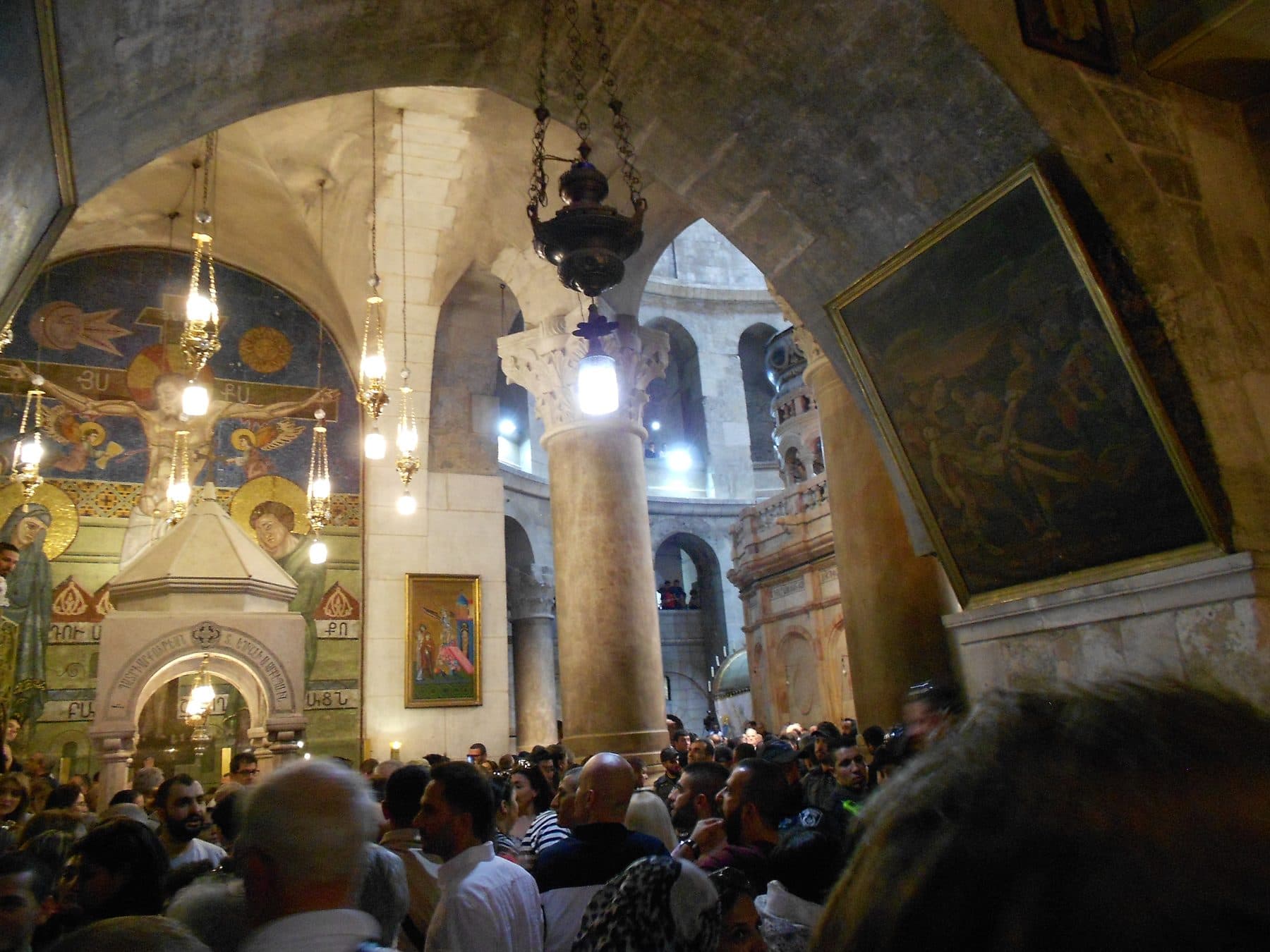
The Holy Fire of Jerusalem — Holy Saturday at the Holy Sepulchre
Photo: Benoit Soubeyran / Wikimedia Commons · CC BY 2.0
The story
Skip to the verdict ↓Each Orthodox Holy Saturday, the Greek Orthodox Patriarch emerges from Christ's Tomb bearing candles said to have been lit by spontaneous blue flame — claimed as the longest-attested annual Christian miracle.
Each Orthodox Holy Saturday, the Greek Orthodox Patriarch enters the sealed Tomb of Christ in the Church of the Holy Sepulchre in Jerusalem and emerges with candles lit from within. The ceremony has taken place there for at least nine centuries of continuous documentation. Believers report that blue flame appears spontaneously and that the fire does not burn skin or hair in its first moments.
Bishop Porphyrius Uspensky (1804-1885), a Russian scholar-archimandrite sent by the Church on official research missions, recorded an account of the ceremony in his published diaries. He wrote that Metropolitan Dionysius related that Archbishop Misael had said the fire was lit from a lamp concealed behind an icon of Christ's Resurrection. Neither Porphyrius nor the Metropolitan claimed to have witnessed this personally.
In 2005, Greek investigator Michael Kalopoulos demonstrated on television that candles pre-treated with white phosphorus dissolved in carbon disulfide would spontaneously ignite after 10-30 minutes — a span consistent with the time the Patriarch spends inside the aedicule. Witnesses say they see blue light phenomena before the Patriarch emerges.
Fr. Lawrence Farley and other Orthodox defenders point to the ceremony's historical longevity, the presence of diverse non-Christian witnesses — including Muslims in some historical reports — across accounts spanning multiple centuries, and the absence of any caught fraud in centuries of observation. Only one individual has access to the Tomb during the ceremony, and no cameras are permitted inside.
Too thin a record to say either way.
Reviewer Notes
Miracles Jar weighs each claim two ways — how extraordinary it would be, and how strong the evidence is.
Assessed by Miracles Jar AI
Controlled ignition plausible and historically attested; extraordinary claim unverified.
The original summary characterized the event as "claimed as the longest-attested annual Christian miracle," documented continuously from 1106 CE with earlier sporadic references from the 9th century.
The strongest evidence against a miraculous origin is the Porphyrius (Uspensky) diary, though that account is third-hand. The Kalopoulos demonstration showed white phosphorus in an organic solvent can spontaneously combust after 10–30 minutes, consistent with the ceremony's timeline. The sole access restriction — only the Patriarch enters the aedicule — prevents independent verification. The reported "non-burning" property in the first moments lacks controlled documentation and may reflect heightened adrenaline or expectation. For the claim: the phenomenon has occurred in front of vast, diverse crowds for centuries; observers report blue light before the flame, which phosphorus does not explain. Against: controlled ignition is physically plausible, access is restricted, and a credible insider admission exists in the historical record.
The Porphyrius diary's third-hand admission by Archbishop Misael is a moderate-weight natural consideration, though Orthodox apologists dispute the chain of testimony. The Kalopoulos demonstration of white phosphorus in organic solvent combusting after 10–30 minutes — shown on Greek television in 2005 — is the strongest natural argument. No independent observer is permitted inside the aedicule, only the Patriarch, which prevents falsification in either direction. Large, religiously diverse crowds — including Muslims in some historical reports — have witnessed blue light before ignition for centuries; the blue pre-flame light is not explained by phosphorus ignition, and mass crowd reporting is consistent but has not been corroborated instrumentally.
The ceremony's structure makes definitive resolution from the outside very difficult in either direction.
Evidence ledger — what the verdict rests on
Bishop Porphyrius diary records a third-hand admission by Archbishop Misael that the fire is lit from a concealed lamp
Account is third-hand; Orthodox apologists dispute the chain of testimony
White phosphorus dissolved in organic solvent can spontaneously combust after a delay of 10-30 minutes, matching ceremony timing
Demonstrated by Michael Kalopoulos on Greek television, 2005
No independent observer is permitted inside the aedicule during the ceremony; only the Patriarch has access
Access restriction prevents falsification in either direction
Large, religiously diverse crowds (including Muslims in some historical reports) have witnessed blue light phenomena before ignition for centuries
Blue pre-flame light is not explained by phosphorus ignition; mass crowd reporting is consistent but uncorroborated instrumentally
What would raise the meter: Adversarial scrutiny with real power to expose deception — hostile investigators, controlled conditions — coming back clean would raise the evidence bar.
What would lower it: A confession, an exposed method, or a documented financial motive would drive the evidence bar toward zero.
How we weigh every claim — the full method, deductions and all →
The natural explanation
The leading natural account for this case is deception: hoaxes, cold reading & stagecraft. Read what it explains — and where it stops.
Sources
Tagged by proximity to the event. Primary sources are direct or contemporaneous; tertiary are downstream retellings.
- 1.Secondaryother
"Holy Fire — Wikipedia", 2024· no public link
Summarizes historical documentation, Porphyrius diary excerpts, and skeptical analyses including Kalopoulos
- 2.Primaryother
Bishop Porphyrius Uspensky, "Kniga bytija moego (The Book of My Being)", 1894· no public link
8-volume diary published 1894-1901; contains third-hand account of Archbishop Misael admitting artificial ignition
- 3.Secondaryinvestigation
"Holy Fire Miracle: True or False?", 2023· no public link
Israel by Locals review of skeptical and believer arguments; references Kalopoulos television demonstration
- 4.Secondaryother
Fr. Lawrence Farley, "Skepticism and the Holy Fire", 2022· no public link
Orthodox defense; engages skeptical arguments while acknowledging historical complexity
Cases like this
Nearest on the map — similar in how miraculous they’d be, and how strong the evidence is.