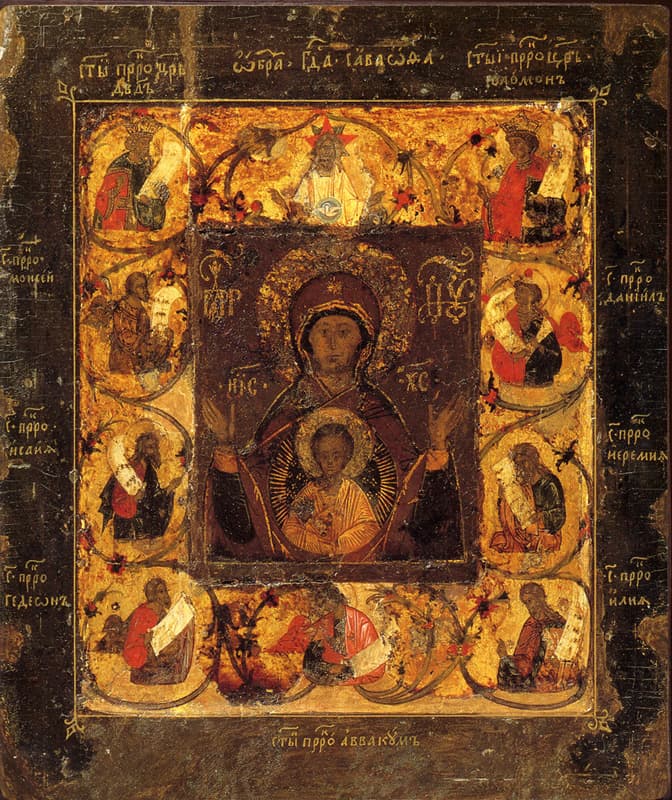
The Kursk Root Icon of the Sign — Survival, Travels, and Diaspora
Photo: Kursk Root Icon (anonymous icon painter) / Wikimedia Commons · Public domain
The story
Skip to the verdict ↓Russia's most-traveled wonder-working icon, the 13th-century Kursk Root Icon of the Sign, survived a 1898 bomb blast that destroyed its iron canopy and marble pedestal while leaving the icon and its glass untouched.
The Kursk Root Icon of the Mother of God of the Sign is one of the most ancient and venerated icons of the Russian Church, reportedly discovered in 1295 by a hunter near the ruins of Kursk following the Mongol invasion. The icon takes its name from the root of a tree by which it was found.
In March 1898, a man named Ufimtsev planted a powerful bomb with a timer at the base of the icon in Kursk's Cathedral of the Sign during an All-Night Vigil service. The bomb detonated at approximately 2 AM, when the cathedral was empty. The explosion tore apart the heavy cast-iron gilded canopy suspended over the icon, shattered the marble pedestal into several pieces, and cracked the stone wall. The damage to the surrounding structure was extensive. The icon itself, and even the glass of its protective case, reportedly remained completely undamaged.
Ufimtsev was arrested and identified. Multiple witnesses, including reportedly a civil engineer who assessed the explosion site, attested to the icon's survival.
The icon subsequently traveled with Russian emigrants fleeing the Revolution and has resided at the Synodal Cathedral of the Russian Orthodox Church Outside Russia in New York City since 1951, where it remains that church's most sacred object. Its broader tradition includes accounts of a spring of water appearing at its discovery, the icon returning to its origin location repeatedly, and its reassembly after being shattered in 1383.
It happened — and nature accounts for it.
Reviewer Notes
Miracles Jar weighs each claim two ways — how extraordinary it would be, and how strong the evidence is.
Assessed by Miracles Jar AI
1898 bombing survival is historically documented; blast-physics explanation is plausible but does not fully account for the degree of selective protection claimed.
The 1898 bombing survival is historically documented; blast-physics explanation is plausible but does not fully account for the degree of selective protection claimed. The case is genuinely uncertain — harder to explain away than most icon-survival claims, though well short of a strong case.
The 1898 bombing destroyed a cast-iron gilded canopy, shattered a marble pedestal, and cracked the stone wall; the bomber was identified and the destruction was documented by civil and ecclesiastical authorities. The icon and its glass kiot survived intact in the documented blast, which a Russian civil engineer at the scene reportedly confirmed as remarkable. The event itself is historically documented; the icon's condition afterward is attested by clergy and civil witnesses, not just devotional literature. This is not an anonymous legend but a documented criminal case, and contemporary church accounts treat it as the icon's defining modern miracle.
Blast dynamics can occasionally produce counterintuitive survival patterns — pressure wave nulls, energy absorption by heavy structural elements — but the combination of massive structural destruction and total icon preservation, including fragile glass, is at the extreme end of such scenarios. Blast wave dynamics can create localized pressure nulls; glass in a rigid frame can survive nearby explosions through specific vibration patterns. Plausible as a partial explanation; the degree of selective protection described — heavy iron destroyed, glass intact — is at the uncommon end of documented blast behavior.
The broader tradition's claims (spring at discovery, icon flying back to origin, reassembly after shattering in 1383) are standard hagiographic topoi without independent verification. Pattern-matching with other icon traditions suggests elaboration over time; this does not affect the 1898 bombing claim specifically.
The engineer witness account is cited in church sources; primary civil documentation has not been independently verified by secular historians. No independent structural analysis was conducted.
Evidence ledger — what the verdict rests on
The 1898 bombing destroyed cast-iron canopy, marble pedestal, and cracked the stone wall; the bomber was identified and the destruction was documented by civil and ecclesiastical authorities
The event itself is historically documented; the icon's condition afterward is attested by clergy and civil witnesses, not just devotional literature
The icon and its glass kiot survived intact in the documented blast, which a Russian civil engineer at the scene reportedly confirmed as remarkable given the physical destruction
Engineer witness account is cited in church sources; primary civil documentation has not been independently verified by secular historians
Blast wave dynamics can create localized pressure nulls; glass in a rigid frame can survive nearby explosions through specific vibration patterns
Plausible as a partial explanation; the degree of selective protection described — heavy iron destroyed, glass intact — is at the uncommon end of documented blast behavior
Broader tradition claims (spring at discovery, icon flying back to origin, reassembly after shattering in 1383) are standard hagiographic topoi without independent verification
Pattern-matching with other icon traditions suggests elaboration over time; does not affect the 1898 bombing claim specifically
What would raise the meter: Independent documentation shrinking the coincidence window (timestamps, third-party records) would move this.
What would lower it: Evidence the timing window was wider than reported would move it down.
How we weigh every claim — the full method, deductions and all →
The natural explanation
The leading natural account for this case is coincidence & the law of truly large numbers. Read what it explains — and where it stops.
The same wonder, across traditions
This claim is one of many that make the same assertion across faiths. See it side by side in Images That Weep, Bleed, and Stir.
Sources
Tagged by proximity to the event. Primary sources are direct or contemporaneous; tertiary are downstream retellings.
- 1.Secondarychurch document
"The Miraculous Kursk-Root Icon — ROCOR Europe", 2020· no public link
Comprehensive church account including 1898 bombing narrative with contemporary witness details
- 2.Secondaryother
Andrei Psarev, "The Kursk Root Icon: The Icon That Preserves Itself", 2023· no public link
Scholarly Orthodox account documenting the 1898 bombing and subsequent history; references civil records
- 3.Tertiarynews
"Russia's Wonderworking Icon Even Able to Overcome Bomb Explosions — Haiti Sun / wire reports", 2021· no public link
Modern news summary of the 1898 event; secondary compilation
Cases like this
Nearest on the map — similar in how miraculous they’d be, and how strong the evidence is.