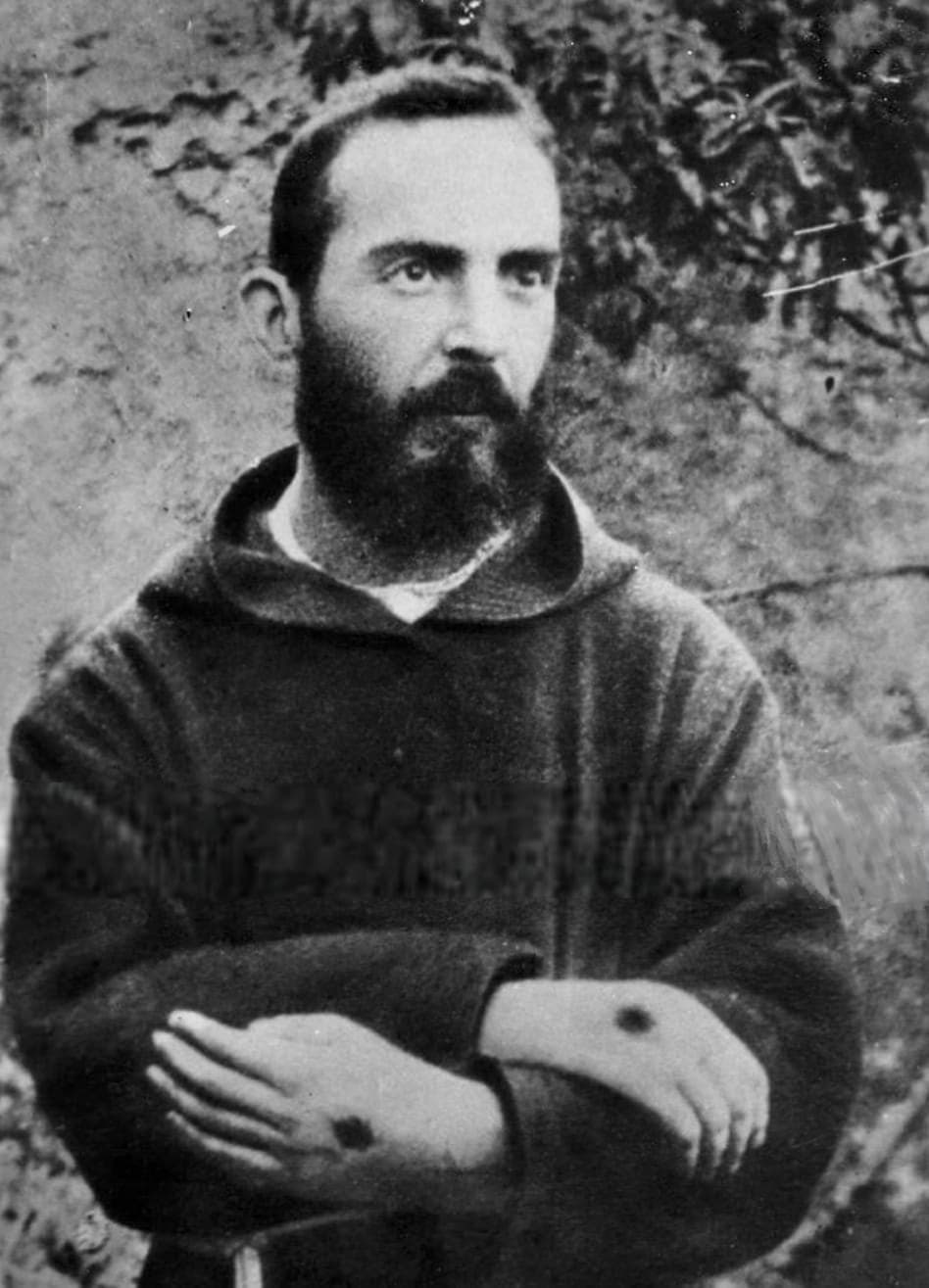
Padre Pio's Stigmata
Photo: Placido Bux (1919) · Public domain
The story
Skip to the verdict ↓On 20 September 1918, a young Capuchin friar at a monastery in the mountains of southern Italy said that as he prayed after Mass, wounds opened in his hands, his feet, and his side. Francesco Forgione was thirty-one. He would carry those wounds — and the crowds they drew — for the next fifty years, while the Church sent one doctor after another to press on them and decide what they were.
The friar was Padre Pio — born Francesco Forgione (1887–1968) — and the monastery was San Giovanni Rotondo. The wounds, the stigmata, stayed open and bleeding on both palms, both feet, and his left side for the next half-century. Millions came to him as a living sign of the Passion. The Holy Office placed him under restrictions for years and had the wounds examined more than once, by doctors of very different temperaments.
What the examiners reported
Luigi Romanelli, chief physician of the city hospital at Barletta, saw him repeatedly over roughly a year in 1919–1920. Pressing on the palm and the back of the hand, he reported that he could feel a gap between the two. He called the lesions impossible to fit into any ordinary clinical category.
Giorgio Festa, a surgeon sympathetic to Padre Pio, examined him in 1920 and again before his 1925 report to the Holy Office. He concluded the wounds were not made by any irritant or external injury he could identify. He also described the skin at the edges of the lesions as perfectly normal, with no swelling, no inflammation, no sign of a wound being forced open.
Amico Bignami, a pathologist who came as a skeptic, examined him in 1919. He judged the wounds shallow, not deep, and proposed they were unconsciously self-inflicted and kept from healing by tincture of iodine. To test the idea, he had the wounds bandaged and the bandages sealed for several days, on the theory that if no one could reach them and nothing was applied, they would close. Devotional accounts say the wounds went on bleeding through the seal. No independent, contemporaneous record of the seal being checked survives in the accessible literature, and Bignami's own conclusion remained a natural one.
Within the first eighteen months, three doctors looking at the same hands produced three first-hand readings: deep, normal-edged, and shallow-and-self-maintained.
The carbolic acid
The historian Sergio Luzzatto, working in Vatican records, published in 2010 the testimony of a pharmacist, Maria De Vito, who stated that in 1919 the young friar bought four grams of carbolic acid from her without a prescription and asked her to keep the purchase quiet. Carbolic acid (phenol) burns skin and can keep a lesion raw. Padre Pio's explanation was that he needed it to sterilize syringes during the influenza epidemic. The testimony was not new in 2010: Archbishop Gagliardi of Manfredonia had handed it to Rome decades earlier as proof that Padre Pio wounded himself, and Rome had dismissed it. What Luzzatto added was the documentary chain, recovered from the file rather than from rumor.
A second Church examiner, Agostino Gemelli — a physician and psychologist, and the founder of the Catholic University of Milan — judged Padre Pio a hysteric whose wounds were self-induced and, he suspected, maintained with caustic substances. Gemelli was sent in an official capacity.
What was never done
The claim of a wound running through the hand was never put to an independent physical check while the question was live. The only X-rays of Padre Pio, taken by Alberto Caserta in 1954, were read for the bones and found them normal; they were never positioned to show whether a channel passed through the soft tissue. There is no through-penetration record at all.
Canonization
Padre Pio was canonized by John Paul II in 2002. The two miracles accepted for his beatification and canonization were unrelated healings attributed to his intercession — an Italian woman, Consiglia De Martino, and a boy, Matteo Pio Colella, who recovered from a coma. Neither concerned the stigmata. The Church declared him a saint on the strength of intercession claims and a life of charity, and left the medical nature of the wounds formally unjudged.
It happened — and nature accounts for it.
Reviewer Notes
Miracles Jar weighs each claim two ways — how extraordinary it would be, and how strong the evidence is.
Assessed by Miracles Jar AI
Medically unresolved. A specific, archive-grounded chemical-fraud hypothesis sits unrefuted alongside examiner reports that found no natural cause — and the wounds were never imaged or sealed under independent control while the question was open.
Medically unresolved. The doctors who examined Padre Pio never agreed — and the differences between their findings are the whole story.
Agostino Gemelli, who examined Pio in 1920, concluded the wounds were self-induced. He was not an outside critic sniping from a distance; he was a respected physician and a Franciscan, which is part of why his verdict carried weight against the friar inside the Church itself. Giorgio Festa and Luigi Romanelli reached the opposite conclusion, with Romanelli's account — reporting that the hand wound passed clean through — standing as the strongest first-hand observation on the case. That finding became the basis for the enduring claim that the wound went fully through the palm.
The most concrete case for a natural origin came later, from the archive: Padre Pio's confessor, Padre Benedetto, purchased carbolic acid, and Pio acknowledged using it on wounds — ostensibly as a disinfectant, a plausible use in itself. Gemelli and the Vatican investigators who relied on his work treated this as supporting their conclusion. Romanelli's gap finding sits awkwardly beside it.
The test that was never performed is the most striking gap. No examiner took a radiograph, measured tissue resistance, or produced any documentation that could be checked by the next investigator. What was never done tells as much as what was: the entire case rests on what individual doctors said they felt rather than on anything that could be verified twice.
Canonization in 2002 is a separate matter. Sainthood is not a verdict on the lesions, and the Church did not treat it as one.
The natural-maintenance account — carbolic acid, self-application — is live and partly documented, but was never demonstrated under controlled conditions and was never ruled out. The anomaly Romanelli reported was never tested by imaging. The documentation, read closely, is precisely what keeps the natural explanation alive rather than closing it out.
Evidence ledger — what the verdict rests on
Examiners who saw the wounds in 1919–1920 could not even agree on their depth: Romanelli reported feeling a gap through the hand, while Bignami judged them shallow and Festa found the surrounding skin normal.
The disagreement itself is the finding — the examiners were not neutral observers, and the deep-penetration claim that defenders rely on was contested by another examiner at the time.
Pharmacist Maria De Vito testified to the Vatican that Padre Pio bought carbolic acid in 1919 with no prescription and asked her to keep it secret; carbolic acid can produce persistent skin lesions.
Submitted to Rome by Archbishop Gagliardi and dismissed at the time; Sergio Luzzatto recovered it from the archive in 2010. Padre Pio said the acid was to sterilize syringes.
The wounds were never imaged while the question was open. The only X-rays, taken by Alberto Caserta in 1954, looked at bone and found it normal — they were never positioned to test whether a wound passed through the hand.
The central authenticity claim — a through-and-through channel — was never put to an independent physical test in his lifetime.
Bignami had the bandages sealed for several days to see whether the wounds would heal once untouched. Devotional accounts say they kept bleeding; no independent contemporaneous record of the seal check survives, and Bignami's own report still concluded a natural cause.
Both sides cite this test for opposite conclusions, which is why it settles nothing on the accessible record.
The two miracles accepted for the 2002 canonization were unrelated healings — Consiglia De Martino and the boy Matteo Pio Colella — not the stigmata. The Church never certified the wounds themselves as supernatural.
Canonization rested on intercession claims, leaving the medical status of the stigmata formally open — the Vatican's own hedge.
What would raise the meter: Adversarial scrutiny with real power to expose deception — hostile investigators, controlled conditions — coming back clean would raise the evidence bar.
What would lower it: A confession, an exposed method, or a documented financial motive would drive the evidence bar toward zero.
How we weigh every claim — the full method, deductions and all →
The natural explanation
The leading natural account for this case is deception: hoaxes, cold reading & stagecraft. Read what it explains — and where it stops.
Sources
Tagged by proximity to the event. Primary sources are direct or contemporaneous; tertiary are downstream retellings.
- 1.Primaryinvestigation
Luigi Romanelli, "Medical examinations by Dr. Luigi Romanelli (1919–1920)", 1920· no public link
Chief physician of the Barletta city hospital; examined repeatedly over about a year, reported feeling a gap through the hand and called the lesions clinically unclassifiable
- 2.Primaryinvestigation
Giorgio Festa, "Report to the Holy Office on the lesions of Padre Pio", 1925· no public link
Examined in 1920 and 1925; found the skin at the wound edges normal, with no penetration, swelling, or redness
- 3.Secondarybook
Sergio Luzzatto, "Padre Pio: Miracles and Politics in a Secular Age", 2010· no public link
Documents the Vatican-archive testimony of pharmacist Maria De Vito: Padre Pio bought four grams of carbolic acid in 1919 with no prescription and asked her to keep it secret. Submitted to Rome by Archbishop Gagliardi as proof of fraud; dismissed at the time.
- 4.Tertiaryother
"Padre Pio (medical examinations summary)", Wikipedia· no public link
Cites the Bignami autosuggestion/iodine report (1919), Gemelli's self-induced/carbolic-acid conclusion, the 1954 Caserta X-rays of the bone, and the two 2002 canonization healings (Consiglia De Martino, Matteo Pio Colella)
Cases like this
Nearest on the map — similar in how miraculous they’d be, and how strong the evidence is.