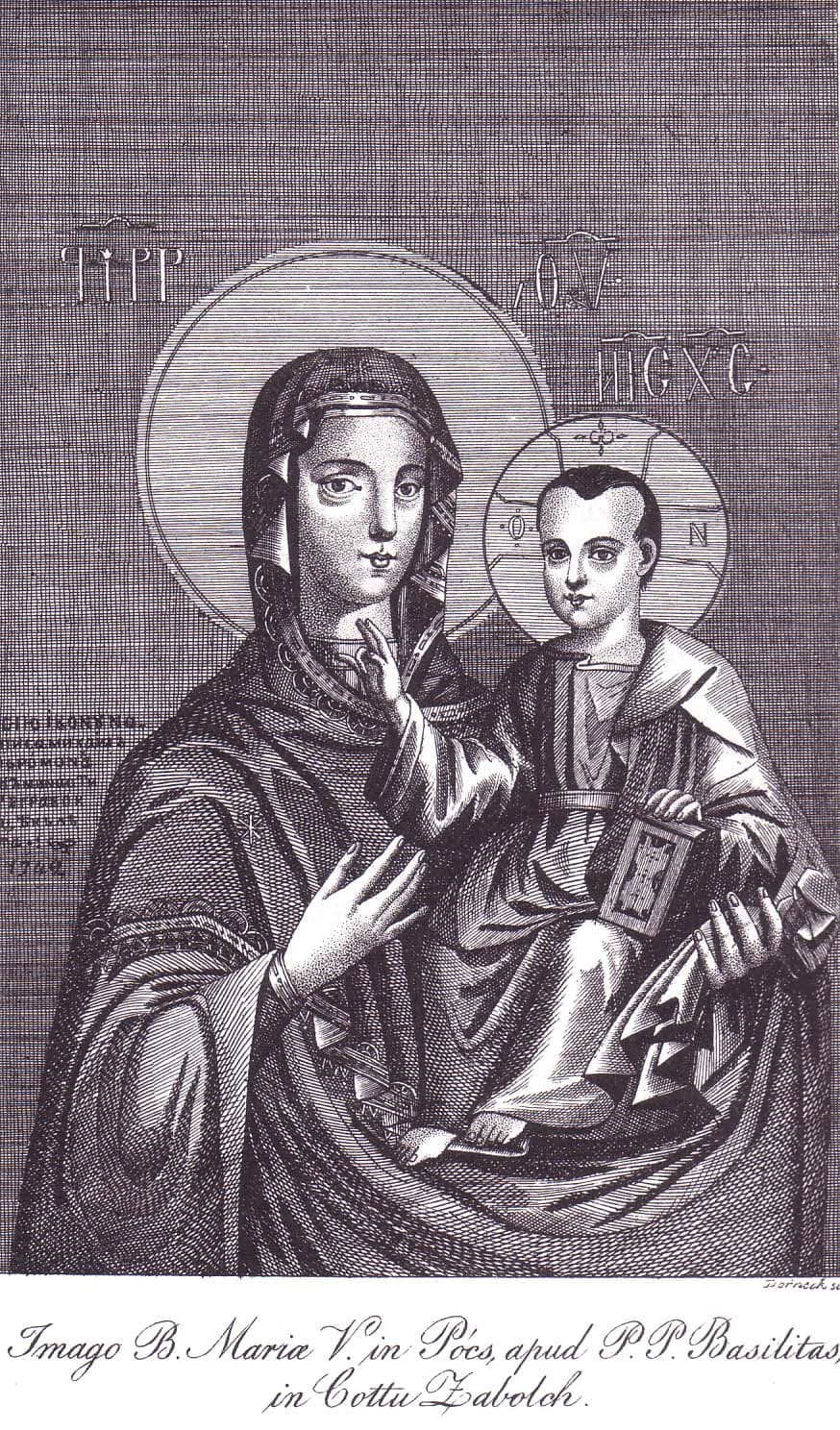
The Máriapócs Weeping Icon
Photo: Elek Jordánszky (1836 engraving) / Wikimedia Commons · Public domain
The story
Skip to the verdict ↓A Byzantine Greek Catholic icon of the Virgin Mary in Máriapócs, Hungary wept visibly for eleven days in November–December 1696, witnessed by large crowds and authenticated by a mixed committee of Catholic, Protestant, and Jewish investigators; it wept again in 1715 and 1905.
In November 1696, a wooden Byzantine icon of the Virgin Mary in the village of Máriapócs began to weep during the Divine Liturgy. The tears were first noticed on November 4, following the consecration of the Holy Gifts, and continued for eleven days until December 8, 1696.
Setting
Hungary was under Ottoman occupation and Hapsburg rule simultaneously; the population was experiencing famine and epidemic disease. The icon had been commissioned by a man freed from Turkish captivity. The tears appeared at a moment of acute communal suffering.
The Investigation
Church and secular officials assembled an investigating committee that included Protestant and Jewish members alongside Catholic clergy. The committee questioned witnesses and examined the icon, ultimately declaring the tears authentic.
Subsequent Events
Emperor Leopold I had the original icon transferred to St. Stephen's Cathedral in Vienna in 1697 as a war trophy and devotional object. A copy was painted for Máriapócs. In August 1715, this copy began to weep. A church tribunal investigated and declared it authentic. A third weeping occurred in 1905 and lasted approximately one month.
No chemical analysis of the fluid was conducted in 1696 or 1715.
It happened — and nature accounts for it.
Reviewer Notes
Miracles Jar weighs each claim two ways — how extraordinary it would be, and how strong the evidence is.
Assessed by Miracles Jar AI
Religiously mixed investigative committee and eleven-day public duration are genuine evidential strengths; absence of chemical analysis is the key weakness.
The case is genuinely uncertain — stronger than most weeping-icon claims, but not a strong case overall.
The investigating committee for the 1696 event included Protestant and Jewish members alongside Catholics — a religiously mixed body with no shared institutional incentive to authenticate a Marian miracle. This is the most distinctive evidential feature of the Máriapócs case. The weeping lasted eleven days and was witnessed publicly by large crowds in Máriapócs, not in a closed religious setting, which reduces the likelihood of small-scale fabrication. A copy of the icon (not the original), sent by Emperor Leopold I, wept in 1715 and was separately authenticated — the phenomenon repeated on a different physical object; recurrence on a distinct object is notable, though the same natural mechanisms would apply to any aged painted wooden icon.
No chemical or biological analysis of the fluid was conducted in 1696 or 1715; the authentication was based on witness testimony and theological assessment alone. Natural explanations — capillary action in cracked paint layers, oil migration from venerating hands, condensation from temperature differentials — were not tested. These mechanisms remain plausible. The absence of chemical testing means neither confirming nor ruling them out is possible from the historical record.
The icon had already been famous for generating cures, creating a community context with strong motivated belief. The tears appeared at a moment of acute communal suffering, which shaped how the event was received.
A Byzantine Greek Catholic icon of the Virgin Mary in Máriapócs, Hungary wept visibly for eleven days in November–December 1696, and wept again in 1715 and 1905.
Evidence ledger — what the verdict rests on
The investigating committee included Protestant and Jewish members — religious minorities with no institutional interest in authenticating a Catholic Marian miracle.
This is the most unusual and significant feature of the Máriapócs case relative to other weeping icon cases
The weeping lasted eleven days and was witnessed publicly by large crowds in Máriapócs, not in a closed religious setting.
Public and extended duration reduces the probability of small-scale fabrication
No chemical or biological analysis of the fluid was conducted; the authentication was based on witness testimony and theological assessment alone.
17th-century investigation methodology could not test for natural causes like capillary action or oil migration through paint layers
A copy of the icon (not the original) sent by Emperor Leopold I wept in 1715 and was separately authenticated — the phenomenon repeated on a different physical object.
Recurrence on a distinct object is notable, though the same natural mechanisms would apply to any aged painted wooden icon
What would raise the meter: Instrumented or physical evidence — measurements, samples, footage that survives analysis — would raise this.
What would lower it: A controlled observation reproducing the experience naturally (lighting, suggestion, pareidolia) would move it down.
How we weigh every claim — the full method, deductions and all →
The natural explanation
The leading natural account for this case is misperception: how honest witnesses get it wrong. Read what it explains — and where it stops.
The same wonder, across traditions
This claim is one of many that make the same assertion across faiths. See it side by side in Images That Weep, Bleed, and Stir.
Sources
Tagged by proximity to the event. Primary sources are direct or contemporaneous; tertiary are downstream retellings.
- 1.Secondaryother
"Hungary's Weeping Icon of Máriapócs", 2008· no public link
CNEWA ONE Magazine; describes the investigation committee composition and the 1696 and 1715 events
- 2.Tertiarychurch document
"Our Lady Máriapócs, the Weeping Icon", 2021· no public link
FSSPX News; historical narrative of three weeping events and Church authentication
- 3.Secondaryother
"The Weeping Icon of Marijapovch: On the 300th Anniversary of the First Miraculous Weeping", 1996· no public link
Carpatho-Rusyn Research Center; historical contextualisation of the 1696 event within Ottoman-era Hungary
Cases like this
Nearest on the map — similar in how miraculous they’d be, and how strong the evidence is.