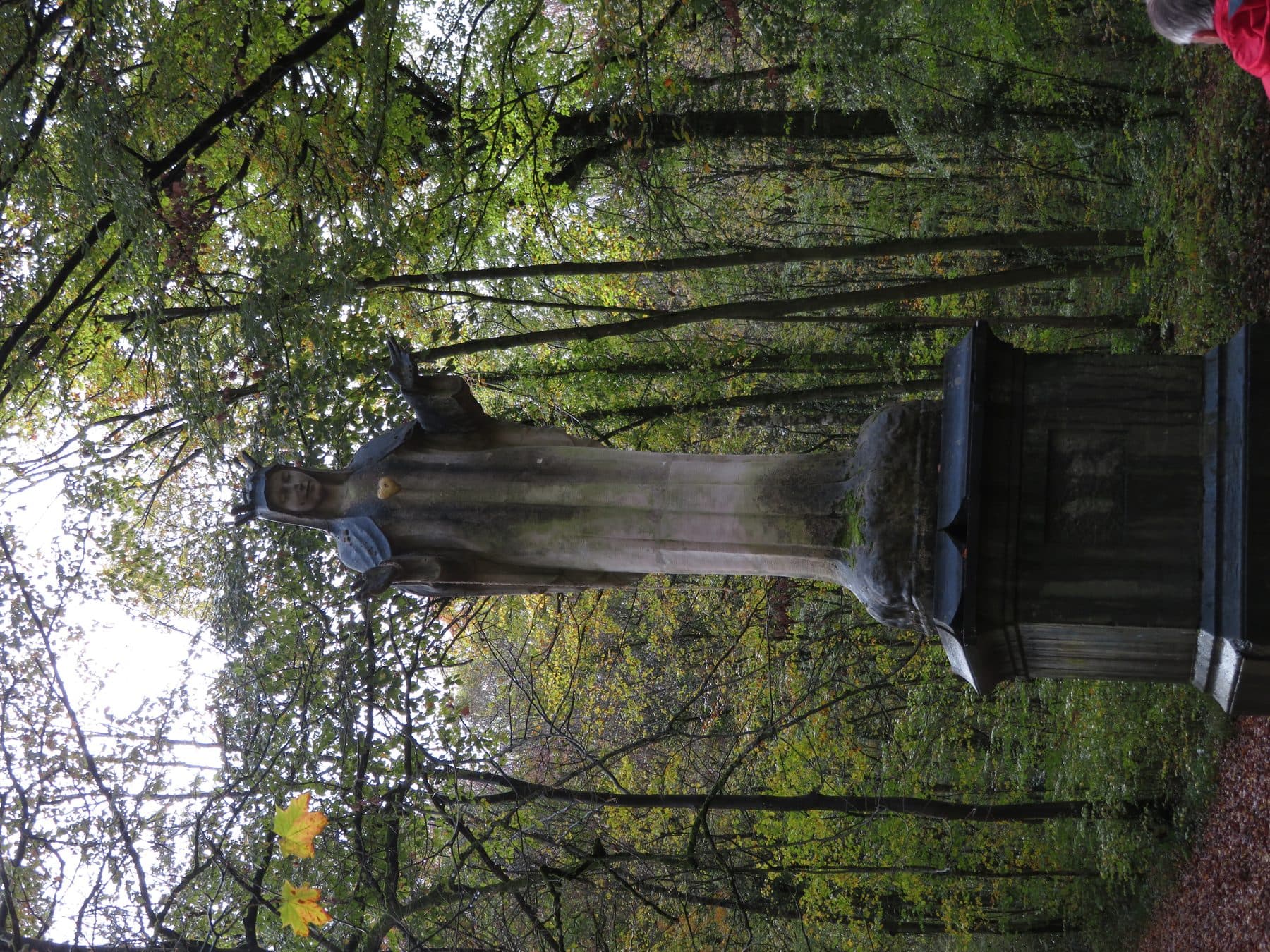
Our Lady of Beauraing (The Golden Heart)
Photo: Donarreiskoffer / Wikimedia Commons · CC BY-SA 4.0
The story
Skip to the verdict ↓Between November 1932 and January 1933, five Belgian children reported 33 apparitions of the Virgin Mary appearing above a hawthorn tree near a convent school in Beauraing, Belgium.
On November 29, 1932, four children walking to meet Gilberte Voisin at the Sisters of Christian Doctrine school in Beauraing, Belgium, reported seeing a luminous figure above the school's iron bridge and garden hawthorn tree. From that date through January 3, 1933, five children — Fernande (15), Gilberte (13), and Albert (11) Voisin, along with Andrée (14) and Gilberte (9) Degeimbre — reported 33 apparitions. The figure identified herself as the 'Immaculate Virgin' and later revealed a 'Heart of Gold.'
The Ecstasies
During the apparitions, witnesses reported the children fell into simultaneous ecstasy, with eyes fixed skyward and no response to external stimuli. On December 23, Dr. Lurquin examined three of the children during an ecstasy and reportedly confirmed insensitivity to pain, fixed gaze, and normal vital signs. This examination was limited in documentation.
Church Investigation
Bishop Thomas-Louis Heylen of Namur established an Episcopal Commission in 1935. After his death, his successor André-Marie Charue continued the work and in December 1942 received Vatican permission to proceed to canonical recognition. In February 1943 he authorized public devotion; in July 1949 the final approbation was granted.
Setting
Belgium in 1932 was in economic depression, Advent religious observance was at its peak, and the children were affiliated with a school run by sisters dedicated to Marian devotion.
It happened — and nature accounts for it.
Reviewer Notes
Miracles Jar weighs each claim two ways — how extraordinary it would be, and how strong the evidence is.
Assessed by Miracles Jar AI
Multi-child, two-family consistency is noteworthy; cultural priming and absence of physical evidence limit confidence.
Verdict: multi-child, two-family consistency is noteworthy, but cultural priming and the absence of physical evidence limit confidence. On balance we lean natural: the case is interesting but well short of compelling.
Beauraing has reasonable evidentiary features. Five children from two separate families gave mutually consistent accounts across 33 apparitions over 35 days, with no apparent motive for collective fabrication. Cross-family consistency is better than single-family testimony, and 35-day consistency is harder to maintain if fabricated. The medical examinations during the final apparition reportedly found the children unresponsive to pain stimuli while in ecstasy, with eye movements fixed and pupils not responding normally; if accurate, this suggests a genuine altered state of consciousness, though the examination conditions and methodology are not fully documented. Dr. Lurquin's December 23 examination of three children was the most significant physical observation made of them, while limited in documentation. Church approval came in stages — 1943 local, 1949 final — after an eight-year episcopal commission, and that eight-year investigation process reflects the Church's own caution.
Against this: all five witnesses were children (ages 9–15) at a convent school with strong Marian devotional culture, immersed in that culture during Advent — a maximally primed context for shared religious visions. Cultural priming creates expectation, and children are more susceptible to shared imaginative experiences than adults; this is a strong factor on the natural side. The apparition context — looking through school gates at a religious institution during Advent — is highly culturally primed. Social contagion of religious experience is well-documented in psychology and does not require dishonesty; the children may have genuinely experienced something that reflection and mutual reinforcement elaborated into the detailed apparition narrative.
No physical trace, verified miraculous cure, or independently documentable phenomenon is associated with Beauraing. Unlike Lourdes, no formal medical review of healing claims exists, and the absence of any physical evidence or independently verified miracle is the major limiting factor.
Evidence ledger — what the verdict rests on
Five children from two separate families gave mutually consistent accounts across 33 apparitions over 35 days with no apparent motive for collective fabrication
Cross-family consistency is better than single-family testimony; 35-day consistency harder to maintain if fabricated
Medical examinations during the final apparition reportedly found children unresponsive to pain stimuli while in ecstasy, with eye movements fixed and pupils not responding normally
If accurate, suggests genuine altered state of consciousness; examination conditions and methodology not fully documented
All five witnesses were children (ages 9–15) immersed in Marian devotional culture at a convent school during Advent — a maximally primed context for shared religious visions
Cultural priming creates expectation; children are more susceptible to shared imaginative experiences than adults
No physical trace, verified miraculous cure, or independently documentable phenomenon is associated with Beauraing
Unlike Lourdes, no formal medical review of healing claims exists
What would raise the meter: Instrumented or physical evidence — measurements, samples, footage that survives analysis — would raise this.
What would lower it: A controlled observation reproducing the experience naturally (lighting, suggestion, pareidolia) would move it down.
How we weigh every claim — the full method, deductions and all →
The natural explanation
The leading natural account for this case is misperception: how honest witnesses get it wrong. Read what it explains — and where it stops.
The same wonder, across traditions
This claim is one of many that make the same assertion across faiths. See it side by side in When a Figure Appears.
Sources
Tagged by proximity to the event. Primary sources are direct or contemporaneous; tertiary are downstream retellings.
- 1.Primarychurch document
"Decree of Bishop André-Marie Charue authorizing public veneration", 1943· no public link
First formal Church authorization after eight-year commission; final approval followed in 1949 with Holy See permission
- 2.Tertiaryother
"Our Lady of Beauraing", 2024· no public link
Wikipedia synthesis; covers commission history and medical examination during ecstasies
- 3.Tertiarynews
"Beauraing: National Catholic Register feature", 2018· no public link
Covers the 'Golden Heart' vision and Church approval timeline; religiously sympathetic framing
Cases like this
Nearest on the map — similar in how miraculous they’d be, and how strong the evidence is.