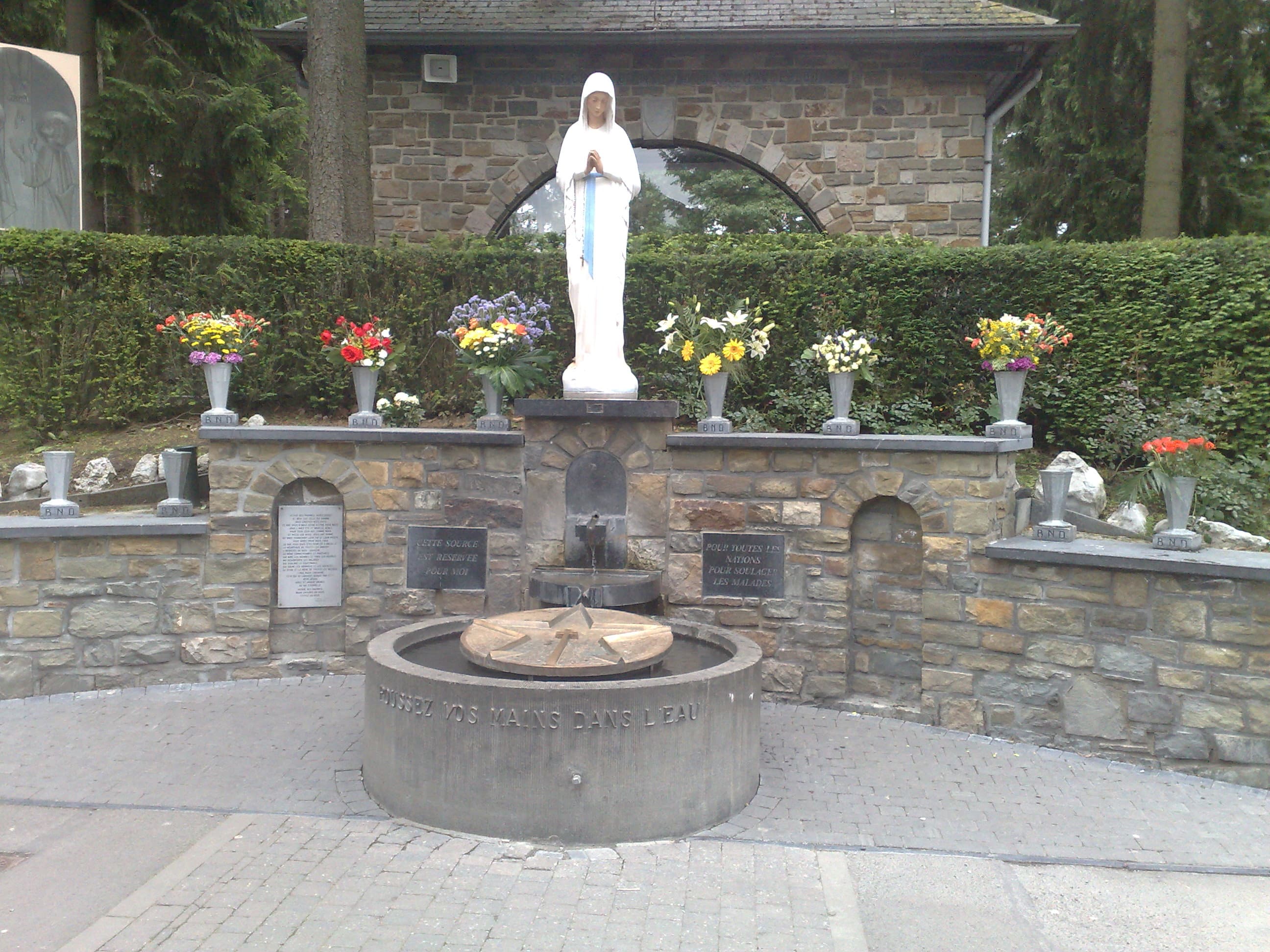
Our Lady of Banneux (Virgin of the Poor)
Photo: Johfrael / Wikimedia Commons · CC BY-SA 3.0
The story
Skip to the verdict ↓In January–March 1933, eleven-year-old Mariette Beco of Banneux, Belgium, reported eight apparitions of the Virgin Mary who identified herself as 'the Virgin of the Poor' and directed her to a spring 'for all nations.'
On January 15, 1933, eleven-year-old Mariette Beco saw a luminous woman through the window of her family's modest home in the hamlet of Banneux, in Liège Province, Belgium. She ran outside, and the figure beckoned her into the garden. Over the following seven weeks, Mariette reported seven further apparitions, during which the figure identified herself as 'the Virgin of the Poor,' instructed her to plunge her hands into a nearby stream ('reserved for all nations, to relieve the sick'), and promised to intercede for the poor and suffering. In all, she reported eight apparitions between January 15 and March 2, 1933.
The Investigation
The Diocese of Liège established an official investigation that ran from 1935 to 1937, followed by a theological commission that deliberated across 20 sessions from 1942 to 1944. The final commission report was notably candid: members debated Mariette's 'hysterical disposition,' the possibility that she had modeled the apparition on Lourdes descriptions she had read, and whether the events represented deception or sincere illusion. The committee's formal 1944 statement called the events 'neither certain nor even probable.'
Despite that conclusion, Bishop Louis-Joseph Kerkhofs approved veneration of Mary under the title 'Our Lady of the Poor' in May 1942 and approved the apparitions themselves in 1949 — largely for pastoral reasons, as Banneux had become a significant pilgrimage site.
The Holy See's Stance
The Holy See granted Kerkhofs permission to approve the apparition but did not itself grant formal approbation. Fátima and Lourdes both received direct Vatican recognition; Banneux did not.
Legacy
Banneux now receives approximately one million pilgrims annually and has established itself as an important healing shrine in the Belgian and wider European Catholic tradition. No formal medical bureau for cure verification exists on the Lourdes model. Mariette Beco married, raised a family, and made no further supernatural claims. She died in 2019 at age 97.
Too thin a record to say either way.
Reviewer Notes
Miracles Jar weighs each claim two ways — how extraordinary it would be, and how strong the evidence is.
Assessed by Miracles Jar AI
Single-child witness with explicit episcopal uncertainty; approved despite the commission's 1944 finding that the apparitions were 'neither certain nor even probable', and on documentary evidence thinner than the major approved apparitions.
Single-child witness with explicit episcopal uncertainty; approved despite the commission's 1944 finding that the apparitions were "neither certain nor even probable," and on documentary evidence thinner than the major approved apparitions.
Banneux rests on a single child witness — a known risk factor for visionary claims — and the initial episcopal commission explicitly hesitated, with some members citing Mariette's "hysterical disposition" and the possibility she had been influenced by hearing about Lourdes. The committee's own 1944 statement called the events "neither certain nor even probable." Subsequent diocesan approval came from the bishop in 1949, but the Holy See itself never formally approved the apparitions — only permitted the bishop to do so. The spring has become a healing pilgrimage site, but without a Lourdes-type medical bureau process. The sole visionary reportedly had no further supernatural experiences and led a normal adult life.
On the key evidence points: Mariette's consistent account through investigation and her unremarkable, credible adult life without seeking further supernatural attention or personal gain is a reasonable character indicator — similar to Bernadette Soubirous in this respect. The investigating body's own 1944 conclusion that the events were "neither certain nor even probable," before the bishop overrode it for pastoral reasons, is the most significant piece of counter-evidence in this case. Mariette was a single child witness with known familiarity with Lourdes devotion, and some commission members cited possible suggestibility from Lourdes-inspired literature — not conclusive, but a plausible psychological priming narrative. The distinction between Vatican permission and formal approbation reflects continuing Vatican-level uncertainty about the evidential basis; the lower level of endorsement relative to Fatima, Lourdes, or Knock is theologically significant within Catholicism.
Evidence ledger — what the verdict rests on
Mariette Beco maintained her account consistently through investigation and lived an unremarkable, credible adult life without seeking further supernatural attention or personal gain
Life conduct post-apparition is a reasonable character indicator; similar to Bernadette Soubirous in this respect
The episcopal commission's own 1944 report explicitly concluded events appeared 'neither certain nor even probable' before the bishop overrode this conclusion for pastoral reasons
The investigating body's own uncertainty is the most significant piece of counter-evidence in this case
Mariette was a single child witness with known familiarity with Lourdes devotion; some commission members cited possible suggestibility from Lourdes-inspired literature
Not conclusive, but a single adolescent witness reading about similar apparitions creates a plausible psychological priming narrative
The Holy See permitted diocesan approval but never granted its own formal approbation — a lower level of Vatican endorsement than Fatima, Lourdes, or Knock received
The distinction between Vatican permission and Vatican approval is theologically significant within Catholicism
What would raise the meter: Instrumented or physical evidence — measurements, samples, footage that survives analysis — would raise this.
What would lower it: A controlled observation reproducing the experience naturally (lighting, suggestion, pareidolia) would move it down.
How we weigh every claim — the full method, deductions and all →
The natural explanation
The leading natural account for this case is misperception: how honest witnesses get it wrong. Read what it explains — and where it stops.
The same wonder, across traditions
This claim is one of many that make the same assertion across faiths. See it side by side in When a Figure Appears.
Sources
Tagged by proximity to the event. Primary sources are direct or contemporaneous; tertiary are downstream retellings.
- 1.Primarychurch document
"Episcopal Commission Report, Diocese of Liège", 1944· no public link
Commission explicitly stated events appeared 'neither certain nor even probable' — unusually candid episcopal caution before final approval
- 2.Tertiaryother
"Our Lady of Banneux", 2024· no public link
Wikipedia article covering apparition history, commission deliberations, and Bishop Kerkhofs's 1942 and 1949 approvals
- 3.Secondaryinvestigation
"The Apparitions of Banneux, January 1933", 2020· no public link
Theotokos Books article covering historical record and commission hesitations
Cases like this
Nearest on the map — similar in how miraculous they’d be, and how strong the evidence is.