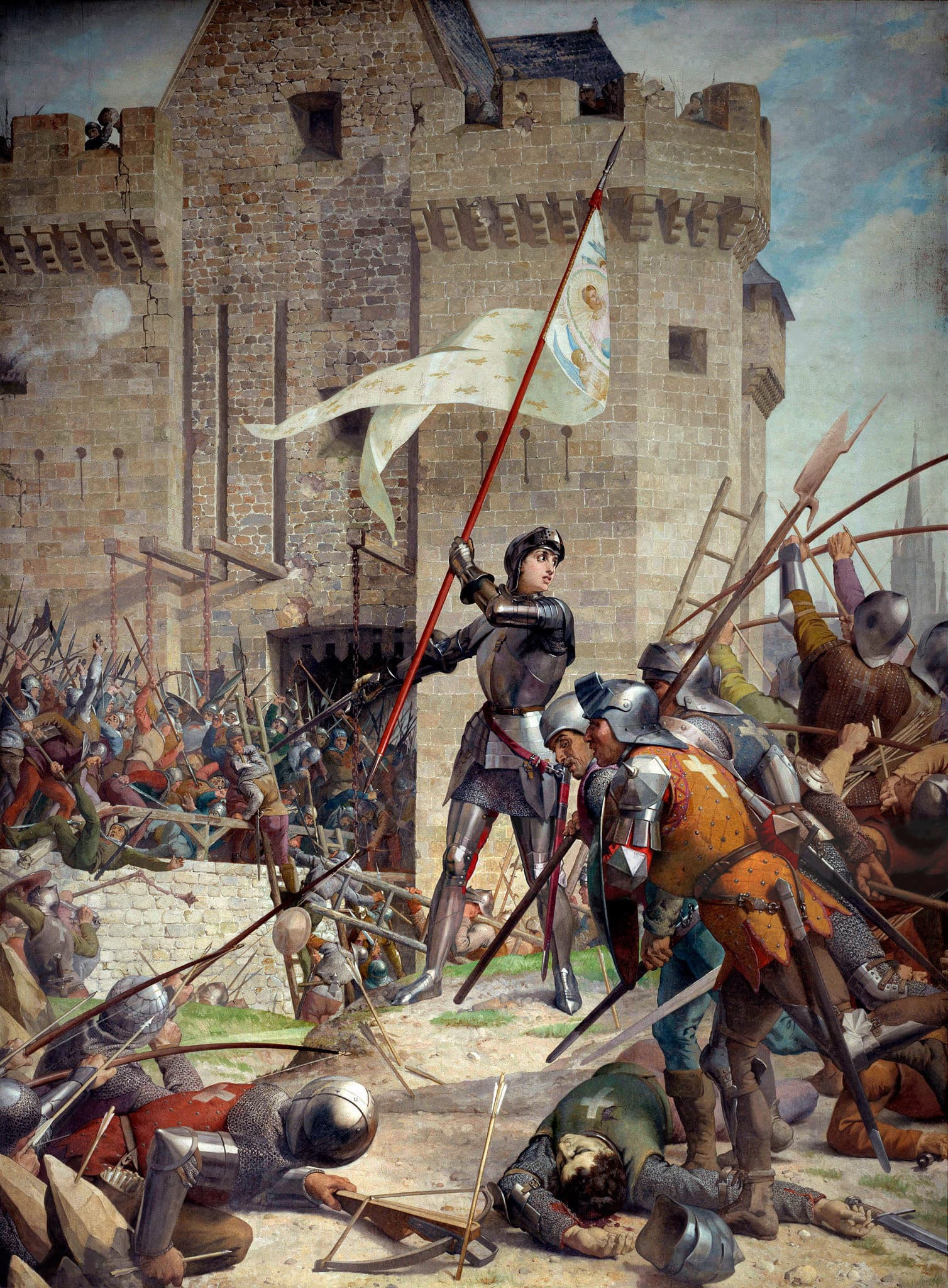
Joan of Arc 'Relics' — Confirmed 20th-Century Forgery
Photo: Eugène Lenepveu · Public domain
The story
Skip to the verdict ↓In 1867 a glass jar appeared at a pharmacy in Chinon, France, labelled in a careful hand: 'Remains found under the pyre of Joan of Arc, maiden of Orléans.' Inside lay a blackened rib, what looked like charred flesh, and a scatter of fragments. For a hundred and forty years they were venerated and displayed as relics of the martyr burned at Rouen — until, in 2007, a forensic team laid them out under the lights.
Treated as genuine relics, the contents of the bottle — the rib, the charred matter, the fragments — attracted wide devotional attention, eventually reaching museum display.
The team of 2007 was assembled by Philippe Charlier — multidisciplinary, including medical examiners, pathologists, geneticists, biochemists, a radiologist, a zoologist, and an archaeologist. The study was published in Forensic Science International in 2010. Techniques included DNA analysis, multiple forms of microscopy, chemical spectrometry, atomic-emission analysis, carbon dating, pollen analysis, and odor profiling by perfume industry experts.
Carbon dating placed the remains in the 6th–3rd century BC — roughly 1,800 to 2,400 years before Joan's death in 1431. The zoologist identified one bone as a mummified cat leg. The chemical analysis of the black coating revealed bitumen, wood resins, gypsum, and pine pollen — signature compounds of ancient Egyptian embalming. The researchers concluded the items were "mummia": fragments of Egyptian mummies that circulated in medieval Europe as pharmaceutical ingredients.
Joan of Arc was burned at the stake, and her executioners reportedly threw the ashes into the Seine to prevent relic collection.
Would be extraordinary if real — but it has been positively shown false.
Reviewer Notes
Miracles Jar weighs each claim two ways — how extraordinary it would be, and how strong the evidence is.
Assessed by Miracles Jar AI
Not “low evidence” — positive proof it’s false: positive evidence shows the claimed facts are false.
Scientifically debunked forgery. Contains mummified cat bone and Egyptian mummy human rib. Not Joan of Arc.
The verdict: Scientifically debunked forgery. The items contain a mummified cat bone and an Egyptian mummy human rib. They are not the remains of Joan of Arc.
This is not an incorruptibility case but a confirmed relic forgery, included as an instructive example of how relic claims can be fully debunked. The multidisciplinary team published results in Forensic Science International: carbon dating placed the remains in the 6th–3rd century BC; zoological analysis identified cat bone; chemical analysis of the black coating matched Egyptian embalming compounds (bitumen, wood resins, gypsum). The researchers concluded the items were "mummia" — Egyptian mummy components used as medieval pharmaceuticals. Joan of Arc was burned at the stake; no charred remains were preserved.
Carbon dating places the remains in the 6th–3rd century BC — pre-dating Joan by 1,700+ years. Radiometric dating is reliable for this timeframe and conclusively rules out a 15th-century origin. Zoological analysis identified the bone as a mummified cat leg, not human — species identification is definitive; a cat bone is not a charred human remain. The chemical coating matched Egyptian embalming compounds: bitumen, wood resins, gypsum, pine resin — signatures of Egyptian mummification, consistent with "mummia" medieval pharmaceutical use. Joan of Arc was burned at the stake; executioners reportedly threw the ashes into the Seine, making survival of any genuine remains highly implausible.
The case shows what rigorous forensic analysis can accomplish with claimed relics, and how the absence of such analysis in most cases leaves the supernatural hypothesis neither confirmed nor truly ruled out. Joan is not an incorruptibility case — she was burned at the stake and the ashes were reportedly thrown into the Seine — so no genuine remains were expected to survive in the first place.
Evidence ledger — what the verdict rests on
Carbon dating places remains in 6th–3rd century BC — pre-dating Joan by 1,700+ years
Radiometric dating is reliable for this timeframe; conclusively rules out 15th-century origin
Zoological analysis identified the bone as a mummified cat leg, not human
Species identification is definitive; cat bone is not a charred human remain
Chemical coating matched Egyptian embalming compounds: bitumen, wood resins, gypsum, pine resin
Compounds are signatures of Egyptian mummification; consistent with 'mummia' medieval pharmaceutical use
Joan of Arc was burned at the stake — executioners reportedly threw ashes into the Seine
Historical record makes survival of any genuine remains highly implausible
What would raise the meter: Adversarial scrutiny with real power to expose deception — hostile investigators, controlled conditions — coming back clean would raise the evidence bar.
What would lower it: A confession, an exposed method, or a documented financial motive would drive the evidence bar toward zero.
How we weigh every claim — the full method, deductions and all →
The natural explanation
The leading natural account for this case is deception: hoaxes, cold reading & stagecraft. Read what it explains — and where it stops.
Sources
Tagged by proximity to the event. Primary sources are direct or contemporaneous; tertiary are downstream retellings.
- 1.Primaryacademic
Charlier, Philippe et al., "The 'relics of Joan of Arc': A forensic multidisciplinary analysis (Forensic Science International, 2010)", 2010· no public link
Peer-reviewed forensic analysis; DNA, carbon dating, spectrometry, zoology, pollen analysis
- 2.Secondaryacademic
"Joan of Arc's relics exposed as forgery (Nature News Brief)", 2007· no public link
Nature coverage of preliminary findings; confirms Egyptian mummy origin
- 3.Secondarynews
"Joan of Arc 'relics' confirmed to be fake (NBC News, 2010)", 2010· no public link
Summary of final Forensic Science International findings for general audience
Cases like this
Nearest on the map — similar in how miraculous they’d be, and how strong the evidence is.