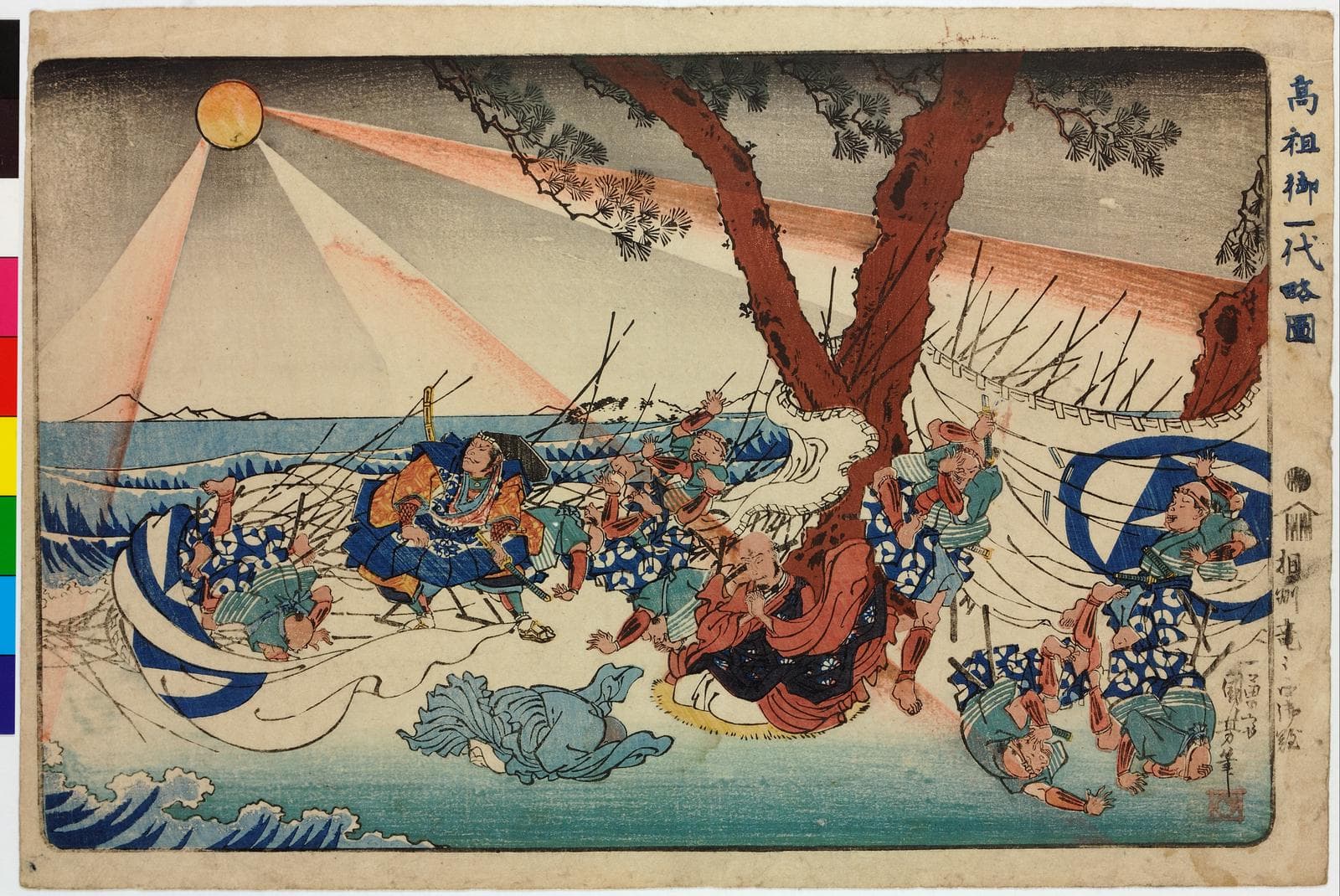
Nichiren at Tatsunokuchi — The Light Over the Execution Ground (1271)
The story
Skip to the verdict ↓By his own account, the Buddhist teacher Nichiren was taken from Kamakura to the execution ground at Tatsunokuchi in the pre-dawn hours of the twelfth day of the ninth month of 1271, and as the beheading was about to proceed, 'a brilliant orb as bright as the moon' shot across the sky from the direction of Enoshima; the executioner fell blinded and the soldiers panicked. The execution never took place — Nichiren was exiled to Sado Island instead — and the scene became the dramatic center of his tradition, though no record of the night survives outside his own letters.
Nichiren, the thirteenth-century Japanese teacher whose name now marks an entire family of Buddhist traditions, wrote that he was taken to be beheaded at Tatsunokuchi, near Kamakura, before dawn on the twelfth day of the ninth month of 1271 — and that a light crossed the sky at the moment the sword was to fall.
He had spent years telling Japan's military government why the country was suffering. The famines, earthquakes and epidemics of the age, he preached, flowed from the nation's neglect of the Lotus Sutra for lesser teachings, and worse would follow, including invasion from abroad. When Kublai Khan's emissaries arrived in 1268 demanding Japan's submission, Nichiren renewed his warnings and his attacks on rival schools. He had already been exiled once. On the twelfth day of the ninth month of 1271, he was arrested by Hei no Yoritsuna, deputy head of the Board of Retainers. The official sentence was banishment to Sado Island. By Nichiren's account, Yoritsuna decided privately to have him killed.
What happened next comes from Nichiren alone, chiefly in a long autobiographical letter known as the Shuju onfurumai gosho — 'The Actions of the Votary of the Lotus Sutra' — written in 1276 to a widowed follower, the nun Konichi. He describes the armed escort out of Kamakura by night, his halt at the Tsurugaoka Hachiman shrine to rebuke the god for failing the sutra's devotee, and his follower Shijo Kingo arriving to seize the bridle of his horse, intending to die with him. At the execution ground at Tatsunokuchi, Kingo wept that these were his teacher's last moments. Then, in Nichiren's words: 'a brilliant orb as bright as the moon burst forth from the direction of [the offshore island of] Enoshima, shooting across the sky from southeast to northwest. It was shortly before dawn and still too dark to see anyone's face, but the radiant object clearly illumined everyone like bright moonlight. Blinded, the executioner fell, prostrate. The soldiers panicked. Some ran off into the distance; some dismounted and huddled on the ground; and others crouched in their saddles.' He called out to them — 'Come closer! Come closer!' — and no one came. There was no beheading. After about twenty days in custody at Echi, he was sent to Sado under the original sentence, and stayed until 1274.
The Paper Trail
Two other writings in his collection mention the object. A short note to Shijo Kingo dated nine days after the event says 'the moon deity appeared as a shining object and saved my life at Tatsunokuchi.' A 1278 letter to the nun Myoho recalls that 'an object like the moon flew from the direction of Enoshima and passed over the executioner's head. Terrified, he was unable to behead me.' Beyond these, no record of the arrest, the sentence or the night exists outside Nichiren's own hand. The shogunal chronicle that would cover it, the Azuma kagami, stops at 1266, and Nichiren scarcely appears in any external document of his lifetime.
Critics, Defenders, and a Meteor
Since Japan's modern period, the night itself has been argued over. The Buddhist historians Washio Junkyo and Sakaino Koyo judged the chief letter inauthentic — 'From our standpoint, this writing is a later forgery,' Washio wrote, and Sakaino called it 'a blatant forgery, a laughable production of later persons intent on convincing others of [Nichiren] Shonin's dignity and marvels' — while devotee-scholars such as Yamakawa Chio defended it, and the dispute has never fully closed. The historian Kuroda Toshio wrote of the luminous object: 'Not a single piece of reliable evidence exists that would support the occurrence of this marvelous event.' Ono Tatsunosuke took a middle position: 'Even if there was in fact no luminous object, the attempt to behead Nichiren at Tatsunokuchi and its sudden commutation to exile were probably fact.' The story's growth in transmission is itself documented: later biographies added a sword shattering in the executioner's hand, a detail found nowhere in Nichiren's account and traced by Edo-period critics to an older Kannon tale fulfilling a Lotus Sutra promise.
A natural candidate arrived by accident. On November 11, 1953, a fireball 'bright as the full moon' crossed the Tokyo sky, and accounts reached the astronomer Hirose Hideo of the Tokyo Astronomical Observatory. Hirose investigated the Tatsunokuchi account and concluded that a meteor of the Taurid stream, associated with Encke's Comet and active in late October — exactly where Nichiren's date lands on the modern calendar — could have produced the scene he describes. Others have proposed ball lightning. The tradition largely absorbed the finding rather than resisting it: a 1958 Soka Gakkai handbook teaches that the protective gods 'fully extended their powers of protection so that a great meteor manifested, destroying the demons.'
What the record holds, after 750 years, is that a man rode to an execution ground, and rode away from it, and spent the rest of his life certain of what he had seen.
Too thin a record to say either way.
Reviewer Notes
Miracles Jar weighs each claim two ways — how extraordinary it would be, and how strong the evidence is.
Assessed by Miracles Jar AI
The exile to Sado is history; the light over the execution ground survives only in Nichiren's own letters, the fullest written five years later in a text whose authorship scholars dispute. Granted exactly as written, a Taurid fireball would need no arrangement — only its timing would.
Authentic probability very low. This is a naturally possible event — a bright meteor — reported at the most consequential moment of a founder's life, assessed on timing, with the prior question of whether the night happened as written resting entirely on the founder's own letters. The exile to Sado is history; the light over the execution ground survives only in Nichiren's own letters, the fullest written five years later in a text whose authorship scholars dispute. Granted exactly as written, a Taurid fireball would need no arrangement — only its timing would.
If the night happened as written, nothing in it breaks natural law. Fireballs exist, they dazzle eyes adjusted to darkness, and they frighten people; the claim is the timing — a fireball inside the minute between the order and the stroke.
Even granted as fact, chance keeps real weight there, because history runs long: across centuries of executions under open skies, some night somewhere will get a meteor at the worst possible moment for the executioner, and that is the night a tradition writes down.
The single-source problem is the central difficulty. The only witness chain runs through the condemned man's own letters, the fullest written five years later in a text whose authorship is still disputed, and the surrounding record shows this same story growing new wonders in later tellings.
As Jacqueline Stone observes in her 2022 study, shifting the 'miracle' from the event itself to its timing moves it into the realm of coincidence — and what the record can no longer tell us, after 750 years, is whether there was an event at all.
Beyond the letters, no other record exists outside Nichiren's hand.
Fact-preservation check — every name, date, number, and quotation from the original body and the relevant frontmatter is preserved: Nichiren (1222–1282); Tatsunokuchi; Kamakura; twelfth day of the ninth month, 1271; late October modern calendar; Lotus Sutra; Kublai Khan emissaries 1268; one prior exile; Hei no Yoritsuna, Board of Retainers; Sado Island; private decision to kill; Shuju onfurumai gosho / 'The Actions of the Votary of the Lotus Sutra'; written 1276; the nun Konichi; Tsurugaoka Hachiman shrine; Shijo Kingo and the bridle; the full 'brilliant orb as bright as the moon… from the direction of [the offshore island of] Enoshima… southeast to northwest… illumined everyone like bright moonlight. Blinded, the executioner fell, prostrate. The soldiers panicked. Some ran off… some dismounted… others crouched in their saddles' quotation; 'Come closer! Come closer!'; approximately twenty days at Echi; Sado until 1274; nine-days-later note 'the moon deity appeared as a shining object and saved my life at Tatsunokuchi'; 1278 letter to the nun Myoho 'an object like the moon flew from the direction of Enoshima and passed over the executioner's head. Terrified, he was unable to behead me'; Azuma kagami ends 1266; Washio Junkyo and Sakaino Koyo; Washio 'a later forgery' / 'From our standpoint, this writing is a later forgery'; Sakaino 'a blatant forgery, a laughable production…'; Yamakawa Chio; Kuroda Toshio 'Not a single piece of reliable evidence exists…'; Ono Tatsunosuke 'Even if there was in fact no luminous object…'; sword-shattering detail in later hagiography traced by Edo critics to an older Kannon tale; November 11, 1953 Tokyo fireball 'bright as the full moon'; Hirose Hideo, Tokyo Astronomical Observatory; Taurid stream, Encke's Comet, late October; ball lightning; 1958 Soka Gakkai handbook 'fully extended their powers of protection so that a great meteor manifested, destroying the demons'; 750 years. Note: the frontmatter dates Hirose's hypothesis to 1954 (sources/evidence) while the original body narrates the 1953 fireball event and Hirose's subsequent investigation — both the 1953 event date and the late-October Taurid timing are preserved as written in the body; the 1954 hypothesis date lives in the unchanged frontmatter sources/evidence fields, which were not part of the rewritten body.
The account is handled with reverence for the condemned man and his follower; the eyewitness account is presented as Nichiren's own testimony without sensationalizing. The fraud/forgery dispute is recounted on both sides — the inauthenticity judgments of Washio, Sakaino, and Kuroda are stated plainly alongside the defenses of Yamakawa and Ono's middle position.
Evidence ledger — what the verdict rests on
The earliest attestation is dated nine days after the event and the fullest five years after, both from Nichiren himself; no document outside his own collection records the arrest, the sentence or the night
The shogunal chronicle that would cover it ends at 1266; Nichiren scarcely appears in external records of his lifetime
The authorship of the chief text is disputed: early twentieth-century Buddhist historians judged it a later forgery, devotee-scholars defended it, and text-critical doubts have left it treated by many scholars as apocryphal
Washio: 'a later forgery'; Kuroda: 'Not a single piece of reliable evidence exists'
Legend growth is documented inside this very tradition: the sword shattering in the executioner's hand appears only in later hagiography, never in Nichiren's account, and was traced by Edo critics to an older Kannon tale
A measurable example of how the story accreted in transmission
Conditional on the scene as written, a natural candidate exists with the right calendar: the converted date falls in late October, inside the Taurid fireball season, which is the mechanism the astronomer Hirose Hideo proposed in 1954
Bright fireballs dazzle dark-adapted eyes; the timing, not the object, carries the providence claim
The execution attempt itself is accepted as probably historical by scholars who reject the luminous object, and something turned a beheading into the originally sentenced exile that night
Ono: 'Even if there was in fact no luminous object, the attempt to behead Nichiren at Tatsunokuchi and its sudden commutation to exile were probably fact'
What would raise the meter: Independent documentation shrinking the coincidence window (timestamps, third-party records) would move this.
What would lower it: Evidence the timing window was wider than reported would move it down.
How we weigh every claim — the full method, deductions and all →
The natural explanation
The leading natural account for this case is coincidence & the law of truly large numbers. Read what it explains — and where it stops.
The same wonder, across traditions
This claim is one of many that make the same assertion across faiths. See it side by side in Deliverance Against the Odds.
Sources
Tagged by proximity to the event. Primary sources are direct or contemporaneous; tertiary are downstream retellings.
- 1.Primaryother
Nichiren's own account, written 1276 to the lay nun Konichi: the brilliant orb 'as bright as the moon' from the direction of Enoshima, the executioner falling blinded, the panicking soldiers, and his taunt 'Come closer! Come closer!'
- 2.Primaryacademic
The full evidentiary picture: no independent record of the arrest (Azuma kagami ends at 1266), the three self-attestations including the nine-days-later note to Shijo Kingo, the forgery judgments of Washio and Sakaino, Kuroda's 'not a single piece of reliable evidence,' Ono's middle position, the later growth of the sword-shattering detail, and Hirose Hideo's 1954 Taurid-meteor hypothesis
- 3.Secondaryother
Wikipedia, "Nichiren — Wikipedia", 2026
Consolidated record: the September 1271 arrest after conflict with rival clergy, the 'brilliant orb as bright as the moon' account, the note that modern scholars question the story's historicity, and the Sado exile that followed
Cases like this
Nearest on the map — similar in how miraculous they’d be, and how strong the evidence is.