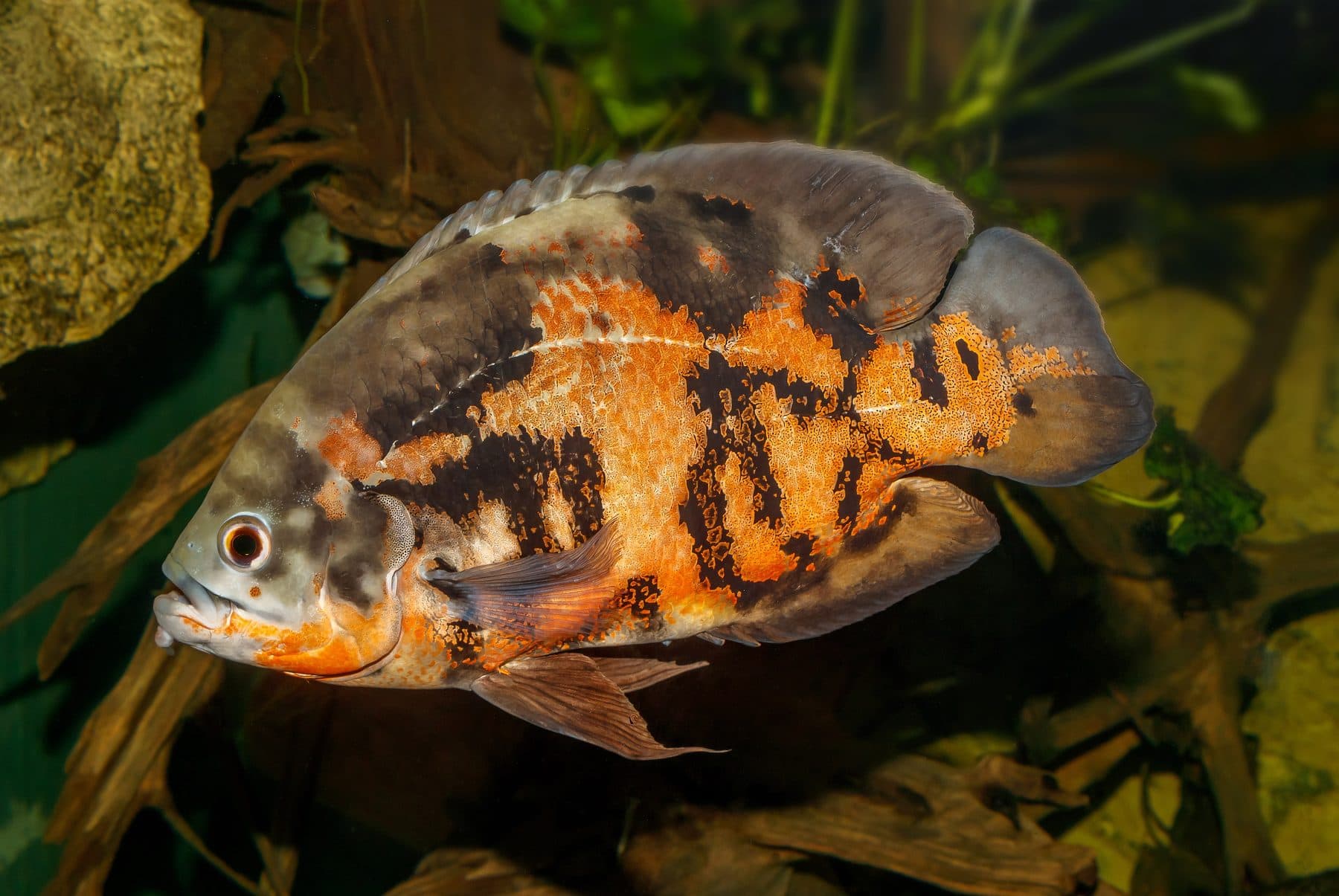
The Manchester 'Allah Fish': Arabic Writing on Animal Markings
Photo: H. Zell · CC BY-SA 3.0
The story
Skip to the verdict ↓In 2006 a pet-shop oscar fish in Greater Manchester was reported to bear the Arabic words 'Allah' and 'Muhammad' in its markings; the report drew widespread attention and was investigated by local Islamic scholars.
In spring 2006, a 23-year-old Muslim named Ali Al-Waqedi visited a pet shop in Speke, Liverpool, and noticed that an albino oscar fish appeared to bear the word 'Allah' (الله) in Arabic on its side; a second fish in the same tank seemed to show 'Muhammad.' The fish had reportedly originated from a shop near Bury, Greater Manchester. The story spread internationally, and the Liverpool mosque issued a statement calling it a divine sign. The Liverpool mosque imam stated the fish was 'a proof and a sign not just to Muslims but for everyone.'
Since the 1990s, similar claims have emerged about fish in Jakarta and Dakar, eggplants whose cross-section seeds spell 'Allah,' tomatoes whose internal chambers form a cross, cloud formations, and wood grain.
Too thin a record to say either way.
Reviewer Notes
Miracles Jar weighs each claim two ways — how extraordinary it would be, and how strong the evidence is.
Assessed by Miracles Jar AI
Pareidolia: pattern-matching of Arabic script shapes onto natural animal markings; no supernatural mechanism required.
Pareidolia — pattern-matching of Arabic script shapes onto natural animal markings; no supernatural mechanism required.
The case fits a well-documented global pattern, structurally identical to pareidolia (face-in-clouds) and apophenia. Multiple prior cases from Jakarta, Dakar, and Singapore follow the same pattern, across multiple unrelated fish of different species, suggesting a widespread perceptual bias rather than a localized miracle.
The specific pattern-recognition phenomenon is well-understood — Arabic script is a flowing, highly pattern-rich writing system with many curves and connections that can be mimicked by natural markings in fish scales, wood grain, clouds, and vegetables. Arabic calligraphy's flowing, interconnected letterforms are among the most pareidolia-susceptible scripts in regular use — more susceptible to this kind of pattern-matching than alphabetic scripts. Hoaxes.org documented the Manchester case and noted that multiple skeptical observers could not read "Muhammad" or "Rasoul Allah" in the markings, while the "Allah" reading required selective attention to specific scale patterns among many competing ones. No independent analyst confirmed a statistically unlikely resemblance.
Pareidolia — the tendency to perceive meaningful patterns in random stimuli — is a well-documented cognitive bias rooted in the brain's overactive pattern-detection systems. It operates independently of the viewer's faith and has been documented in every culture. The human visual system evolved to err on the side of detection: a predator that wasn't there is less costly than missing one that was.
These natural-object cases are typically sincere. Witnesses genuinely perceive the pattern. The question is whether the pattern is more than chance — and whether the selection effect (billions of fish, only the ones resembling script get photographed) has been accounted for. It has not.
The imam's statement that the fish was "a proof and a sign not just to Muslims but for everyone" indicates sincere religious interpretation, not hoax. Sincerity of belief is not evidence for the claim.
In 2006 a pet-shop oscar fish in Greater Manchester was reported to bear the Arabic words "Allah" and "Muhammad" in its markings, sparking international media coverage and becoming one of the most documented cases of perceived divine Arabic script in natural objects.
Evidence ledger — what the verdict rests on
Arabic calligraphy uses flowing, highly variable letterforms that are more susceptible to pareidolic pattern-matching than alphabetic scripts
Skeptical observers documented on hoaxes.org could not independently read 'Muhammad' or 'Rasoul Allah' on the same fish
Identical claims have surfaced globally (Jakarta, Dakar, Singapore) across multiple unrelated fish of different species, suggesting a widespread perceptual bias rather than a localized miracle
The Liverpool mosque imam stated the fish was 'a proof and a sign not just to Muslims but for everyone' — indicating sincere religious interpretation, not hoax
Sincerity of belief is not evidence for the claim
What would raise the meter: Instrumented or physical evidence — measurements, samples, footage that survives analysis — would raise this.
What would lower it: A controlled observation reproducing the experience naturally (lighting, suggestion, pareidolia) would move it down.
How we weigh every claim — the full method, deductions and all →
The natural explanation
The leading natural account for this case is misperception: how honest witnesses get it wrong. Read what it explains — and where it stops.
The same wonder, across traditions
This claim is one of many that make the same assertion across faiths. See it side by side in Images That Weep, Bleed, and Stir.
Sources
Tagged by proximity to the event. Primary sources are direct or contemporaneous; tertiary are downstream retellings.
- 1.Secondaryinvestigation
Museum of Hoaxes / hoaxes.org, "Fish Spells Allah and Muhammad", 2006· no public link
Documents the Manchester case and inability of skeptical observers to confirm the reading
- 2.Secondaryother
Bidoun magazine, "Sign of Allah", 2007· no public link
Cultural analysis of recurring pattern across multiple countries and objects
- 3.Secondarynews
Religion News Blog, "'Miracle fish of Allah' discovered", 2006· no public link
Contemporary news coverage including mosque imam's statement
Cases like this
Nearest on the map — similar in how miraculous they’d be, and how strong the evidence is.