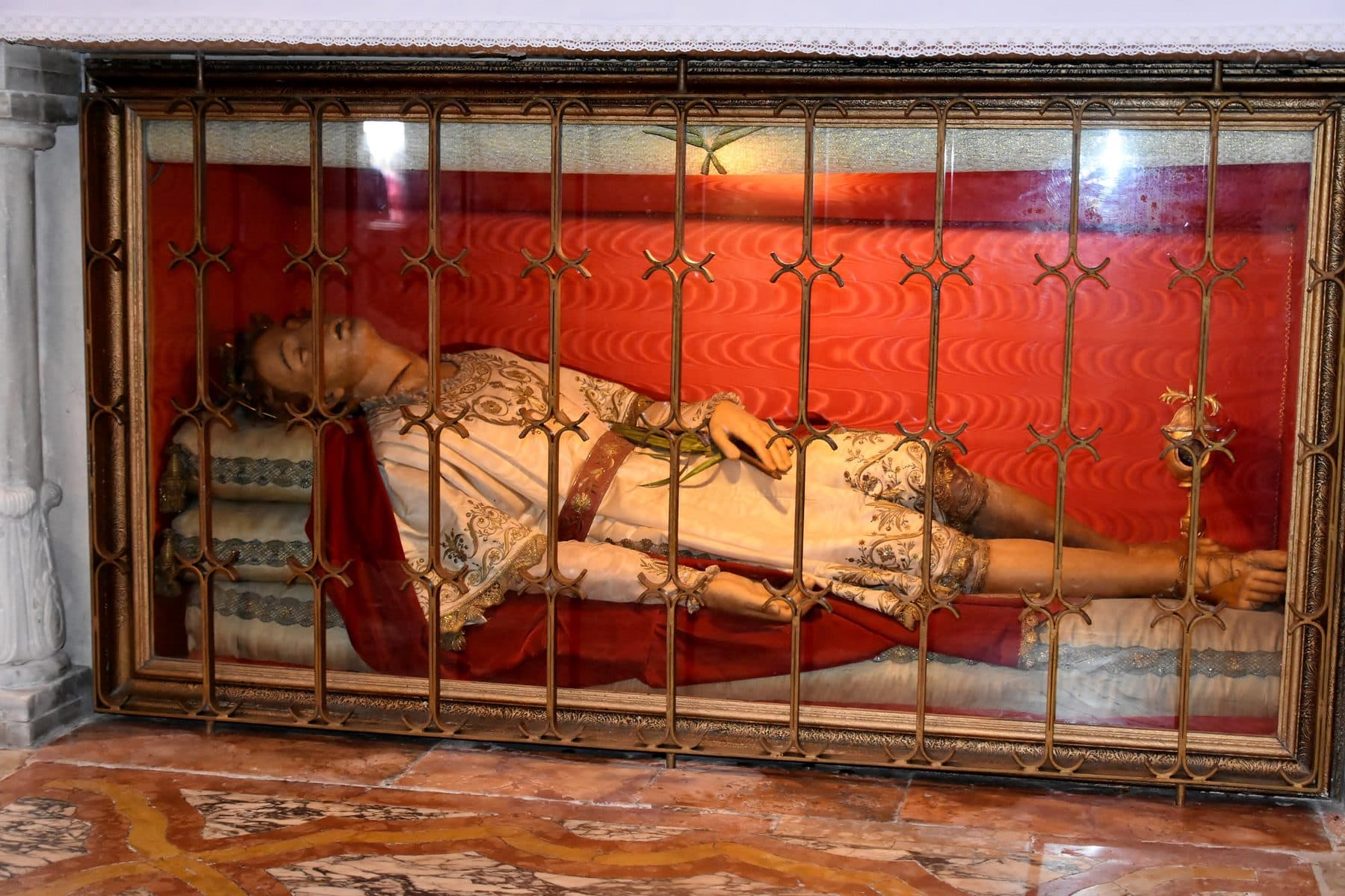
Saint Silvan — Oldest 'Incorrupt' Body Is Actually a Wax Sculpture
Photo: Richard Mortel from Riyadh, Saudi Arabia · CC BY 2.0
The story
Skip to the verdict ↓Silvan, claimed to be the oldest incorrupt body in the Catholic Church, is on display at a Croatian church; skeptical examination reveals the 'body' is a wax sculpture with painted features, glued-on eyebrows and wig, and artificially shallow nostrils and ear canals.
The oldest incorruptible?
Saint Silvan is sometimes presented as the oldest incorrupt body in the Catholic Church — a 4th-century martyr whose body has supposedly survived intact for nearly 1,700 years. The figure is on display at the Church of St. Blaise, in the Dubrovnik area of Croatia. Silvan is said to have been martyred c. 300–350 AD; the date of the modern display is unknown.
What examination of the figure shows
Examination of the displayed figure yields findings that do not require laboratory analysis. Paint on the surface is visibly chipping and fading in places. The eyebrows appear to be separately crafted and glued on. A wig covers the head rather than natural hair growing from the scalp. The ear canals and nostrils have shallow, artificial depth rather than the depth of actual anatomical structures.
Two skeptical sources document these observations. *Incorrupt Saints* (Tekton Ministries, 2018) records the paint chipping, glued eyebrows, wig, and artificial nostrils. *Do the Incorruptible Bodies of the Saints Prove Roman Catholicism?* (James Attebury, 2018) uses Silvan as its primary example of a wax statue identified as a body.
The covered-body argument
Some defenders of incorruptibility claims argue that obvious wax coverings still conceal real preserved tissue underneath — an argument applied partially in the Bernadette and Vincent de Paul cases. In Silvan's case, there is no documented preservation method, no historical record of intact preservation upon discovery, and no scientific investigation establishing tissue presence.
A body of this age
No other body from the early Christian martyrdom period has survived with soft tissue intact through any documented mechanism. Even the best naturally mummified bodies do not survive 1,700 years in this condition.
Would be extraordinary if real — but it has been positively shown false.
Reviewer Notes
Miracles Jar weighs each claim two ways — how extraordinary it would be, and how strong the evidence is.
Assessed by Miracles Jar AI
Not “low evidence” — positive proof it’s false: positive evidence shows the claimed facts are false.
Wax sculpture, not a preserved body. The 'oldest incorrupt' claim is false.
The claimed incorrupt body of Saint Silvan is visually identifiable as a wax sculpture: paint is chipping and fading, eyebrows are glued on, a wig is attached, and the ear canals and nostrils are of artificial depth rather than anatomical depth. No body supposedly preserved from the 4th century without any documented preservation method would display these characteristics. The wax-sculpture identification is a straightforward observational finding requiring no forensic laboratory. The displayed object is almost certainly entirely artificial.
Silvan's case shows how a wax sculpture can be incorporated into the incorruptibles tradition and venerated for an extended period without challenge. It also illustrates why the higher-profile cases — where actual bodies are documented — deserve careful evidential distinction rather than being grouped with clear fabrications.
Evidence ledger — what the verdict rests on
Paint on the 'skin' is chipping and fading in places — inconsistent with organic tissue
Paint does not form on biological tissue in this manner; characteristic of painted wax
Eyebrows appear to be glued on; wig is visibly attached
Anatomical hair does not detach and reattach in this fashion; clear signs of artificiality
Ear canals and nostrils have artificial, shallow depth rather than anatomical depth
Cast or sculpted cavities differ from biological canals; observable without laboratory analysis
A 1,700-year-old body without any documented preservation method surviving intact is implausible
Even the best naturally mummified bodies do not survive 1,700 years in this condition
What would raise the meter: Adversarial scrutiny with real power to expose deception — hostile investigators, controlled conditions — coming back clean would raise the evidence bar.
What would lower it: A confession, an exposed method, or a documented financial motive would drive the evidence bar toward zero.
How we weigh every claim — the full method, deductions and all →
The natural explanation
The leading natural account for this case is deception: hoaxes, cold reading & stagecraft. Read what it explains — and where it stops.
Sources
Tagged by proximity to the event. Primary sources are direct or contemporaneous; tertiary are downstream retellings.
- 1.Secondaryinvestigation
"Incorrupt Saints (Tekton Ministries)", 2018· no public link
Documents visual observations of the wax sculpture: paint chipping, glued eyebrows, wig, artificial nostrils
- 2.Secondaryinvestigation
"Do the Incorruptible Bodies of the Saints Prove Roman Catholicism? (James Attebury, 2018)", 2018· no public link
Skeptical analysis; uses Silvan as primary example of wax statue misidentified as body
Cases like this
Nearest on the map — similar in how miraculous they’d be, and how strong the evidence is.