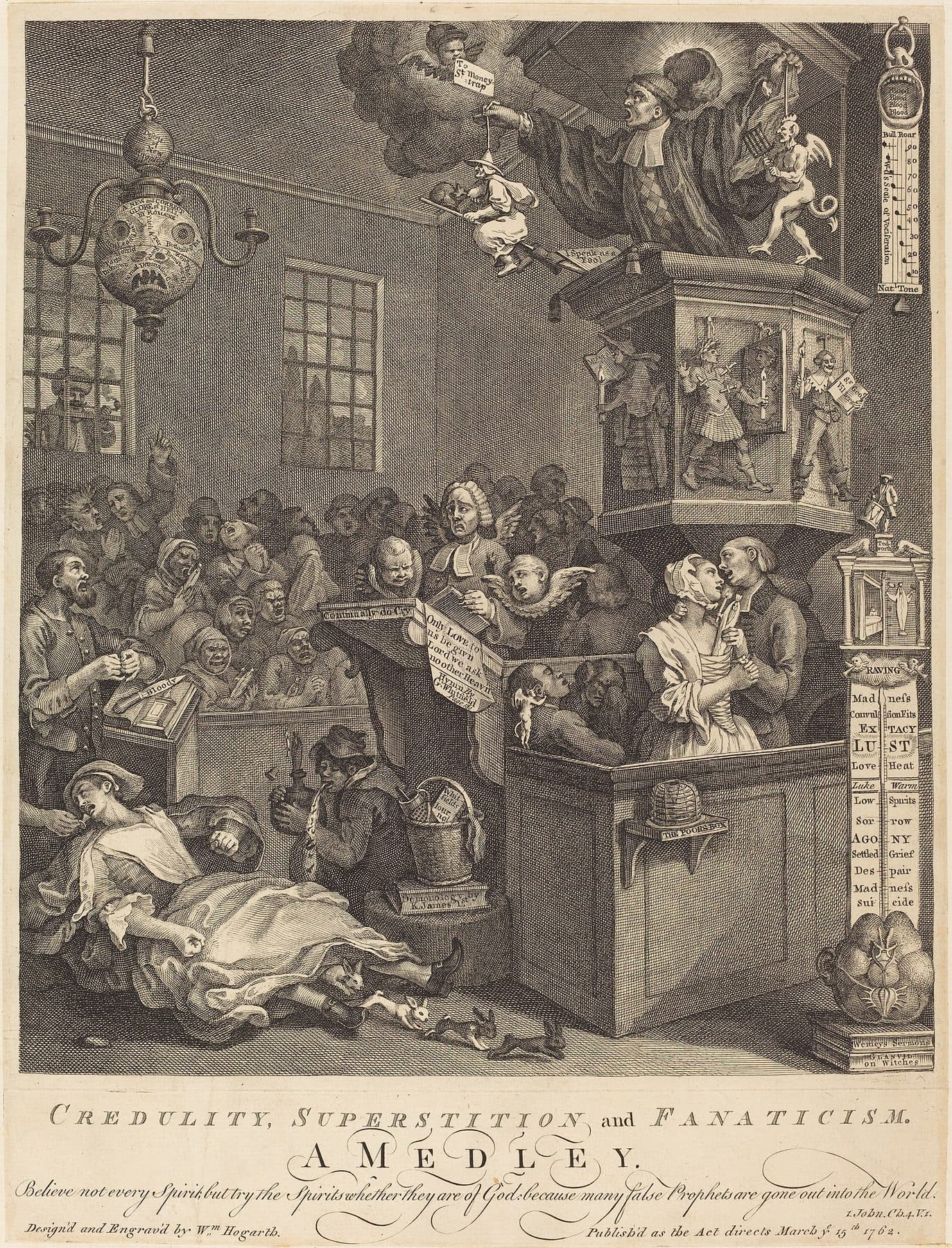
The Cock Lane Ghost
Photo: William Hogarth; National Gallery of Art open access · CC0
The story
Skip to the verdict ↓In 1762, a supposed haunting at a lodging house on Cock Lane, London -- attributed to the spirit of a murdered woman -- was investigated by a committee including Samuel Johnson and exposed as a fraud perpetrated by a young girl and her father.
In the winter of 1762, a lodging house on Cock Lane, a narrow street near Smithfield Market in the City of London, became the center of a popular haunting. Scratching and knocking sounds, channeled through yes/no responses by the young daughter of landlord Richard Parsons (Elizabeth, then about 11 years old), were attributed to the spirit of Frances Lynes, a woman who had died in the house and whose partner William Kent was accused by the "ghost" of murdering her with arsenic.
The case drew huge crowds, coverage in every London newspaper, and visits by prominent figures. The Reverend John Moore organized paid seances.
A committee was organized to investigate, including Samuel Johnson, clergyman John Douglas, and several other witnesses. They conducted controlled experiments: moving Elizabeth between houses to see if the knocking followed her, suspending her in a hammock with hands and feet bound, and visiting Fanny's vault in St. John's Church to request a sign — which did not come. The knocking ceased when Elizabeth Parsons was isolated and her hands and feet were bound.
Servants then discovered Elizabeth hiding a small wooden board, which had been used to create the scratching sounds. Samuel Johnson's published report stated that "it is the opinion of the whole assembly that the child has some art of making or counterfeiting a particular noise and that there is no agency of any higher cause," and concluded that no supernatural agency was present.
On 10 July 1762, Richard Parsons was sentenced to two years in the pillory; his wife received shorter sentences; the Reverend Moore was also convicted. Richard Parsons, his wife, and associates were convicted at the Guildhall on 10 July 1762.
Would be extraordinary if real — but it has been positively shown false.
Reviewer Notes
Miracles Jar weighs each claim two ways — how extraordinary it would be, and how strong the evidence is.
Assessed by Miracles Jar AI
Not “low evidence” — positive proof it’s false: positive evidence shows the claimed facts are false.
Definitively debunked fraud; perpetrators criminally convicted; Samuel Johnson's investigation committee provides a clear evidentiary record.
This case is atypical in that it was exposed through rigorous contemporary investigation and the perpetrators were criminally prosecuted. A committee including Samuel Johnson conducted systematic tests: isolating the girl, binding her hands and feet, moving her between locations. When the knocking failed to occur under controlled conditions, the fraud was confirmed. Servants subsequently found Elizabeth Parsons hiding a wooden board used to create the scratching sounds. Richard Parsons and associates were convicted at the Guildhall in July 1762. The Cock Lane ghost is a textbook case of a thoroughly investigated and definitively debunked paranormal claim.
What distinguished it from most 18th-century ghost cases was the quality of the investigation that followed. Johnson's committee applied something close to modern controlled-experiment logic to a paranormal claim, and the claim failed. The episode was immediately cited by rationalist writers as a template for evaluating miracle testimony, and it is historically significant not only for what it found but for demonstrating what 18th-century investigation methods could achieve.
Evidence:
- The knocking ceased under isolation and binding — controlled-condition failure is the strongest form of debunking evidence. Strong evidence for fraud.
- The hidden wooden board was found — physical evidence of the fraud mechanism. Strong evidence for fraud.
- The Guildhall convictions add institutional confirmation of the fraud finding. Strong evidence for fraud.
Evidence ledger — what the verdict rests on
The knocking ceased when Elizabeth Parsons was isolated and her hands and feet were bound, directly demonstrating the humanly produced source
Controlled-condition failure is the strongest form of debunking evidence
Servants discovered a small wooden board hidden on the girl's person, used to create the scratching sounds
Physical evidence of the fraud mechanism
Richard Parsons, his wife, and associates were convicted at the Guildhall on 10 July 1762
Legal conviction adds institutional confirmation of the fraud finding
What would raise the meter: Adversarial scrutiny with real power to expose deception — hostile investigators, controlled conditions — coming back clean would raise the evidence bar.
What would lower it: A confession, an exposed method, or a documented financial motive would drive the evidence bar toward zero.
How we weigh every claim — the full method, deductions and all →
The natural explanation
The leading natural account for this case is deception: hoaxes, cold reading & stagecraft. Read what it explains — and where it stops.
The same wonder, across traditions
This claim is one of many that make the same assertion across faiths. See it side by side in When a Figure Appears.
Sources
Tagged by proximity to the event. Primary sources are direct or contemporaneous; tertiary are downstream retellings.
- 1.Primaryinvestigation
Samuel Johnson (committee), "Samuel Johnson's Investigation Report", 1762· no public link
Johnson concluded 'it is the opinion of the whole assembly that the child has some art of making or counterfeiting a particular noise and that there is no agency of any higher cause'
- 2.Secondaryother
Multiple, "Cock Lane ghost (Wikipedia / contemporary accounts)", 1762· no public link
Synthesizes newspaper accounts, the Guildhall trial record, and Johnson's report
Cases like this
Nearest on the map — similar in how miraculous they’d be, and how strong the evidence is.