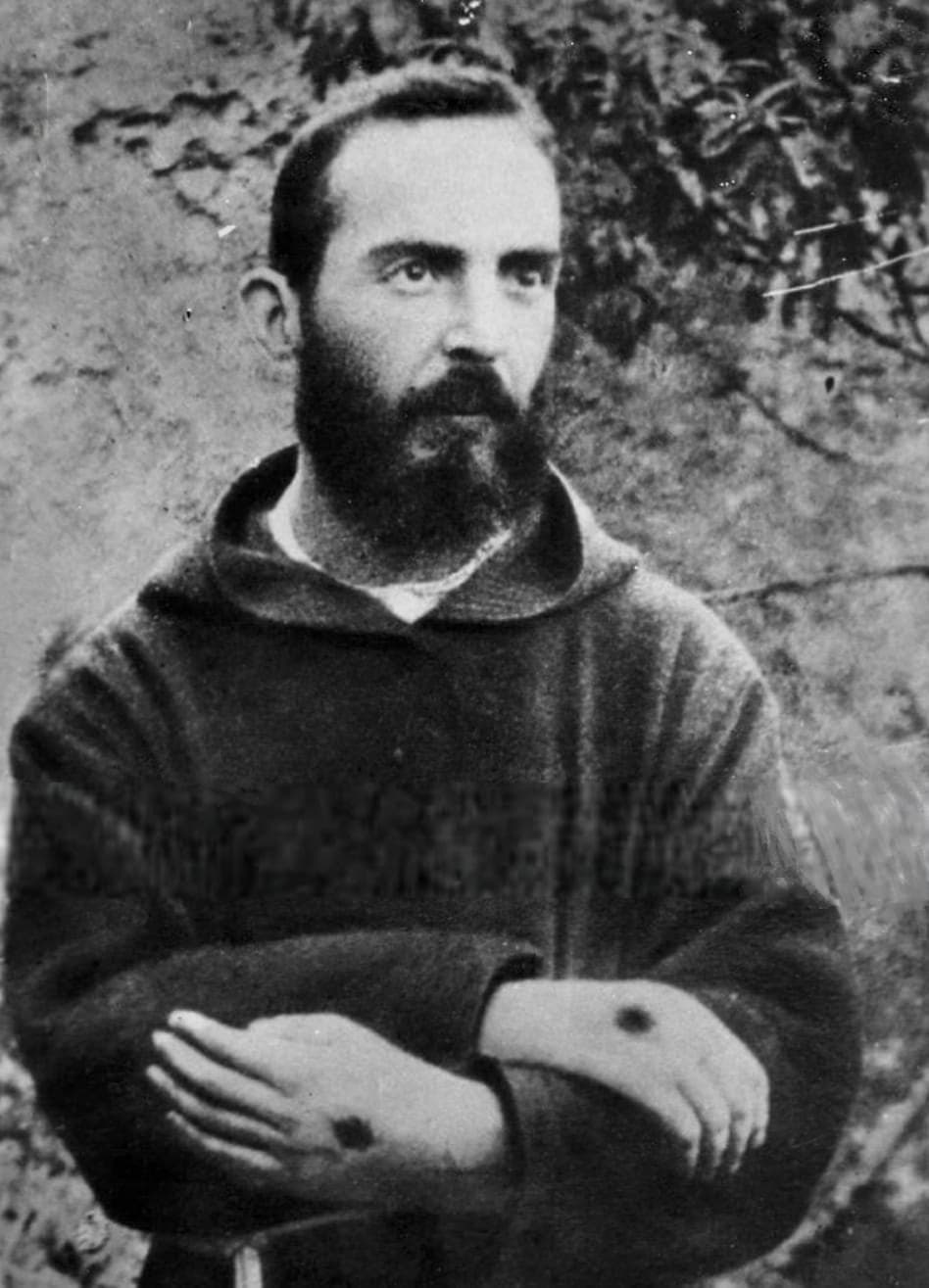
Consiglia De Martino: Ruptured Thoracic Duct Heals Before Surgery
Photo: Placido Bux · Public domain
The story
Skip to the verdict ↓An Italian woman's ruptured thoracic duct — containing two liters of lymphatic fluid — resolved completely overnight after prayer to Padre Pio, the miracle used for his beatification.
Consiglia De Martino, a married mother of three from Salerno, Italy, arrived at Riuniti Hospital on October 31, 1995, with acute pain and rapidly growing neck swelling. Two CT (CAT) scans led the examining physician to diagnose a ruptured thoracic duct — the body's main lymphatic vessel — with an estimated two liters of lymphatic fluid collecting in her neck. Surgery was scheduled for November 3.
On November 2, she prayed intensely to Padre Pio and telephoned his monastery at San Giovanni Rotondo, speaking with Fra Modestino Fucci, a friar known for his intercessory role. On November 3, the pre-operative team found the swelling had vanished. X-rays that day showed the rupture healed and the collection gone, in the neck and in the abdomen; a confirming CT scan on November 6 agreed. Surgery was cancelled and she was discharged.
The Vatican's Consulta Medica examined the case over several years. On April 30, 1998, its five-member panel issued a unanimous finding: 'scientifically inexplicable.' The cardinals and bishops of the Congregation confirmed the miracle, and Padre Pio was beatified on May 2, 1999.
The Surgical Background
A ruptured thoracic duct is a recognized, serious problem with a well-defined playbook. Standard management is conservative first — chest-tube drainage to re-expand the lung, a low-fat diet or intravenous nutrition to slow lymph flow — escalating to surgical ligation of the duct, or percutaneous embolization, if the leak persists (University of Iowa Head and Neck Protocols; the same source classes a high-volume leak as more than a liter a day). Leaks do sometimes close on their own: roughly half resolve with conservative care, over about two weeks.
Documentation and Sources
The load-bearing numbers — the two liters, the imaging dates — come from the canonical proceedings of the Congregation for the Causes of Saints, as summarized for general readers by the Magis Center, rather than from an independently released hospital record. The case has no peer-reviewed medical publication; by contrast, the Micheli pelvic-sarcoma case was written up in a peer-reviewed medical journal. The hospital records remain outside independent scientific access.
Hard to explain by nature — and strongly documented.
Reviewer Notes
Miracles Jar weighs each claim two ways — how extraordinary it would be, and how strong the evidence is.
Assessed by Miracles Jar AI
A unanimous Consulta Medica verdict on a CT-documented thoracic-duct rupture. Standard management of such a leak is conservative drainage over weeks, not overnight reabsorption — but the case has no peer-reviewed medical write-up, unlike the strongest Lourdes cures.
The crux of the case
Spontaneous closure of a small thoracic leak over a fortnight is ordinary medicine. What this case turns on is reabsorption of an estimated two-liter cervical collection inside roughly twenty-four hours — and that has no close analog in the surgical literature. The University of Iowa Head and Neck Protocols note that roughly half of chyle leaks close spontaneously, but over roughly two weeks, not overnight; that is the reference frame for what is and isn't ordinary here.
The case for authenticity
The imaging before and after is the strongest documentation in these cases: two CT scans diagnosing the rupture, X-rays on November 3 and a confirming CT on November 6 showing the collection and rupture gone. The Consulta Medica's unanimous "scientifically inexplicable" finding (five-member specialist panel, April 30, 1998) carries weight. The standard-of-care gap — conservative drainage over up to two weeks before ligation/embolization, versus roughly 24-hour resolution of a two-liter collection — points in the same direction.
Provenance limits
Two honest caveats belong on the record. First, the load-bearing numbers (the two liters, the imaging dates) come from the church proceedings as summarized by the Magis Center, not from an independent hospital record. Second, unlike the strongest Lourdes cures — the Micheli pelvic-sarcoma case was written up in a peer-reviewed medical journal — this case has no peer-reviewed medical publication at all. The hospital records remain outside independent scientific access, and that limit should temper the weight the imaging otherwise invites. Spontaneous closure of smaller leaks is real, which keeps a natural pathway on the table.
The woman had been praying to Padre Pio and contacted his monastery the evening before the healing was discovered. Temporal correlation is established; a causal mechanism is not.
The CT-documented before/after on a compressed timescale is what does the work for authenticity; the absence of any peer-reviewed write-up and the single-source (canonical) provenance are what hold the confidence and the score below the strongest documented Lourdes cures.
Evidence ledger — what the verdict rests on
Two CT (CAT) scans diagnosed the ruptured thoracic duct with an estimated two liters of lymphatic fluid; X-rays on November 3 and a confirming CT on November 6 showed the collection and rupture gone.
Imaging before and after is the strongest documentation in these cases. The 'two liters' figure and the imaging timeline come from the church proceedings as summarized by the Magis Center, not an independent record.
The Consulta Medica (5-member specialist panel) unanimously declared the cure scientifically inexplicable on April 30, 1998.
Standard care for a thoracic-duct leak is conservative drainage over up to two weeks, then ligation/embolization if it persists; spontaneous closure of an estimated two-liter cervical collection within ~24 hours has no close analog in the surgical literature.
Per University of Iowa Head and Neck Protocols: ~half of chyle leaks close spontaneously, but over roughly two weeks, not overnight.
There is no peer-reviewed medical publication of this case — unlike the Micheli sarcoma cure, which was written up in a medical journal.
The documentation is canonical (church proceedings), not independently published; the hospital records remain outside independent scientific access.
The woman had been praying to Padre Pio and contacted his monastery the evening before the healing was discovered.
Temporal correlation established but causal mechanism not.
What would raise the meter: Long-term follow-up documenting permanence, in a condition with a near-zero spontaneous-resolution base rate, would raise the meter.
What would lower it: A documented relapse, or case literature showing the condition fluctuates or remits on its own, would move it down.
How we weigh every claim — the full method, deductions and all →
The natural explanation
The leading natural account for this case is spontaneous remission & the body's own recovery. Read what it explains — and where it stops.
Sources
Tagged by proximity to the event. Primary sources are direct or contemporaneous; tertiary are downstream retellings.
- 1.Secondaryinvestigation
Magis Center, "The Padre Pio Miracle That Led to His Beatification", 2002· no public link
Summary based on the Congregation for the Causes of Saints proceedings. Source of the operative details: two CAT scans diagnosing the rupture and ~2 liters of fluid, X-rays on Nov 3 showing resolution, confirming CT on Nov 6. No peer-reviewed medical publication is cited.
- 2.Secondaryacademic
University of Iowa, Carver College of Medicine, "Thoracic Duct and Chylothorax: General Considerations (Head and Neck Protocols)"· no public link
Standard management: conservative drainage, low-fat diet/TPN, then ligation if persistent; ~half of chyle leaks close spontaneously within about two weeks (not overnight). High-volume leak = >1,000 mL/day. The reference frame for what is and isn't ordinary here.
- 3.Primarychurch document
"The Path of Padre Pio to Sainthood: The Miracle of Consiglia De Martino", 2002· no public link
Italian-language detailed account of the medical and canonical investigation; most detailed primary-adjacent source.
- 4.Secondarynews
Catholic Culture, "After Much Study, a Miracle", 1999· no public link
Reports the Consulta Medica unanimous decision.
Cases like this
Nearest on the map — similar in how miraculous they’d be, and how strong the evidence is.