Antonietta Raco: Primary Lateral Sclerosis Healed — The 72nd Recognized Miracle
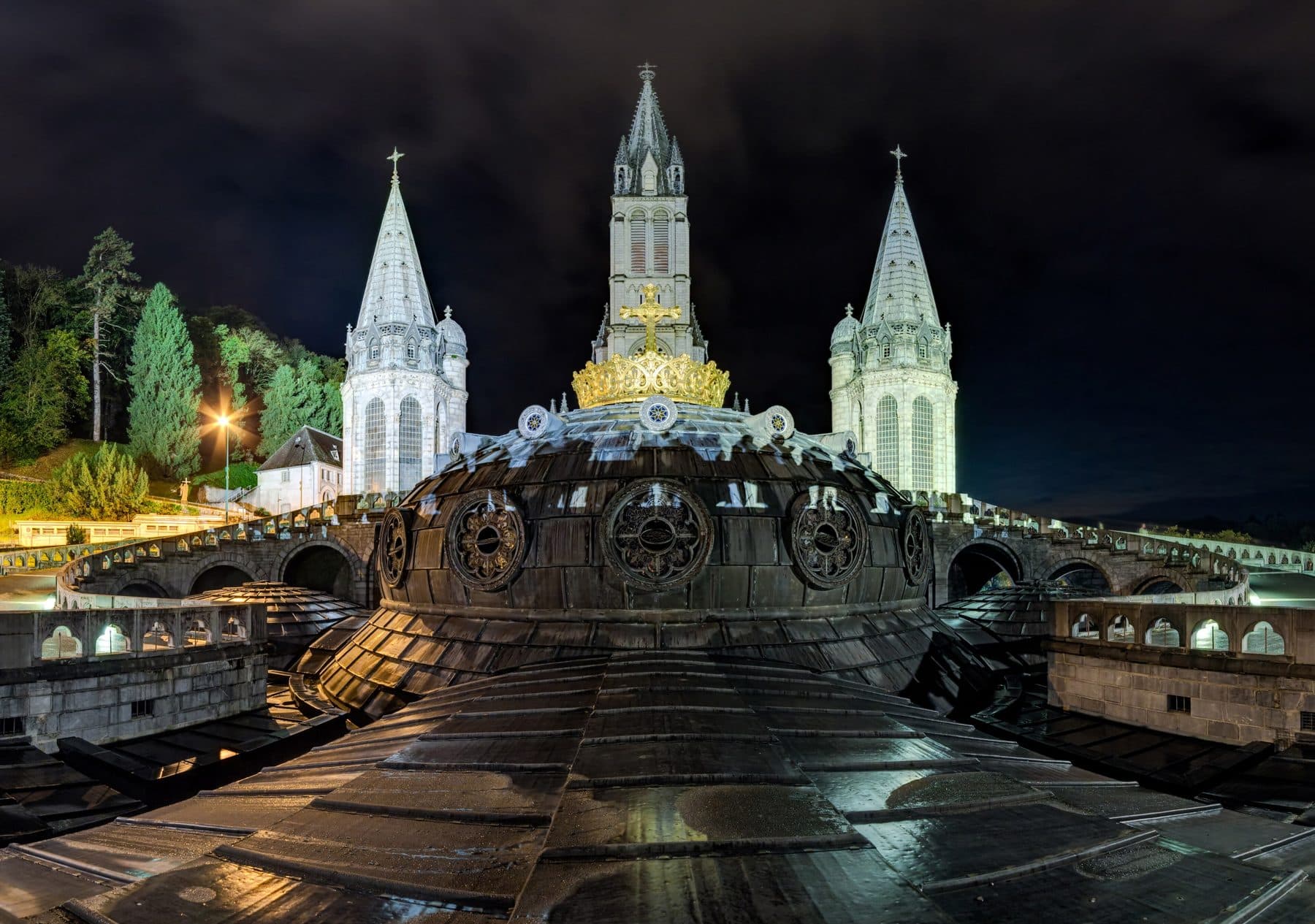
Photo: Moahim · CC BY-SA 4.0
The story
Skip to the verdict ↓By 2008, Antonietta Raco's own legs had stopped answering her. Four years of headaches and creeping weakness had narrowed to a diagnosis — primary lateral sclerosis — and the breath was going out of her. The next spring she was lowered into the baths at Lourdes, where she later said a young voice told her three times not to be afraid.
The illness had been closing in for years. Raco, from the Tursi-Lagonegro region of southern Italy, first developed symptoms around 2004 — the severe headaches, cramps, generalized weakness, and trouble walking — which over the next two years progressed to difficulty swallowing and slurred speech. The formal diagnosis of Primary Lateral Sclerosis came in 2006; by 2008 her breathing capacity was measurably reduced and the weakness ran across all four limbs, worse on the left.
The Pilgrimage
The pilgrimage came in 2009. It was in the sanctuary baths at Lourdes that Raco reported the voice — young, female, repeating three times: 'Don't be afraid.' She subsequently recovered her motor function completely.
The Diagnosis
Primary Lateral Sclerosis is a clinical diagnosis of exclusion rather than a single positive test: a physician establishes a progressive pure upper-motor-neuron syndrome and then rules out the conditions that imitate it. The case was not left resting on the original 2006 label. In 2013 the neurology department of the University of Milan re-examined Raco and confirmed the diagnosis, taking over her follow-up; the neurologist Vincenzo Silani, a PLS specialist who later helped author the international diagnostic criteria, was among those involved. When a formal consensus definition of PLS was published in 2020, her records were checked against it again in 2024 and found to meet it.
The Investigation
The Lourdes Medical Bureau and CMIL (the Lourdes International Medical Committee) reviewed the case across more than fifteen years, meeting repeatedly before reaching a verdict. In November 2024, 17 of 21 CMIL members voted that the cure was 'unexplained, complete, and lasting,' meeting the required two-thirds majority. On April 16, 2025, Bishop Vincenzo Carmine Orofino of the Diocese of Tursi-Lagonegro proclaimed it the 72nd officially recognized Lourdes miracle.
Hard to explain by nature — and strongly documented.
Reviewer Notes
Miracles Jar weighs each claim two ways — how extraordinary it would be, and how strong the evidence is.
Assessed by Miracles Jar AI
Recognized April 2025 as 72nd miracle; PLS has no documented spontaneous remission — if diagnosis is confirmed, natural explanation is weak.
The diagnostic confirmation matters because PLS is the crux of the case. PLS is a clinical diagnosis of exclusion. The repeated, independent confirmation — the University of Milan re-examining and confirming the diagnosis in 2013 and taking over follow-up, and the records being re-checked against the 2020 consensus criteria in 2024 — is what makes the diagnosis unusually hard to wave away as a simple misdiagnosis.
Why PLS makes this a strong case is its course. Established PLS is degenerative and, in the published literature, does not spontaneously and completely reverse — unlike relapsing-remitting MS, or tuberculosis, or some cancers, which can. If the diagnosis holds, the natural explanation is genuinely weak.
Where This Lands
The honest caveat is still diagnostic. PLS is reached by exclusion, and several mimics — primary progressive MS, hereditary spastic paraparesis, structural or inflammatory disease of the spinal cord — can present as the same pure upper-motor-neuron picture, and a few of them carry fluctuating or treatable courses. If the original label were one of those, the natural explanation would strengthen. What pushes against that worry here is that the diagnosis was confirmed by an independent academic neurology service and re-validated against modern criteria years apart. The remaining open check is the absence, as of this writing, of a peer-reviewed publication of the medical file; the record is carried by the Bureau, CMIL, and the diocesan proclamation. The case is well-supported if the diagnosis holds — and it has held up to more scrutiny than most.
Evidence ledger — what the verdict rests on
PLS is a slowly progressive neurodegenerative disorder with no documented pathway to spontaneous complete remission; the 2020 international consensus criteria describe a monotonic course, and Raco's records were re-checked against those criteria in 2024
Unlike MS, TB, or even Hodgkin's, established PLS lacks any recognized spontaneous-recovery pathway in the literature
CMIL vote: 17 of 21 international medical experts found cure 'unexplained, complete, and lasting' — met two-thirds majority threshold
International multi-specialist panel; includes non-Catholic physicians
16-year investigation (2009-2025) is the most thorough modern Lourdes review timeline
Extended follow-up eliminates late-relapse scenarios
PLS is a diagnosis of exclusion; mimics such as primary progressive MS, hereditary spastic paraparesis, and structural or inflammatory cord disease can present as a pure upper-motor-neuron syndrome and some carry fluctuating or treatable courses
The key uncertainty: if the original label was a PLS mimic with remitting potential, the natural explanation strengthens. Against this, the University of Milan neurology department confirmed the diagnosis in 2013 and the records were re-checked against the 2020 consensus criteria in 2024
No independent peer-reviewed medical publication on the case exists as of mid-2026; the medical record is carried by the Lourdes Bureau and CMIL process and the diocesan proclamation
The PLS-misdiagnosis caveat and the absence of journal publication are the open checks a future record could close
What would raise the meter: Independent diagnostic confirmation from before the event — imaging, biopsy, a second named clinician — would raise this substantially.
What would lower it: Records showing the original diagnosis was provisional or never independently confirmed would move it down.
How we weigh every claim — the full method, deductions and all →
The natural explanation
The leading natural account for this case is misdiagnosis & the overstated prognosis. Read what it explains — and where it stops.
Sources
Tagged by proximity to the event. Primary sources are direct or contemporaneous; tertiary are downstream retellings.
- 1.Primarychurch document
"Bishop Orofino Proclamation — Diocese of Tursi-Lagonegro, April 16, 2025", 2025· no public link
Official 72nd miracle declaration following 16-year canonical and medical investigation
- 2.Secondaryother
"The 72nd Miracle of Lourdes — lourdes-france.com", 2025· no public link
Official Lourdes sanctuary website; describes CMIL vote (17/21) and investigation timeline
- 3.Secondarynews
"A Voice Told Me Not to Be Afraid — Catholic Telegraph / CNA", 2025· no public link
First-person account and case details; covers the CMIL process and timeline
- 4.Primaryacademic
Turner MR, Barohn RJ, Corcia P, Fink JK, Harms MB, Kiernan MC, Ravits J, Silani V, Simmons Z, Statland J, van den Berg LH, Mitsumoto H, "Primary lateral sclerosis: consensus diagnostic criteria", Journal of Neurology, Neurosurgery & Psychiatry, 2020· no public link
Establishes PLS as a slowly progressive neurodegenerative upper-motor-neuron disorder; diagnosis is clinical after excluding mimics, requires at least two years of progressive dysfunction, and is supported by MRI and EMG (the latter to rule out lower-motor-neuron involvement). The criteria against which Raco's records were re-checked in 2024.
- 5.Secondaryacademic
Turner MR, Talbot K, "Mimics and chameleons in motor neurone disease", Practical Neurology 13:153-164, 2013· no public link
Catalogues the conditions that imitate motor-neurone disease — including upper-motor-neuron presentations — making the point that PLS is a diagnosis reached by exclusion and that some mimics (e.g. hereditary spastic paraparesis, structural cord lesions) carry different prognoses.
Cases like this
Nearest on the map — similar in how miraculous they’d be, and how strong the evidence is.