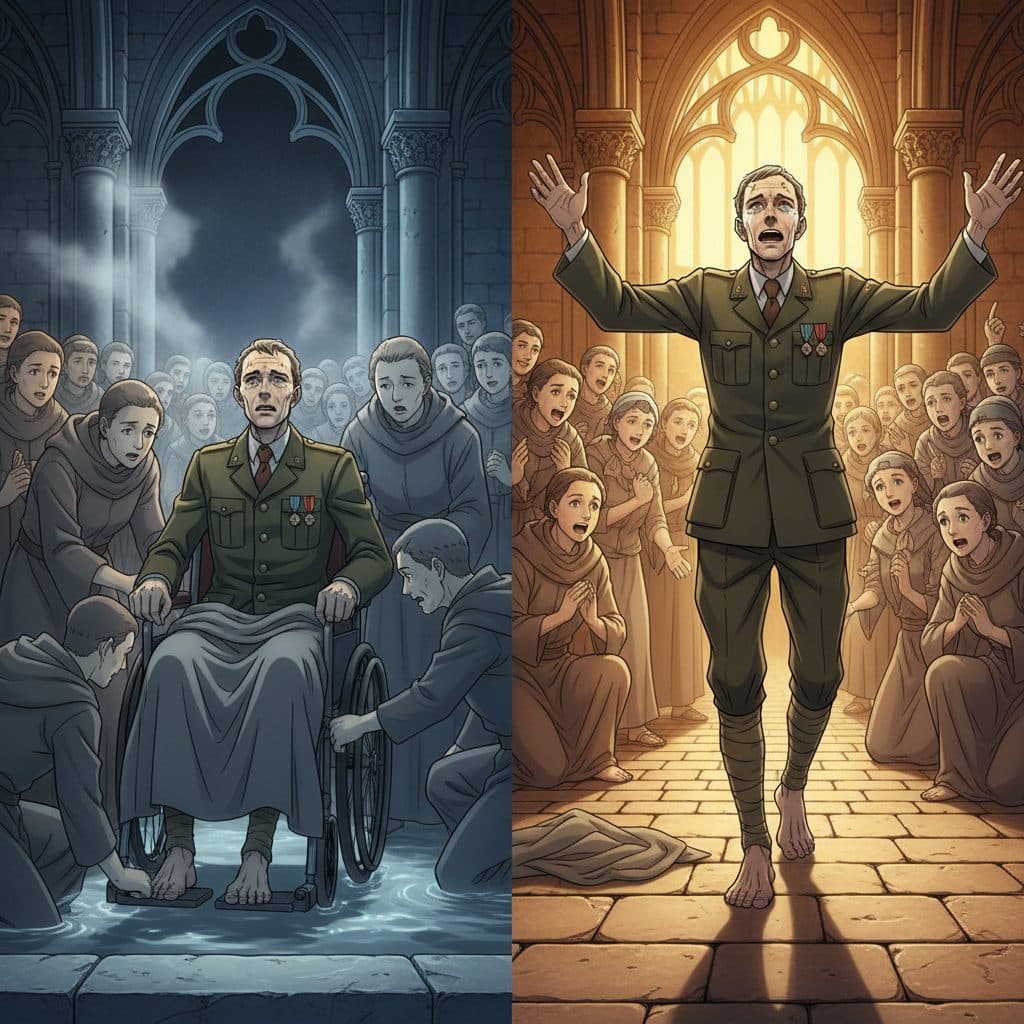
John Traynor: WWI Wounded Sailor Walks — The 71st Recognized Miracle
Illustration: AI-generated dramatization (Gemini Flash Image)
The story
Skip to the verdict ↓A Royal Marine severely disabled in the Gallipoli campaign — epileptic, partially paralyzed, right arm immobile — experienced sudden complete recovery at the 1923 Lourdes Eucharistic Procession, recognized as the 71st miracle in December 2024.
John Traynor (1883–1943) was a Liverpool-born reservist hit by machine-gun fire on May 8, 1915 during the Gallipoli campaign. A bullet passed through the inner side of his upper right arm and lodged beneath the collarbone, severing the nerves running to the arm. The 1923 Lourdes examination recorded the result precisely: paralysis of the radial, median, and ulnar nerves of the right arm, with atrophy of the shoulder and pectoral muscles — in modern terms, a complete traumatic brachial plexus lesion. Four surgical attempts in 1915 and 1916 failed to rejoin the nerves; the arm was, in his own words, "dead since 1915." Severe epileptic seizures began during his evacuation by hospital ship, at times three a day, and a later operation meant to relieve them left him with leg paralysis and an opening in his skull. By 1923 he held a substantial war disability pension and was judged incurable.
In July 1923, against family and medical objection, Traynor joined the Archdiocese of Liverpool's inaugural Lourdes pilgrimage. During the Eucharistic Procession on July 25, his paralyzed arm moved for the first time in eight years; within days he was walking. Three Liverpool physicians — Drs. Azurdia, Finn, and Marley — examined him before and after and recorded that he had recovered the use of his right arm, regained sensation in his legs, that the opening in his skull had diminished, and that the epileptic attacks had stopped. A fuller Medical Bureau review followed in 1926 under its president, Dr. Auguste Vallet. Traynor returned to Liverpool, did heavy physical work for the next twenty years, never had another seizure, and died in 1943 of causes unrelated to his injuries.
The century-long gap before recognition was administrative. The 1926 Medical Bureau findings were never transmitted to the Liverpool archdiocese, and the case stalled for want of contemporaneous medical records on the home side; it was only reconstructed after Dr. Kieran Moriarty located the archival documents in Lourdes. Archbishop Malcolm McMahon proclaimed Traynor's cure the 71st Lourdes miracle on December 8, 2024 — the first recognized for a British Catholic.
Extraordinary if it happened as told — but the evidence can't fully confirm it.
Reviewer Notes
Miracles Jar weighs each claim two ways — how extraordinary it would be, and how strong the evidence is.
Assessed by Miracles Jar AI
Recognized December 8, 2024 as 71st Lourdes miracle; traumatic multi-system injury with 20-year sustained cure after witnessed recovery at the procession.
The verdict. Recognized December 8, 2024 as the 71st Lourdes miracle; traumatic multi-system injury with a 20-year sustained cure after a witnessed recovery at the procession.
Weighing the pieces separately. The components do not all carry the same force and must be weighed individually.
- *The arm is the strongest element.* The natural-recovery literature on wartime gunshot injury to the brachial plexus is clear that complete, total-palsy lesions almost never recover spontaneously, and that the late recovery which does occur belongs to incomplete/partial lesions and usually arrives within months, not after eight years of fixed atrophy. Traynor's lesion was complete and long-established — outside both that lesion type and that window. The reference for this baseline is the 2009 academic source "Gunshot injuries to the brachial plexus during wartime," which distinguishes the natural-recovery pathway from Traynor's complete, eight-year-fixed multi-nerve palsy.
- *The epilepsy is weaker as a standalone marvel.* Roughly half of patients with late post-traumatic epilepsy eventually remit on their own (per the Medscape "Posttraumatic Epilepsy: Epidemiology and Prognosis" reference), so the seizures ceasing is, by itself, within the natural range.
- *What resists a tidy natural account is the simultaneity* — a fixed nerve palsy, leg paralysis, and epilepsy all turning at a single moment rather than each drifting back over years. No mechanism explains all three systems recovering at one moment.
Evidence favoring authenticity.
- The injuries had an organic traumatic origin (machine-gun wounds, failed brain surgery) — not functional or psychiatric. This removes the conversion-disorder counterargument applicable to some other cases.
- The recovery was witnessed at the Eucharistic Procession by medical personnel present, with immediate and complete restoration of arm function and walking; multiple medical observers documented the recovery event.
- Traynor lived 20 years post-cure without relapse (died 1943 of unrelated causes), and the epilepsy also ceased — longitudinal evidence of sustained multi-system recovery.
Evidence on the natural side. Natural-history baselines apply unevenly: late post-traumatic epilepsy remits spontaneously in about half of patients, but complete (total-palsy) gunshot brachial plexus lesions almost never recover, and the late recovery seen in such injuries is confined to incomplete lesions within months. The epilepsy alone is within natural range; the complete eight-year-fixed arm palsy is not.
Reasoning summary. Traynor's case involves complex multi-system traumatic injury. The complete brachial plexus lesion, fixed and atrophied for eight years, sits outside the window and lesion type where natural late recovery is described; the epilepsy resolution is in isolation within the natural range; the simultaneity of arm, legs, and epilepsy all resolving at one moment is what is hardest to absorb naturally. The recovery was observed by the Liverpool physicians present and reviewed more fully by the 1926 Medical Bureau under Dr. Vallet, and the 20 relapse-free years are strong longitudinal confirmation. The century-long delay to recognition was bureaucratic: the 1926 Bureau findings were never transmitted to Liverpool, and the file was only reconstructed after Dr. Moriarty located the archival documents. First British Catholic with a recognized Lourdes cure.
Evidence ledger — what the verdict rests on
Injuries had organic traumatic origin (machine gun wounds, failed brain surgery) — not functional or psychiatric in nature
Removes the conversion disorder / hysteria counterargument applicable to Perrin's case
Witnessed recovery at the Eucharistic Procession by medical personnel present; immediate and complete restoration of arm function and walking
Multiple medical observers documented the recovery event
Lived 20 years post-cure without relapse (died 1943 of unrelated causes); epilepsy also ceased
Longitudinal evidence of sustained multi-system recovery
Natural-history baselines apply unevenly: late post-traumatic epilepsy remits spontaneously in about half of patients, but complete (total-palsy) gunshot brachial plexus lesions almost never recover, and the late recovery seen in such injuries is confined to incomplete lesions within months
The epilepsy alone is within natural range; the complete eight-year-fixed arm palsy is not, and no mechanism explains all three systems recovering at one moment
What would raise the meter: Long-term follow-up documenting permanence, in a condition with a near-zero spontaneous-resolution base rate, would raise the meter.
What would lower it: A documented relapse, or case literature showing the condition fluctuates or remits on its own, would move it down.
How we weigh every claim — the full method, deductions and all →
The natural explanation
The leading natural account for this case is spontaneous remission & the body's own recovery. Read what it explains — and where it stops.
Sources
Tagged by proximity to the event. Primary sources are direct or contemporaneous; tertiary are downstream retellings.
- 1.Primarychurch document
"Archbishop McMahon Declaration — Archdiocese of Liverpool, December 8, 2024", 2024· no public link
Formal proclamation of 71st miracle; first recognized Lourdes cure for a British Catholic
- 2.Secondarynews
"Lourdes Confirms 71st Miracle — America Magazine", 2024· no public link
Covers the recognition process and historical case details from the Liverpool archdiocese investigation
- 3.Tertiaryother
"John Traynor (Lourdes Pilgrim) — Wikipedia", 2024· no public link
Detailed biographical account; sources from historical records and Liverpool archdiocesan archives
- 4.Secondaryacademic
"Gunshot injuries to the brachial plexus during wartime", 2009· no public link
Natural-history reference for traumatic brachial plexus lesions: complete (total-palsy) gunshot lesions have almost no chance of spontaneous recovery, while incomplete/partial lesions can recover late. Distinguishes the natural-recovery pathway from Traynor's complete, eight-year-fixed multi-nerve palsy.
- 5.Secondaryacademic
"Posttraumatic Epilepsy: Epidemiology and Prognosis (Medscape Reference)"· no public link
Cited for the spontaneous-remission rate of late post-traumatic epilepsy: about half of patients with late post-traumatic epilepsy undergo spontaneous remission. Frames the epilepsy resolution against the natural baseline.
Cases like this
Nearest on the map — similar in how miraculous they’d be, and how strong the evidence is.