Gabriel Gargam: Railroad Accident Survivor Walks After Two Years Bedridden
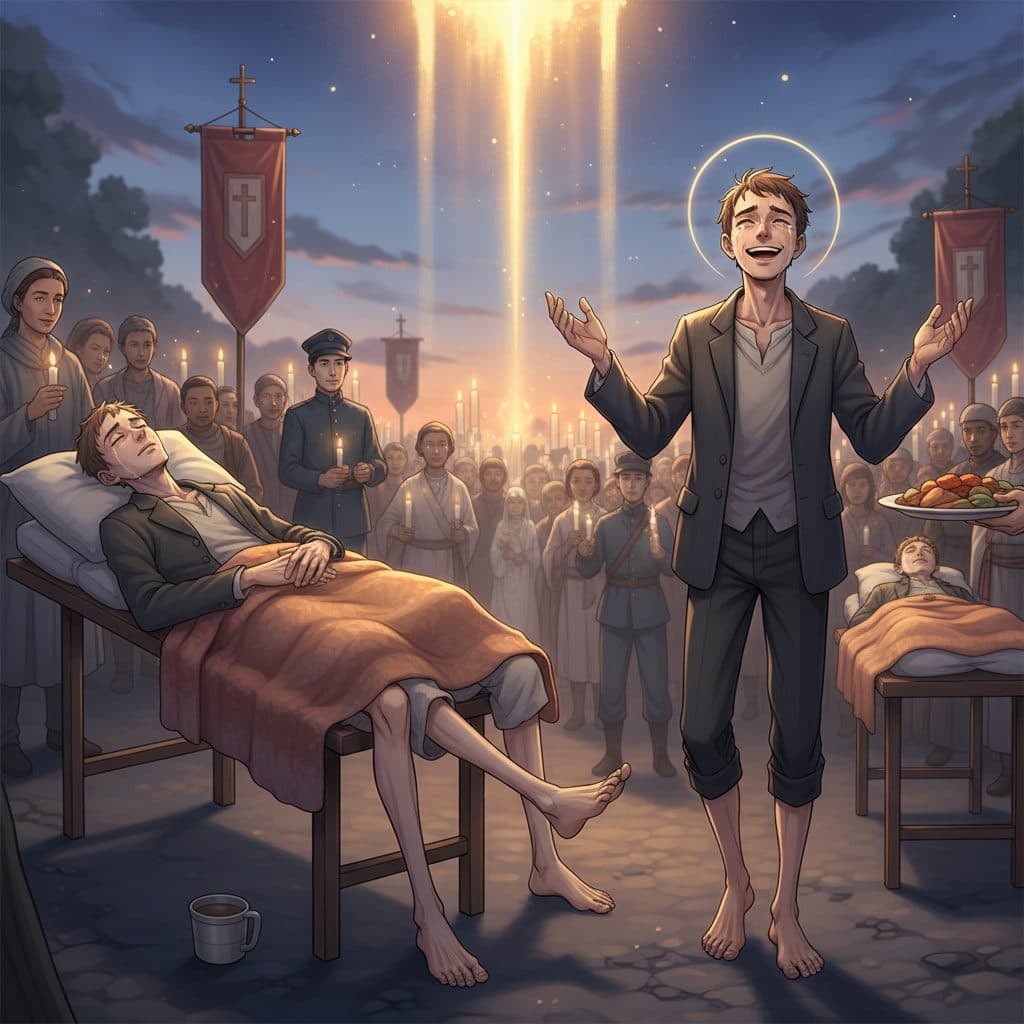
Illustration: AI-generated dramatization (Gemini Flash Image)
The story
Skip to the verdict ↓By the summer of 1901 Gabriel Gargam weighed around seventy-eight pounds. A train wreck had left the postal sorter paralyzed below the waist and fed through a tube, his legs withered, bedridden for twenty months. Carried by stretcher into Lourdes on 20 August, he rose during the eucharistic procession, stood, walked a few steps, and asked for a full meal — his first solid food in over a year.
The wreck had come on December 17, 1899, when the Paris-Bordeaux express Gargam was riding collided with another train at high speed. He was thrown clear and arrived in critical condition. The wasting over the months that followed was severe: his legs atrophied, he could keep down no solid food, and by contemporary accounts the nourishment through the tube came roughly once a day.
The August 1901 journey was made against medical advice. After he rose on August 20 and ate the meal he had asked for, sixty physicians who were present at Lourdes that day examined him the same afternoon. Speaking for them, Dr. Gustave Boissarie — who headed the Lourdes Medical Bureau from 1891 to 1914 — first stated that a man with no remaining leg muscle after twenty months of paralysis could not walk, and then recorded that he had. The physicians signed a declaration that they could find no medical explanation.
The Lourdes Medical Bureau documents cures and judges whether they are medically unexplained; it does not, and did not, pronounce them miraculous — that canonical step belongs to a bishop. Gargam's case was attested by the Bureau's physicians but, on the available record, was never the subject of a formal episcopal declaration, and he is not among the roughly seventy cures the Church has canonically recognized. He went on to serve as a brancardier — a stretcher bearer — at Lourdes for the rest of his life, returning each year until his death in 1953.
One question 1901 medicine could not answer was whether his spinal injury was complete or incomplete. Drawing that distinction would have required imaging that did not exist at the time.
Extraordinary if it happened as told — but the evidence can't fully confirm it.
Reviewer Notes
Miracles Jar weighs each claim two ways — how extraordinary it would be, and how strong the evidence is.
Assessed by Miracles Jar AI
60-physician simultaneous exam on the day of cure is the most rigorous early-era documentation; whether natural recovery was possible turns on the injury's completeness, which 1901 neurology could not establish.
The headline judgment is that the 60-physician simultaneous exam on the day of cure is the most rigorous early-era documentation, while whether natural recovery was possible turns on the injury's completeness, which 1901 neurology could not establish.
Weighing of the evidence. The case rests its whole weight on a single question — was the spinal injury complete or incomplete? — and both branches must be considered:
- If the injury was *complete*, the modern literature is decisive against natural recovery. Kirshblum and colleagues (2004) found that almost no one neurologically complete at one year later regains motor function, let alone unaided walking, and certainly not after twenty months of wasting. Their figures: of patients neurologically complete at one year, 94.4% remained complete at five years; only about 2.1% converted from motor-complete to motor-incomplete late, and none of that amounts to regaining unaided walking.
- If the injury was *incomplete*, late spontaneous improvement is at least biologically conceivable — though recovery of this degree and speed at that interval would still be extraordinary. This is the only natural opening, and it is narrow.
- Without imaging, the distinction cannot be drawn, and the case turns on it.
Evidence for authenticity. Sixty physicians examined Gargam the same day and certified total cure of documented post-traumatic paraplegia with severe wasting — he had received food only via feeding tube. The large-scale simultaneous medical examination is unusually rigorous for 1901. The scale and timing of the observation — sixty physicians examining him the day he stood — is what makes Gargam compelling, and the unanswerable completeness question is the one fact that would settle it and the reason a strong contemporaneous record lands short of a closed case. He stands as one of the best-documented unexplained cures of the early Bureau era, not a proclaimed miracle.
Evidence on the natural side. The full mechanism of his paralysis was not established with the precision of modern imaging; severe traumatic paraplegia from spinal shock — as distinct from complete cord transection — can theoretically resolve, though after 20 months of total wasting the prognosis would be extremely poor. If the 1899 injury was incomplete rather than a complete cord transection, late spontaneous improvement is biologically conceivable, but modern literature shows recovery of unaided walking from a complete injury 20 months out is essentially unrecorded.
Source notes. O'Reilly (Tradition in Action, 2005) is a detailed secondary narrative drawn from contemporary accounts, not peer-reviewed; it records the weight loss to 78 pounds, the once-daily tube feeding, and Dr. Boissarie speaking for the examining physicians on the day of the cure. The Lourdes Medical Bureau source (2024) confirms Boissarie headed the Bureau from 1891 to 1914 and that the Bureau documents cures but does not declare them miraculous — only a bishop can make that canonical judgment. Kirshblum et al. (2004), Archives of Physical Medicine and Rehabilitation 85:1811–1817, is the primary academic source for the late-recovery statistics, establishing that recovery of ambulation from a complete cord injury 20 months out has essentially no support in the modern literature, leaving an incomplete injury as the only natural opening.
Evidence ledger — what the verdict rests on
60 physicians simultaneously examined Gargam on the day of the alleged cure and declared him entirely healed
The scale of contemporaneous medical observation is exceptional for the period
20 months of complete lower-body paralysis with severe nutritional failure; muscle atrophy documented
Medical consensus was that walking was biologically impossible given atrophied musculature
If the 1899 injury was incomplete rather than a complete cord transection, late spontaneous improvement is biologically conceivable — but the modern literature shows recovery of unaided walking from a complete injury 20 months out is essentially unrecorded
Kirshblum et al. (2004): 94.4% of injuries complete at one year stayed complete at five; late conversion to motor-incomplete was about 2.1% and did not amount to regained ambulation. The natural door is narrow and depends entirely on the injury having been incomplete — which 1901 neurology could not establish
What would raise the meter: Long-term follow-up documenting permanence, in a condition with a near-zero spontaneous-resolution base rate, would raise the meter.
What would lower it: A documented relapse, or case literature showing the condition fluctuates or remits on its own, would move it down.
How we weigh every claim — the full method, deductions and all →
The natural explanation
The leading natural account for this case is spontaneous remission & the body's own recovery. Read what it explains — and where it stops.
Sources
Tagged by proximity to the event. Primary sources are direct or contemporaneous; tertiary are downstream retellings.
- 1.Secondaryinvestigation
Hugh O'Reilly, "The Lourdes' Miracle of Gabriel Gargam (Tradition in Action)", 2005· no public link
Detailed narrative drawn from contemporary accounts; not peer-reviewed. Records the weight loss to 78 pounds, the once-daily tube feeding, and Dr. Boissarie speaking for the examining physicians on the day of the cure.
- 2.Secondarywebsite
"Lourdes Medical Bureau (Bureau des Constatations Médicales) — history and process", 2024· no public link
Confirms Dr. Gustave Boissarie headed the Medical Bureau from 1891 to 1914, and that the Bureau documents cures but does not itself declare them miraculous — only a bishop can make that canonical judgment.
- 3.Primaryacademic
Kirshblum S, Millis S, McKinley W, Tulsky D, "Late neurologic recovery after traumatic spinal cord injury", Archives of Physical Medicine and Rehabilitation 85:1811-1817, 2004· no public link
Of patients neurologically complete at one year, 94.4% remained complete at five years; only about 2.1% converted from motor-complete to motor-incomplete late, and none of that amounts to regaining unaided walking. Establishes that recovery of ambulation from a complete cord injury 20 months out has essentially no support in the modern literature — leaving an incomplete injury as the only natural opening.
Cases like this
Nearest on the map — similar in how miraculous they’d be, and how strong the evidence is.