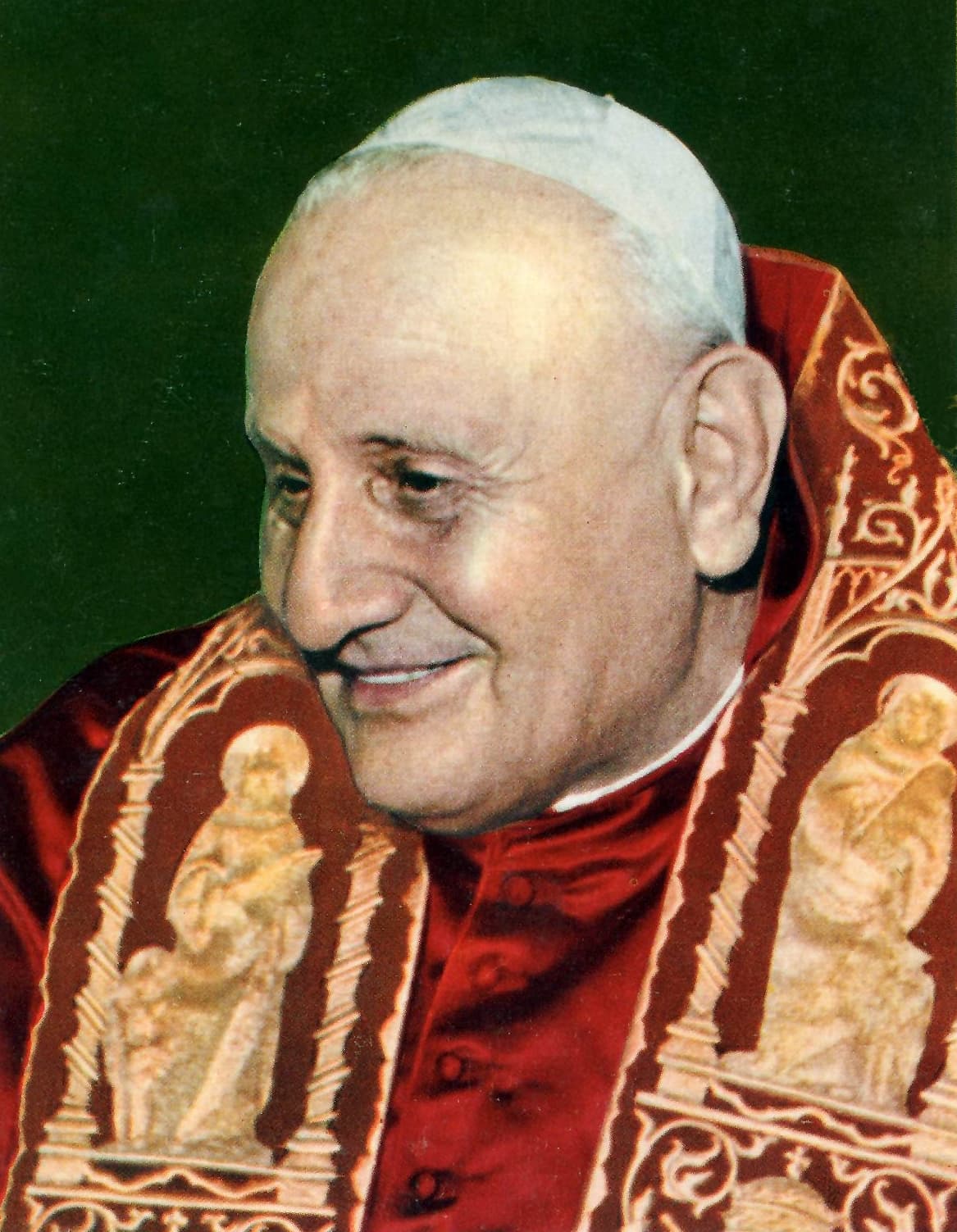
Sister Caterina Capitani: Gastric Fistula Healed After John XXIII Relic
Photo: Unknown author; files from the Patriarchate of Venice · Public domain
The story
Skip to the verdict ↓An Italian nun dying from a post-operative gastric fistula recovered instantly after a piece of John XXIII's bed sheet was placed on her wound — the case used for his beatification.
In 1966, Sister Caterina Capitani, a 22-year-old Italian Daughter of Charity, was hospitalized in Naples with a hemorrhaging gastric tumor. Surgeons removed most of her stomach along with her spleen and pancreas. After the operation, she developed an external fistula — a breach in the abdominal wall through which gastric and lymphatic fluid leaked continuously. She was near death.
On May 22, 1966, the assistant provincial of her congregation brought her a relic — reportedly a piece of Pope John XXIII's bed sheet. She placed it on her wound. Almost immediately, she later reported, she felt a hand on the wound and heard a voice call her name. The pain stopped. Within hours the fistula had closed and she recovered fully.
The Vatican medical commission could find no scientific explanation for the recovery. John XXIII was beatified on September 3, 2000. Capitani, still alive at the beatification, described herself as a "walking miracle." Pope Francis canonized John XXIII on April 27, 2014 — notably waiving the usual second-miracle requirement, citing John's "virtues of light."
Extraordinary if it happened as told — but the evidence can't fully confirm it.
Reviewer Notes
Miracles Jar weighs each claim two ways — how extraordinary it would be, and how strong the evidence is.
Assessed by Miracles Jar AI
Compelling clinical situation — terminal post-surgical fistula — but very old case with no publicly accessible primary medical records.
Compelling clinical situation — terminal post-surgical fistula — but a very old case with no publicly accessible primary medical records.
The Vatican medical commission found no scientific rationale for the recovery. Capitani had undergone extensive surgery (removal of most of her stomach, her spleen, and pancreas) and had developed a leaking external fistula; her condition was terminal. The recovery was declared instantaneous. Against: spontaneous fistula closure occasionally occurs, though typically over weeks not instantly; original records are not available for independent review. The documentation is nearly 60 years old and mostly accessible only through church sources.
The case
- Terminal post-surgical external gastric fistula — after removal of most stomach, spleen, and pancreas — closed instantaneously. Spontaneous instant closure of an established external fistula is not documented in surgical literature.
- Vatican medical commission found no scientific rationale for the recovery.
- The case is from 1966; original imaging and medical records are not publicly accessible and cannot be independently evaluated. Historical distance limits verification even more than in modern cases.
- Capitani reported sensory experiences (a hand on her wound, a voice calling her name) at the moment of healing. Subjective experiences are not verifiable and could reflect her psychological state.
The historical distance of six decades means no independent medical review is now feasible. The case is assessed through church-generated documentation exclusively. The instant closure of a post-surgical external fistula in a terminally ill patient remains the extraordinary claim at the core. This case was used for John XXIII's beatification.
Evidence ledger — what the verdict rests on
Terminal post-surgical external gastric fistula — after removal of most stomach, spleen, and pancreas — closed instantaneously.
Spontaneous instant closure of an established external fistula is not documented in surgical literature.
Vatican medical commission found no scientific rationale for the recovery.
Case is from 1966; original imaging and medical records are not publicly accessible and cannot be independently evaluated.
Historical distance limits verification even more than in modern cases.
Capitani reported sensory experiences (a hand on her wound, a voice calling her name) at the moment of healing.
Subjective experiences are not verifiable and could reflect her psychological state.
What would raise the meter: Long-term follow-up documenting permanence, in a condition with a near-zero spontaneous-resolution base rate, would raise the meter.
What would lower it: A documented relapse, or case literature showing the condition fluctuates or remits on its own, would move it down.
How we weigh every claim — the full method, deductions and all →
The natural explanation
The leading natural account for this case is spontaneous remission & the body's own recovery. Read what it explains — and where it stops.
Sources
Tagged by proximity to the event. Primary sources are direct or contemporaneous; tertiary are downstream retellings.
- 1.Secondarynews
Messenger of Saint Anthony, "An Uncontested Miracle", 2014· no public link
Detailed account of the 1966 case and Vatican investigation; Catholic outlet.
- 2.Secondarychurch document
"The Miracle of Sister Caterina Capitani (papagiovanni.com)", 2014· no public link
Official John XXIII Foundation account; first-person elements from Capitani herself.
- 3.Secondarynews
Religion News Service, "Meet the Women Behind the Miracles Credited to John Paul II and John XXIII", 2014· no public link
Secular outlet; brief but contextualizes the Vatican process.
Cases like this
Nearest on the map — similar in how miraculous they’d be, and how strong the evidence is.