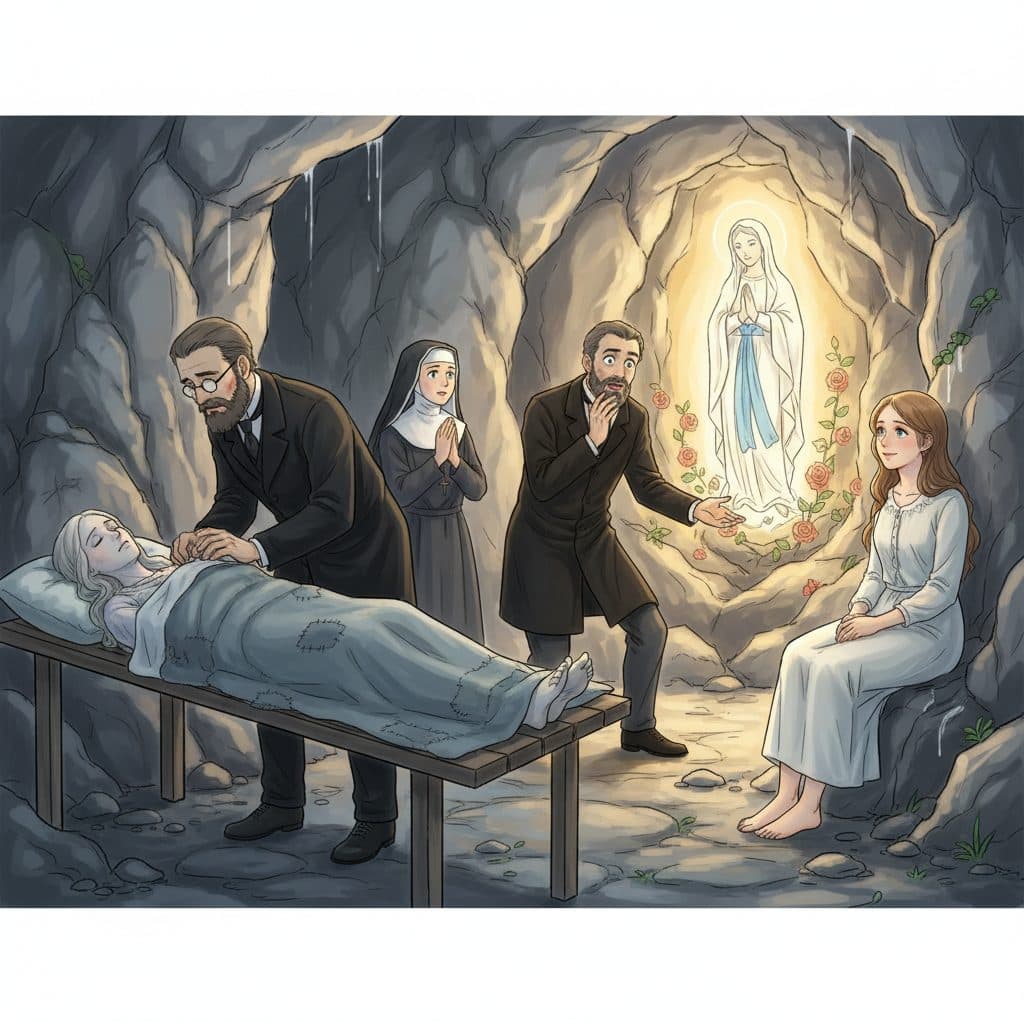
Marie Bailly: Tuberculous Peritonitis Vanishes Before a Nobel Laureate
Illustration: AI-generated dramatization (Gemini Flash Image)
The story
Skip to the verdict ↓A dying 23-year-old woman with advanced peritoneal tuberculosis appeared to recover instantly at Lourdes, witnessed and documented by Dr. Alexis Carrel, later winner of the 1912 Nobel Prize in Medicine.
In May 1902, Dr. Alexis Carrel, a young Lyon surgeon, was persuaded to accompany a hospital train carrying the sick to Lourdes. Among the patients was Marie Bailly — identified as "Marie Ferrand" in Carrel's later account — a 23-year-old woman moribund with tuberculous peritonitis. Her abdomen was rigid and distended; she drifted in and out of coma; her pulse was near zero. Multiple physicians had declared her close to death.
At the Grotto on May 28, Bailly received water poured over her abdomen three times. Carrel watched closely and recorded in his notes that the massive abdominal distension visibly reduced over approximately 30 minutes, that the pulse normalized, and that the patient recovered consciousness and lucidity. She lived several more years in good health.
Carrel described the event in detail in "The Voyage to Lourdes," published posthumously in 1950. The Lourdes Medical Bureau recognized the cure. Carrel — an agnostic at the time of the event — did not arrive at a straightforward conversion; he spent decades in intellectual struggle over what he had seen.
Extraordinary if it happened as told — but the evidence can't fully confirm it.
Reviewer Notes
Miracles Jar weighs each claim two ways — how extraordinary it would be, and how strong the evidence is.
Assessed by Miracles Jar AI
Medically documented by a future Nobel laureate; fastest-recorded resolution is the key anomaly.
The case lands in genuinely uncertain territory — not easily explained, but not impossible.
Why this lands where it does. Dr. Alexis Carrel — then a committed agnostic — personally documented the rapid resolution of a massively distended tuberculous abdomen over approximately 30 minutes, recording it in detailed notes and later in his book "The Voyage to Lourdes." Carrel's status as a Nobel laureate (winner of the 1912 Nobel Prize in Medicine) and known skeptic lends credibility. His firsthand record is the work of a scientifically trained observer with a professional incentive to remain skeptical, and is among the most detailed firsthand medical records in any Lourdes healing case.
The case against / natural explanations. Peritoneal tuberculosis can enter spontaneous remission, particularly with severe febrile episodes and in patients with fluctuating fever states. That undermines any claim of absolute medical impossibility — though it does not explain a minute-scale resolution. Carrel's account was written as a thinly veiled novella decades after the event, raising questions about the exactness of recalled detail; however, his private notes from 1902 also exist and are consistent with the later narrative. Carrel himself struggled with the event for decades and never fully resolved his doubts.
The key anomaly. The speed of resolution — not the recovery itself — is what strains natural explanation. A complete flattening of massively distended ascites in 30 minutes has no known physiological mechanism. The case was recognized by the Lourdes Medical Bureau, but the unusually rapid timeline (minutes, not days) is the element hardest to explain naturally. The retrospective, novella form of Carrel's published account introduces uncertainty.
Evidence ledger — what the verdict rests on
Dr. Carrel, an agnostic physician, personally observed and recorded the abdomen flattening from massively distended to normal within ~30 minutes
Firsthand record by a scientifically trained observer with professional incentive to remain skeptical
Peritoneal tuberculosis can produce spontaneous partial remission, especially in patients with fluctuating fever states
Does not explain minute-scale resolution, but undermines any claim of absolute medical impossibility
Carrel's account was written as a thinly veiled novella decades after the event, raising questions about exactness of recalled detail
His private notes from 1902 also exist and are consistent with the later narrative
What would raise the meter: Long-term follow-up documenting permanence, in a condition with a near-zero spontaneous-resolution base rate, would raise the meter.
What would lower it: A documented relapse, or case literature showing the condition fluctuates or remits on its own, would move it down.
How we weigh every claim — the full method, deductions and all →
The natural explanation
The leading natural account for this case is spontaneous remission & the body's own recovery. Read what it explains — and where it stops.
Sources
Tagged by proximity to the event. Primary sources are direct or contemporaneous; tertiary are downstream retellings.
- 1.Primarybook
Alexis Carrel, "The Voyage to Lourdes", 1950· no public link
Carrel's firsthand account, written as a novella but based on personal observation notes from 1902; published posthumously
- 2.Tertiarynews
"The Lourdes Miracle That Brought a Nobel Prize-Winning Doctor to Faith (Aleteia)", 2018· no public link
Good summary of Carrel's account and its context; secondary only
- 3.Secondaryinvestigation
"Two Lourdes Miracles and a Nobel Laureate: What Really Happened? (Catholic Culture)", 2004· no public link
Critical review of Carrel's reliability and the medical documentation limits
Cases like this
Nearest on the map — similar in how miraculous they’d be, and how strong the evidence is.