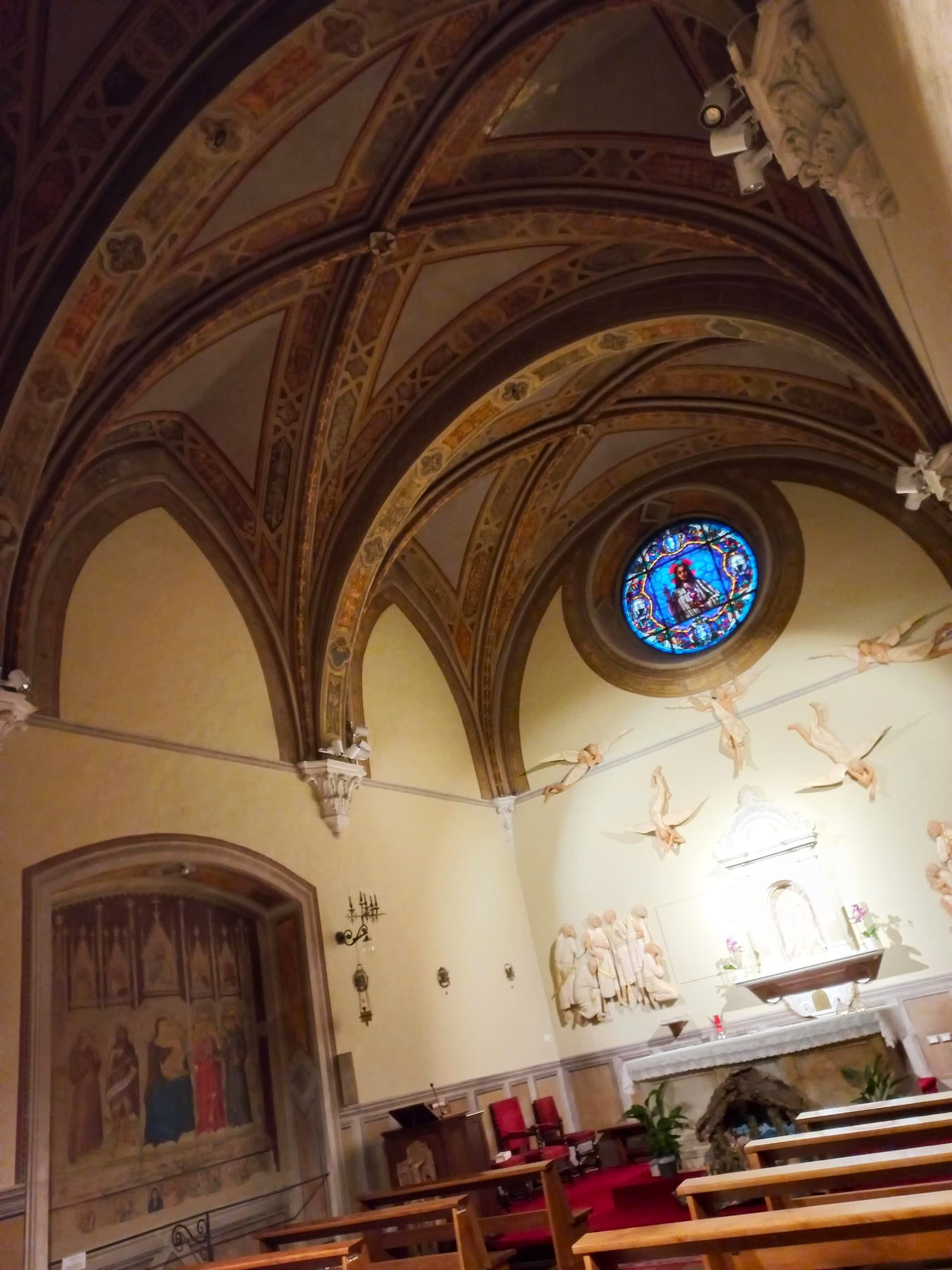
Eucharistic Miracle of Siena — Incorrupt Hosts (1730)
Photo: Nikozw / Wikimedia Commons · CC0
The story
Skip to the verdict ↓Three hundred fifty-one consecrated hosts stolen in 1730 and recovered three days later have reportedly remained intact for nearly 300 years, surviving conditions that should have caused rapid organic decay.
On August 14, 1730, thieves broke into the Church of St. Francis in Siena and stole a golden ciborium containing 351 consecrated hosts. Three days later, on August 17, the hosts were found in the alms box of the Basilica of Santa Maria in Provenzano, covered in dust. Despite the theft, exposure to dust, and handling, the hosts appeared intact.
The Hosts
Of the original 351 hosts, 223 remain. They are reported to be still intact nearly 300 years after the 1730 theft. Unleavened bread under ordinary conditions typically degrades within months to a few years from microbial activity and moisture.
Examinations
A 1914 commission examined the hosts and concluded their preservation "reverses the natural laws of conservation of organic matter." A 1922 commission noted that strictly sterile preparation and airtight storage could theoretically allow very long preservation — but concluded that the hosts had not been prepared under such conditions. In 2014, new tests including surface analysis under digital microscopy, ATP (adenosine triphosphate) testing, and microbial culture were carried out, and reported continued integrity.
Custody
The hosts have been in continuous Church custody. No independent continuous monitoring of their storage environment exists. The 2014 testing has not been published in a peer-reviewed journal with full methodological detail.
Too thin a record to say either way.
Reviewer Notes
Miracles Jar weighs each claim two ways — how extraordinary it would be, and how strong the evidence is.
Assessed by Miracles Jar AI
Long-term preservation is empirically observable; natural mechanism remains unproven but also not fully excluded.
Why this case is distinct. Unlike most Eucharistic miracles, which are historical one-time events, Siena's case presents an empirically testable, ongoing phenomenon: the hosts' preservation is either real or not, independent of historical narrative. The claimed miracle is measurable and ongoing.
Evidence weighing.
- The 1914 and 1922 commissions concluded that ordinary unleavened bread cannot survive 184+ years under normal storage. This was a multi-scientist commission; however, the 1922 report acknowledged that sterile/airtight storage could extend preservation. The 1914 report's strong conclusion ("reverses the natural laws of conservation of organic matter") was partially qualified by the 1922 commission.
- The 2014 investigation confirmed continued physical integrity using digital microscopy and ATP testing. Modern instrumentation was applied, but findings were not published in a peer-reviewed journal.
- Storage conditions across 295 years cannot be independently audited. The hosts have been in Church custody with no continuous independent monitoring of humidity, temperature, or air exposure. If at any point the reliquary was sealed under low-humidity, oxygen-limited conditions, preservation via desiccation alone might be possible.
- The 1922 commission acknowledged that sterile, airtight storage could theoretically achieve very long preservation. This is the key natural alternative.
Key limitations. The exact storage conditions across 295 years cannot be independently verified, and no published, peer-reviewed study has definitively ruled out abiotic preservation mechanisms. The 2014 testing, while encouraging, has not been published in a peer-reviewed journal with full methodological detail.
Bottom line. This case is the strongest empirical claim of the group reviewed — but "strongest empirical claim" still falls well short of scientific confirmation.
Evidence ledger — what the verdict rests on
1914 and 1922 commissions concluded ordinary unleavened bread cannot survive 184+ years under normal storage
Multi-scientist commission; however, 1922 report acknowledged sterile/airtight storage could extend preservation
2014 investigation confirmed continued physical integrity using digital microscopy and ATP testing
Modern instrumentation applied; findings not published in peer-reviewed journal
Storage conditions across 295 years cannot be independently audited
Church custody; no continuous independent monitoring of humidity, temperature, air exposure
1922 commission acknowledged that sterile, airtight storage could theoretically achieve very long preservation
This is the key natural alternative; the 1914 report's strong conclusion was partially qualified by 1922
What would raise the meter: Long-term follow-up documenting permanence, in a condition with a near-zero spontaneous-resolution base rate, would raise the meter.
What would lower it: A documented relapse, or case literature showing the condition fluctuates or remits on its own, would move it down.
How we weigh every claim — the full method, deductions and all →
The natural explanation
The leading natural account for this case is spontaneous remission & the body's own recovery. Read what it explains — and where it stops.
Sources
Tagged by proximity to the event. Primary sources are direct or contemporaneous; tertiary are downstream retellings.
- 1.Secondarynews
"Most Recent Investigations of Eucharistic Miracle of Siena Published", 2014· no public link
Reports 2014 tests including digital microscopy, ATP determination, culture tests; theeponymousflower.com
- 2.Tertiaryother
"The Miraculous Hosts of Siena: The Body of Christ, Ever New", 2015· no public link
Aleteia overview of 1914 and 1922 commission findings; aleteia.org
- 3.Tertiaryother
"The Eucharistic Miracle of Siena, Italy (1730)", 2025· no public link
Overview of history and examination history; nelsonmcbs.com
Cases like this
Nearest on the map — similar in how miraculous they’d be, and how strong the evidence is.