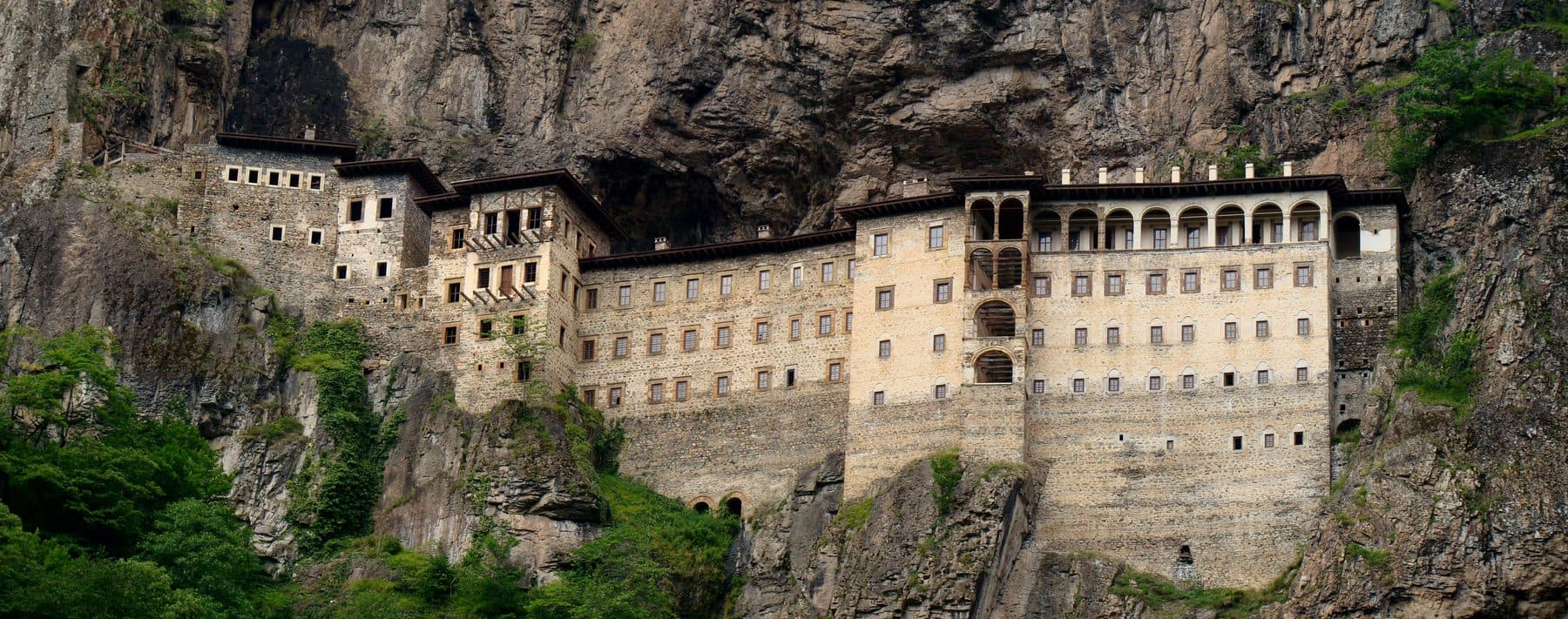
The Panagia Soumela Icon — Exile, Concealment, and Recovery
Photo: Bjørn Christian Tørrissen / Wikimedia Commons · CC BY-SA 3.0
The story
Skip to the verdict ↓The icon central to Pontic Greek Orthodox identity, attributed by tradition to St. Luke the Evangelist, was secretly buried by monks in 1923 at the time of the Lausanne population exchange and successfully recovered and transferred to Greece in 1931.
The Soumela Monastery, perched on a dramatic cliff face in the Pontic Alps near Trabzon (then Trebizond), was one of the defining institutions of Greek Orthodox life in Pontus for over 1,500 years. Its central icon, the Panagia Soumela, is attributed by Orthodox tradition to the hand of St. Luke the Evangelist and is believed to have arrived at the site miraculously in the late 4th century. In that tradition, the icon flew from Athens to Pontus around 380 CE and was discovered in a cave.
In 1923, as the Lausanne Convention mandated the exchange of populations between Greece and Turkey, the monks of Soumela abandoned the monastery. Before departing, they buried the icon along with other sacred objects in the ruined Chapel of St. Barbara, approximately 10 km from the main monastery.
Eight years later, in 1931, Greek Prime Minister Eleftherios Venizelos — himself of Pontic origin — negotiated with Turkish Prime Minister Ismet Inonu for permission to retrieve the relics. Permission was granted, the monk Ambrosius recovered the objects from the chapel, and the icon was transported to Greece, where it was housed in Athens' Benaki Museum until 1951, when a new monastery built in Veria (Veroia) — Nea Soumela — became its permanent home.
Too thin a record to say either way.
Reviewer Notes
Miracles Jar weighs each claim two ways — how extraordinary it would be, and how strong the evidence is.
Assessed by Miracles Jar AI
Historical preservation events are well-documented; Lucan attribution and miraculous provenance are unverified tradition.
Historical preservation events are well-documented; the Lucan attribution and miraculous provenance are unverified tradition.
The historical events — concealment in 1923, diplomatic negotiation by Venizelos, recovery in 1931 — are documented in Greek and Turkish diplomatic records, including the Venizelos-Inonu exchange, not just church tradition. This makes the Soumela case primarily a documented history of cultural survival rather than a contemporary miracle claim. State-level documentation makes the physical preservation of the icon through eight years of concealment a historical fact.
The miraculous claims about the icon's origin — painted by St. Luke the Evangelist in the first century, a miraculous flight from Athens to Pontus around 380 CE, discovery in a cave — are standard hagiographic tradition for major Byzantine icons and lack any independent historical or art-historical verification. Attribution to St. Luke is shared by dozens of other icons; no dendrochronology, pigment analysis, or radiocarbon dating of the panel has been published. The icon's origin story follows a recurring template seen across multiple Orthodox icon traditions, which does not disprove it but suggests elaboration in transmission.
The eight-year concealment in the St. Barbara chapel ruins preserved the icon through a period of active destruction of Greek heritage in Pontus. Human intentionality — the monks who buried the icon — accounts for the survival; the preservation is notable but not inexplicable.
The 1923 departure was forced by the Lausanne Convention. Scientific dating of the panel, pigments, and binding media would be the most direct method for assessing the antiquity of the current object; that work has not been done.
Evidence ledger — what the verdict rests on
The 1931 recovery and transfer are documented in Greek-Turkish diplomatic correspondence, including the Venizelos-Inonu exchange
State-level documentation makes the physical preservation of the icon through 8 years of concealment a historical fact, not a tradition
Attribution to St. Luke the Evangelist (1st century) is standard hagiographic tradition shared by dozens of other icons; no art-historical or scientific dating has been conducted
Dendrochronology, pigment analysis, or radiocarbon dating of the panel could provide a date range; this has not been published
The icon's miraculous flight from Athens to Pontus (c. 380 CE) and discovery in a cave follow a recurring hagiographic template seen across multiple Orthodox icon traditions
Pattern similarity with other icon origin stories is not dispositive but suggests elaboration in transmission
The 8-year concealment in the St. Barbara chapel ruins preserved the icon through a period of active destruction of Greek heritage in Pontus
Human intentionality (monks burying the icon) accounts for the preservation; the survival is notable but not inexplicable
What would raise the meter: Long-term follow-up documenting permanence, in a condition with a near-zero spontaneous-resolution base rate, would raise the meter.
What would lower it: A documented relapse, or case literature showing the condition fluctuates or remits on its own, would move it down.
How we weigh every claim — the full method, deductions and all →
The natural explanation
The leading natural account for this case is spontaneous remission & the body's own recovery. Read what it explains — and where it stops.
The same wonder, across traditions
This claim is one of many that make the same assertion across faiths. See it side by side in Images That Weep, Bleed, and Stir.
Sources
Tagged by proximity to the event. Primary sources are direct or contemporaneous; tertiary are downstream retellings.
- 1.Secondaryother
"Sumela Monastery — Wikipedia", 2024· no public link
Documents 1923 burial, 1931 Venizelos-Inonu diplomatic exchange, and transfer to Athens Benaki Museum
- 2.Secondarychurch document
"Panagia Soumela — OrthodoxWiki", 2022· no public link
Detailed Orthodox account of icon's traditional history and modern travels
- 3.Tertiaryother
"The History of Panagia Soumela Icon and Monastery — Zorbabook", 2021· no public link
Popular Greek heritage account; useful for recovery timeline details
Cases like this
Nearest on the map — similar in how miraculous they’d be, and how strong the evidence is.