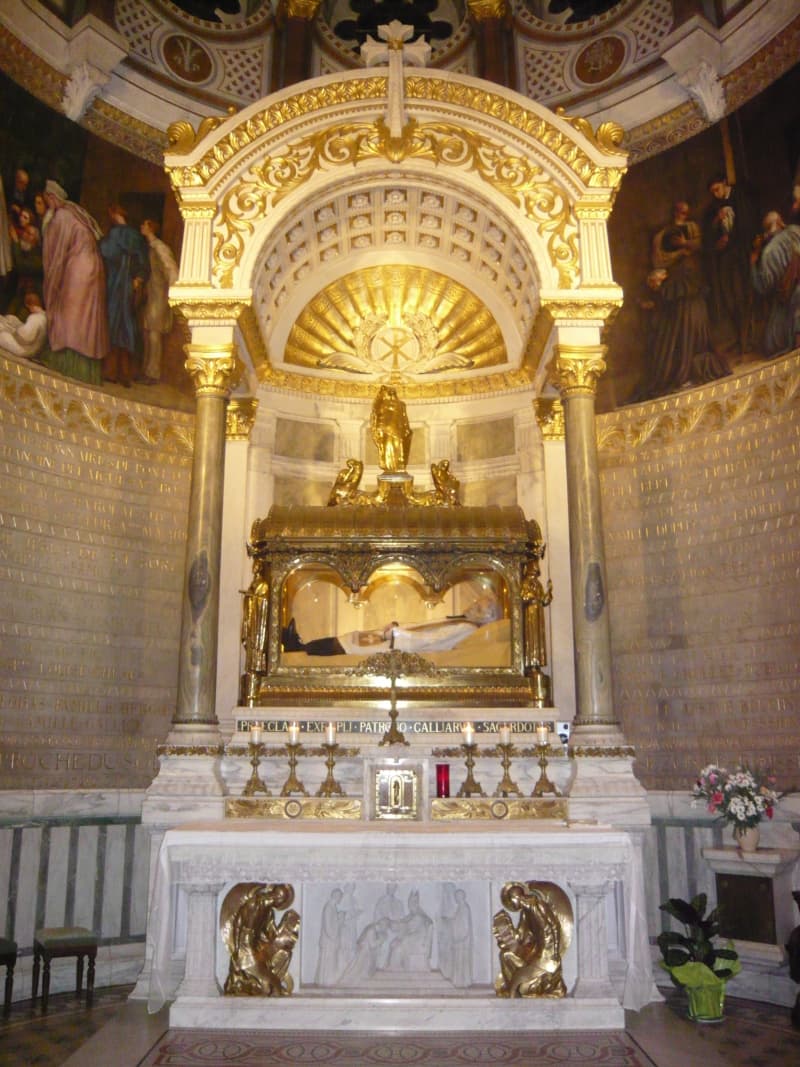
John Vianney (Curé d'Ars) — Dried Body, Wax Mask, Incorrupt Heart
Photo: Laifen / Wikimedia Commons · CC BY-SA 3.0
The story
Skip to the verdict ↓John Vianney's body was found dried and darkened after death and bears a wax mask over the face; his heart, removed in 1904, is separately venerated as a first-class relic and described as incorrupt, though it has undergone a century of conservation treatment.
The Curé of Ars
Jean-Marie Vianney served as the parish priest of the tiny village of Ars-sur-Formans from 1818 until his death in 1859. His reputation for penance, spiritual discernment, and long confessional sessions drew pilgrim traffic to the village. He was canonized in 1925 and named patron saint of parish priests in 1929.
The Body and the Wax Mask
After his death, Vianney's body was found dried and darkened. A wax mask was fitted over the face. The body is displayed in a reliquary at the Basilique d'Ars, in the Ain region; what visitors see is substantially the wax overlay.
The Heart Relic
In 1904, Vianney's heart was surgically removed and placed in a separate reliquary. It has been described as incorrupt for over 150 years and has been venerated internationally. A United States tour in 2018–2019 brought it to over 1,200 hours of public veneration across 36,000 miles. The heart has not been overlaid with wax and is handled and observed directly.
The Heart's Condition
The heart is kept isolated from the body in a cool metal reliquary in stable humidity. No published chemical or histological analysis of the heart has been made available.
Too thin a record to say either way.
Reviewer Notes
Miracles Jar weighs each claim two ways — how extraordinary it would be, and how strong the evidence is.
Assessed by Miracles Jar AI
Body dried and wax-masked; heart claim more interesting but lacks independent forensic analysis.
John Vianney's body was described as dried and darkened — not the fresh, lifelike state associated with miraculous incorruption — and it has a wax mask over the face, paralleling Bernadette's case. The wax mask suggests the original face condition was not display-worthy. The preservation is consistent with textbook desiccation mummification in a cool, stone-walled church.
The more compelling claim is for the separately kept heart, removed in 1904 and said to be incorrupt for over 150 years; this has been extensively venerated and toured internationally. The heart claim is more substantive than the body claim because it has not been overlaid with wax. However, hearts have been known to mummify naturally in certain environmental conditions, and no independent chemical or histological analysis of Vianney's heart has been published. Without such analysis, the heart claim cannot be distinguished from natural organ mummification. It remains the more interesting open question in Vianney's case.
The body was described as "dried and darkened" — consistent with desiccation mummification, which is a strong natural explanation. The wax mask over the face reinforces this reading; a similar parallel holds in Bernadette's case. The heart, removed in 1904 and venerated separately as incorrupt for 150+ years, is a moderate-weight consideration on the believer's side — isolated organs can mummify naturally, and the claim needs chemical analysis to advance. The heart toured internationally in 2018–2019, logging 36,000 miles and 1,200 hours of veneration — scale of veneration does not constitute evidence for supernatural preservation.
Location: Basilique d'Ars, Ars-sur-Formans, France. Died 1859; heart removed 1904; body exhumed for canonization.
Evidence ledger — what the verdict rests on
Body described as 'dried and darkened' — not fresh or lifelike
Desiccation mummification consistent with conditions in the Ain region church
Wax mask covers face — similar to Bernadette's case
Presence of wax mask suggests original face condition was not display-worthy
Heart removed in 1904 and venerated separately as 'incorrupt' for 150+ years
Isolated organs can mummify naturally; claim needs chemical analysis
Heart toured internationally 2018–2019, logged 36,000 miles and 1,200 hours of veneration
Scale of veneration does not constitute evidence for supernatural preservation
What would raise the meter: Long-term follow-up documenting permanence, in a condition with a near-zero spontaneous-resolution base rate, would raise the meter.
What would lower it: A documented relapse, or case literature showing the condition fluctuates or remits on its own, would move it down.
How we weigh every claim — the full method, deductions and all →
The natural explanation
The leading natural account for this case is spontaneous remission & the body's own recovery. Read what it explains — and where it stops.
Sources
Tagged by proximity to the event. Primary sources are direct or contemporaneous; tertiary are downstream retellings.
- 1.Tertiaryother
"John Vianney — Wikipedia", 2024· no public link
Canonization history; describes body condition and wax mask
- 2.Secondarynews
"Incorrupt Heart Relic of St. John Vianney Visiting the United States (Catholic Pilgrimage Sites, 2016)", 2016· no public link
Documents US tour of heart relic; describes ongoing condition claims
- 3.Tertiaryother
"France, Ars-sur-Formans: Shrine of St. John Vianney (Catholic Travel Guide)", 2020· no public link
Current display conditions; location of heart vs. body reliquary
Cases like this
Nearest on the map — similar in how miraculous they’d be, and how strong the evidence is.