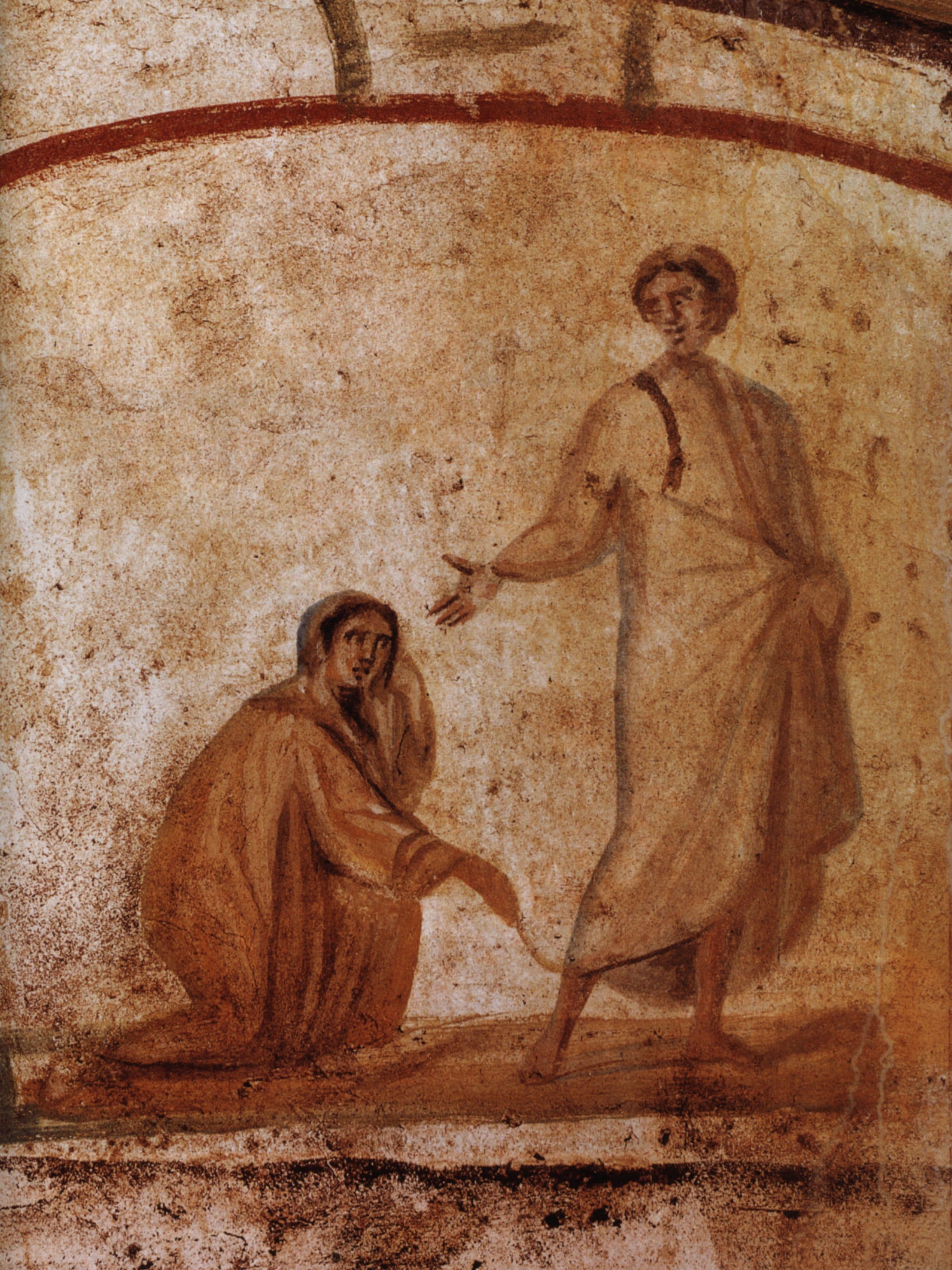
The Hemorrhoissa: Healing of the Woman with the Issue of Blood
Photo: 4th-c. fresco, Catacombs of Marcellinus and Peter, Rome / Wikimedia Commons · Public domain
The story
Skip to the verdict ↓The synoptic Gospels (Mark 5:24-34, Luke 8:42-48, Matthew 9:19-22) describe Jesus healing a woman who had hemorrhaged for twelve years by her touching the hem of his garment.
The story of the hemorrhoissa, the "bleeding woman," appears in three of the New Testament Gospels: Mark 5:24-34, Luke 8:42-48, and Matthew 9:19-22. It is set in Galilee, in an unspecified town, and is dated to roughly 28-30 CE. The accounts that record it were written some 35 to 55 years later, between about 65 and 85 CE.
In the narrative, the episode is embedded within the larger Markan account of Jairus's daughter (Mark 5:21-43). A woman who had suffered hemorrhage for twelve years, having spent her savings on physicians who could not help her, touches the fringe of Jesus's cloak in a crowd and is immediately healed. Jesus perceives that "power had gone out from him" and stops to identify who touched him. The woman confesses, and Jesus declares that her faith has healed her.
The woman's condition — translated variously as "issue of blood" or "hemorrhage" — has been understood as chronic uterine bleeding, which under Jewish purity law would have rendered her ritually impure and socially isolated.
The account is recorded across all three synoptic Gospels. Mark, dated c. 65-70 CE, contains the earliest and most detailed version, including the "power going out" phrase, which is absent in Matthew's version. Luke, dated c. 80-85 CE, follows Mark closely with minor editorial changes. The narrative includes incidental specifics such as the twelve-year duration, the detail about the physicians, and the "power going out" phrase.
The tradition was later reinterpreted. Augustine and the Latin tradition treated the hemorrhoissa primarily as an allegory of spiritual disease rather than a physical healing claim. In Luther and Calvin, the emphasis shifted further toward her faith rather than the physical event.
The Gospel accounts are the only record of the episode. There is no independent corroboration outside the Gospels, no named witnesses, and no post-event verification. The woman is unnamed and the town is unspecified.
Too thin a record to say either way.
Reviewer Notes
Miracles Jar weighs each claim two ways — how extraordinary it would be, and how strong the evidence is.
Assessed by Miracles Jar AI
Early and widely circulated healing tradition; historicity possible but cannot be demonstrated beyond the Gospel text itself.
The story appears in three independent or semi-independent Gospel traditions, suggesting early and widespread circulation. Triple attestation gives this account broader textual support than many Gospel healings — though Matthew and Luke likely depend on Mark, independent transmission is possible.
The detail of Jesus perceiving "power going out" is unique and theologically awkward — an argument from embarrassment that apologists use to support historicity, as it is unlikely to be invented. That argument has limited force, however, given the literary creativity in the Gospel tradition. The incidental specifics (twelve-year duration, the detail about physicians, the "power going out" phrase) are the kinds of details that lend historical texture, though skeptics note that literary realism is a well-developed narrative technique.
The woman is unnamed, the town is unspecified, and no corroborating source exists outside the Gospels. The narrative serves multiple theological functions — faith, ritual purity boundaries, Gentile inclusion, the interruption of a greater miracle — suggesting literary shaping. All written sources date 35–55 years after the event; the woman cannot be traced. The condition is unspecified and the cure is instantaneous contact, patterns common to ancient healing legends. The story fits naturally within the broader tradition of touch-healing in ancient Jewish and Hellenistic contexts. The ritual-impurity dynamic adds theological depth to the healing.
The interpretive history — Augustine and the Latin tradition, Luther, Calvin — shows how fluidly the tradition adapted across contexts, which cuts both for and against historical literalism. As a historical source, the Gospel accounts are the only evidence; no post-event verification is possible.
Evidence ledger — what the verdict rests on
Triple attestation in three Gospels suggests the tradition circulated early and widely
Though Matthew and Luke likely depend on Mark, independent transmission is possible
The 'power going out' detail in Mark is theologically awkward and unlikely to be invented
Argument from embarrassment has limited force given literary creativity in Gospel tradition
Woman is unnamed, town is unspecified, and no corroborating source exists outside the Gospels
The narrative serves multiple theological functions (faith, purity boundaries, interruption of greater miracle), suggesting literary shaping
What would raise the meter: Long-term follow-up documenting permanence, in a condition with a near-zero spontaneous-resolution base rate, would raise the meter.
What would lower it: A documented relapse, or case literature showing the condition fluctuates or remits on its own, would move it down.
How we weigh every claim — the full method, deductions and all →
The natural explanation
The leading natural account for this case is spontaneous remission & the body's own recovery. Read what it explains — and where it stops.
Sources
Tagged by proximity to the event. Primary sources are direct or contemporaneous; tertiary are downstream retellings.
- 1.Primarybook
Unknown, "Gospel of Mark", c. 65-70 CE· no public link
Mark 5:24b-34; earliest version, most detailed, with the 'power going out' detail absent in Matthew's version
- 2.Primarybook
Unknown, "Gospel of Luke", c. 80-85 CE· no public link
Luke 8:42b-48; closely dependent on Mark with minor editorial changes
- 3.Secondaryacademic
Multiple authors, "An Issue of Blood: Journal for Religion and Health (2012)", 2012· no public link
Scholarly study of the healing narrative in early Christian and medieval visual culture
Cases like this
Nearest on the map — similar in how miraculous they’d be, and how strong the evidence is.