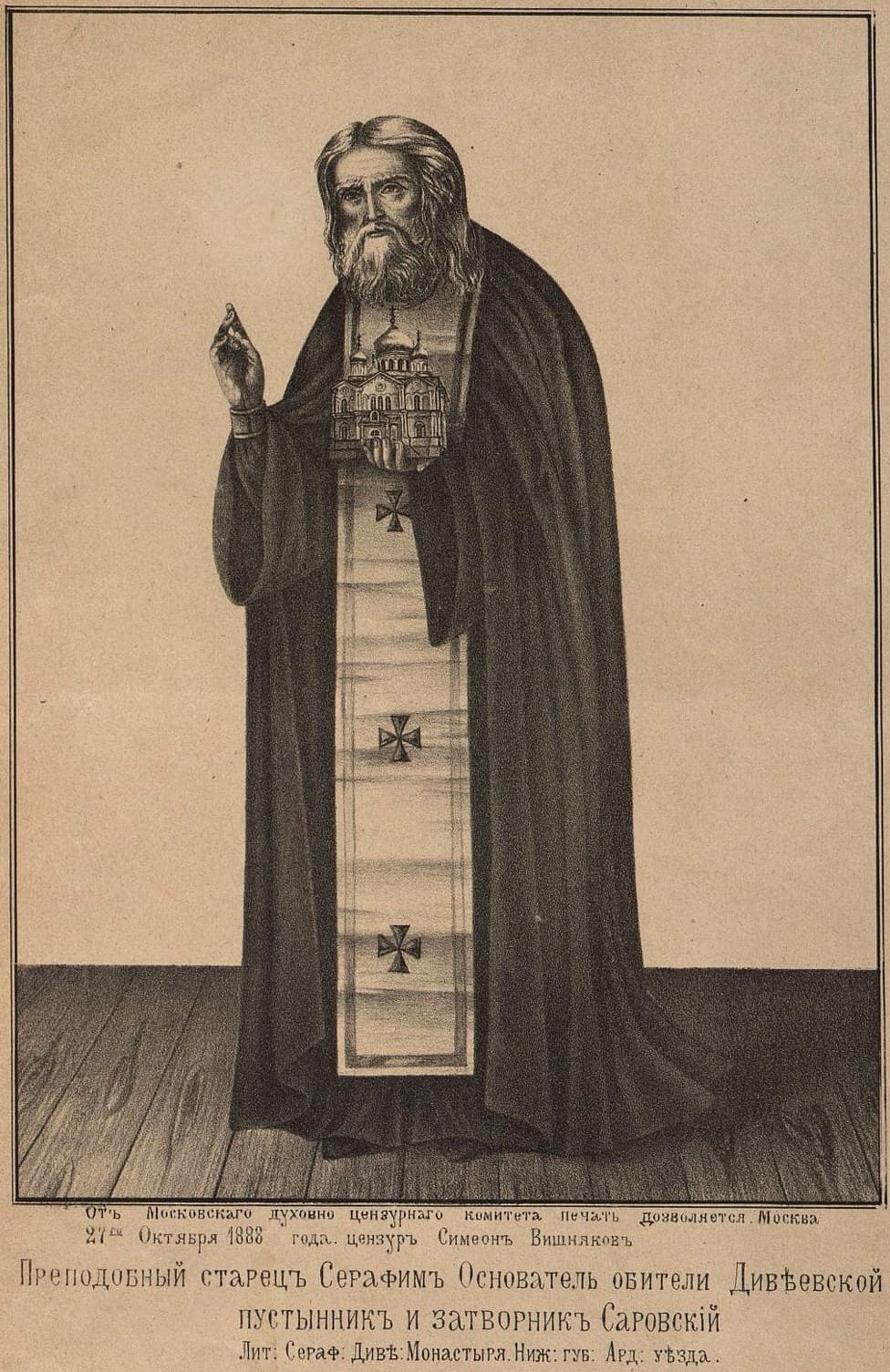
St. Seraphim of Sarov — Healings at Canonization and the Question of Incorruptibility
Photo: 1888 engraving, State Historical Museum, Moscow / Wikimedia Commons · Public domain
The story
Skip to the verdict ↓At the 1903 canonization of Seraphim of Sarov, attended by 200,000 including Tsar Nicholas II, numerous healings were reported at the translation of his relics — even though the pre-canonization commission had found the body was NOT incorrupt.
Seraphim of Sarov (1754-1833) is one of the most beloved saints of Russian Orthodoxy, known for his extreme asceticism and for teaching that the goal of Christian life is acquisition of the Holy Spirit. His canonization in 1903 became one of the major religious events of imperial Russia, attended by Tsar Nicholas II, his family, and an estimated 200,000 pilgrims.
The commission that examined Seraphim's remains in January 1903 found that the body had undergone normal decomposition. Only bones, hair, and some vestment fragments were preserved. This contradicted widespread popular expectation in Russia that saints' bodies are incorrupt. A formal theological clarification followed, establishing that incorruptibility is not a requirement for canonization.
At the July canonization itself, numerous healing accounts were reported in the crowd — recoveries from paralysis, blindness, and other conditions attributed to touching or being brought near the relics. Contemporary Russian accounts name specific individuals and describe the circumstances. No independent medical examination was conducted before or after the claimed healings.
In 1920, Soviet authorities confiscated the relics, and they eventually ended up in the State Museum of the History of Religion and Atheism in Leningrad. In 1991, following the Soviet collapse, the relics were rediscovered in the museum's collection and transferred in a major religious procession — on foot from Moscow to Diveyevo — where they remain. No new miracle claims are associated with the 1991 recovery.
Too thin a record to say either way.
Reviewer Notes
Miracles Jar weighs each claim two ways — how extraordinary it would be, and how strong the evidence is.
Assessed by Miracles Jar AI
Non-incorruptibility finding adds credibility to honest reporting; healing accounts are numerous but unverified medically.
The 1903 finding is a striking institutional concession: the relics were found not incorrupt, and the Church reported this rather than suppressing it. An institution does not voluntarily report evidence that embarrasses its preferred narrative unless honest internal process required it; this increases the credibility of the broader reportage. Tsar Nicholas II and 200,000 witnesses attended the canonization; contemporary Russian press and imperial records document the event. Scale and state documentation of the event provide historical grounding; healing claims within this context are separately attested.
The healing reports at the 1903 ceremony are attested by thousands of witnesses; the most documented cases in contemporary Russian accounts involve recovery from paralysis and blindness. However, mass emotional events with large religious crowds are among the most susceptible contexts for psychosomatic healing, placebo effects, and confirmation bias. The intense emotional and religious atmosphere of a mass canonization event is precisely the context most susceptible to psychosomatic recovery and confirmation-driven reporting. No independent medical examination of claimed healings with pre/post documentation was conducted; the standard of evidence for miraculous healing was not applied. Soviet archival access to the original case files remains incomplete.
Soviet authorities confiscated the relics in 1920 and they were lost until 1991; the disruption makes the relics' modern history an additional evidential layer without new miracle claims. The relics' survival in an anti-religious museum for 70 years is historically notable.
Evidence ledger — what the verdict rests on
Pre-canonization commission explicitly found the body decayed — not incorrupt — forcing a theological clarification that the Church itself did not expect or want
An institution does not voluntarily report evidence that embarrasses its preferred narrative unless honest internal process required it; this increases credibility of the broader reportage
Tsar Nicholas II and 200,000 witnesses attended; contemporary Russian press and imperial records document the event
Scale and state documentation of the event provide historical grounding; healing claims within this context are separately attested
Mass religious gatherings with high emotional expectation are well-documented contexts for psychosomatic healing and misattribution of recovery timing
No pre/post medical documentation of claimed healings exists from 1903; the standard of evidence for miraculous healing was not applied
Soviet authorities confiscated the relics in 1920 and they were lost until 1991; the disruption makes the relics' modern history an additional evidential layer without new miracle claims
Relics' survival in an anti-religious museum for 70 years is historically notable but does not constitute a miracle claim
What would raise the meter: Documented recurrence in cases with no expectancy pathway — or records ruling out functional overlay — would raise the meter.
What would lower it: Evidence of symptom relapse, revised diagnosis, or undisclosed treatment would lower the evidence bar.
How we weigh every claim — the full method, deductions and all →
The natural explanation
The leading natural account for this case is expectation, suggestion & the placebo response. Read what it explains — and where it stops.
Sources
Tagged by proximity to the event. Primary sources are direct or contemporaneous; tertiary are downstream retellings.
- 1.Secondaryother
"Seraphim of Sarov — Wikipedia", 2024· no public link
Documents 1903 commission findings, canonization events, healing claims, and Soviet-era relics history
- 2.Secondarychurch document
"Miraculous Occurrences at Sarov Monastery in 1903 at the Opening of the Holy Relics of St. Seraphim of Sarov", 2019· no public link
OrthoChristian.com compilation of contemporary Russian accounts; references named witnesses and specific healing cases
- 3.Secondaryother
"The Relics of Saint Seraphim: A Journey Through Russian Orthodoxy", 2018· no public link
Modern Diplomacy; traces relics from 1903 canonization through Soviet seizure and 1991 return to Diveyevo
Cases like this
Nearest on the map — similar in how miraculous they’d be, and how strong the evidence is.