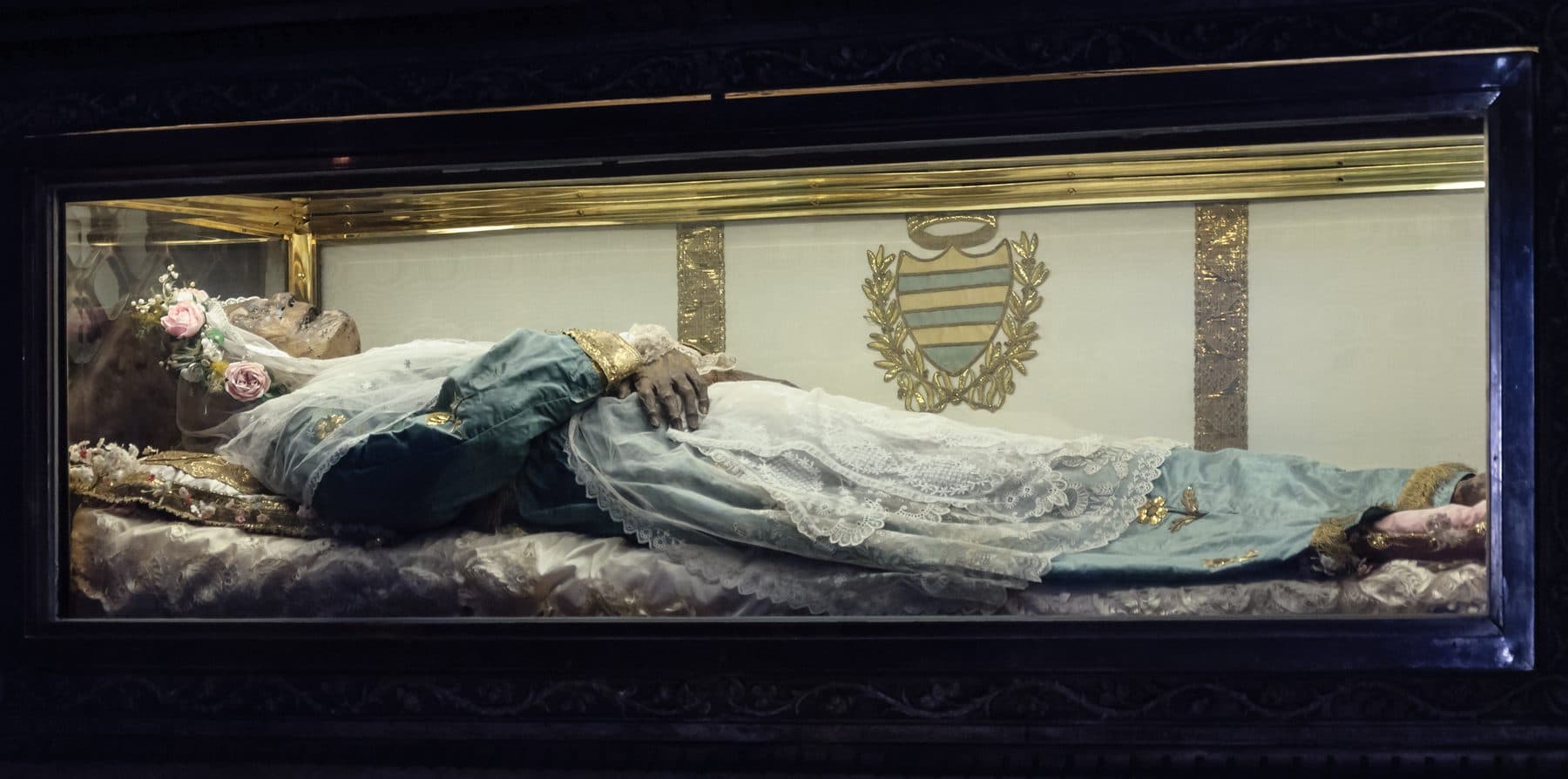
Saint Zita of Lucca — Natural Mummification After 700 Years
Photo: Myrabella / Wikimedia Commons · CC BY-SA 3.0
The story
Skip to the verdict ↓Zita of Lucca's body, exhumed and found incorrupt in 1580, has been on display in the Church of San Frediano for over 700 years; a 1988 University of Pisa examination confirmed it as a case of natural mummification, browned and wizened.
The Servant of Lucca
Zita of Lucca entered domestic service at age 12 and spent nearly her entire life as a servant in the Fatinelli household, reportedly giving bread and food to the poor from her own rations. She died in 1272 and was canonized in 1696. Her body has rested in the Church of San Frediano in Lucca since her death, and today it remains on display — face and hands uncovered — over 750 years later.
The 1580 Exhumation
In 1580, Zita's body was exhumed and declared incorrupt, and formal veneration began. The body was placed in a glass case for display, where it has remained accessible to pilgrims ever since. Unlike most relics kept in sealed conditions, Zita's body is exposed: visitors can see the actual tissue.
The 1988 Examination
In 1988, Gino Fornaciari of the University of Pisa examined the remains. The body is browned, wizened, and desiccated. Fornaciari identified the cause of death as lung problems, likely from prolonged inhalation of coal dust and smoke.
The body has persisted recognizably in the Church of San Frediano for over 700 years, its face and hands uncovered to view.
It happened — and nature accounts for it.
Reviewer Notes
Miracles Jar weighs each claim two ways — how extraordinary it would be, and how strong the evidence is.
Assessed by Miracles Jar AI
Scientifically confirmed natural mummification; preserved but desiccated, not miraculously intact.
A 1988 examination by Gino Fornaciari of the University of Pisa confirmed the body as naturally mummified — browned, wizened, and desiccated, not the supple and lifelike state associated with supernatural incorruptibility. Natural mummification in Lucca's climate and the church's dry stone environment is scientifically plausible. The body does persist after 700 years, which is the genuine fact of interest. The scientific examination provides good-quality evidence for the natural explanation.
Fornaciari found she likely died of lung problems from coal dust and smoke inhalation. The body has persisted recognizably for over 700 years — unusual but consistent with dry-stone church environment and desiccation.
Evidence ledger — what the verdict rests on
1988 University of Pisa examination by Gino Fornaciari confirmed natural mummification
Professional forensic anthropological analysis; natural cause identified
Body is browned and wizened — consistent with desiccation mummification, not miraculous preservation
Physical appearance aligns with documented natural mummification process
Body has persisted recognizably for over 700 years
Longevity is unusual but consistent with dry-stone church environment and desiccation
Fornaciari found she likely died of lung problems from coal dust and smoke inhalation
Pathological analysis demonstrates scientific access; natural preservation mechanism inferred from environment
What would raise the meter: Long-term follow-up documenting permanence, in a condition with a near-zero spontaneous-resolution base rate, would raise the meter.
What would lower it: A documented relapse, or case literature showing the condition fluctuates or remits on its own, would move it down.
How we weigh every claim — the full method, deductions and all →
The natural explanation
The leading natural account for this case is spontaneous remission & the body's own recovery. Read what it explains — and where it stops.
Sources
Tagged by proximity to the event. Primary sources are direct or contemporaneous; tertiary are downstream retellings.
- 1.Secondarynews
"The Incorruptible St. Zita in Lucca (Atlas Obscura)", 2019· no public link
Describes 1988 Fornaciari examination; confirms natural mummification diagnosis
- 2.Tertiaryother
"Saint Zita — Mummipedia Wiki", 2022· no public link
Physical condition described; context on display history
- 3.Tertiarynews
"Saint Zita — 700 Year Old Mummified Relic (WhatBoundaries Travel, 2022)", 2022· no public link
First-person visitor account of visible condition; corroborates desiccated appearance
Cases like this
Nearest on the map — similar in how miraculous they’d be, and how strong the evidence is.