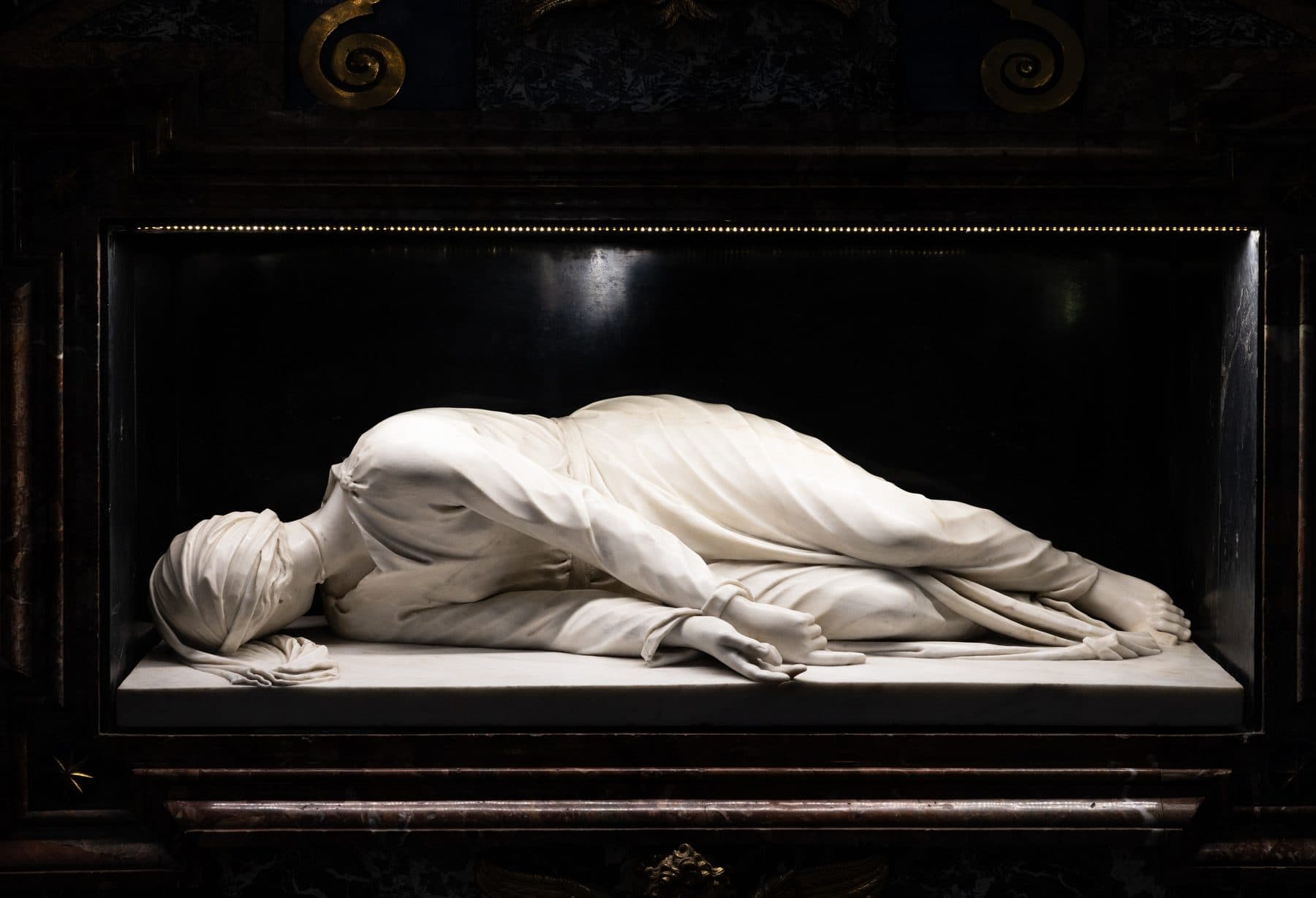
Saint Cecilia — The 1599 Discovery and Maderno's Sculpture
Photo: Jacek Durski / Wikimedia Commons · CC BY-SA 4.0
The story
Skip to the verdict ↓When a sarcophagus believed to contain Saint Cecilia was opened in 1599, witnesses reported finding a body in a distinctive position; sculptor Stefano Maderno created an exact marble replica — but no witness actually saw her face, and historians dispute the account.
The 1599 Discovery
During renovations of Santa Cecilia in Trastevere in preparation for the Jubilee of 1600, Cardinal Paolo Emilio Sfondrati ordered excavations under the high altar. On October 22, 1599, three marble sarcophagi were uncovered. One was opened, and the body inside was reportedly found in a distinctive position — lying on her right side, knees bent, with three fingers of the right hand extended, interpreted as referring to the Trinity.
Maderno's Marble
Sfondrati commissioned 23-year-old sculptor Stefano Maderno to create an exact marble reproduction of what he had seen. The resulting sculpture remains beneath the altar today. Sfondrati's own inscription beneath it reads: "I, Paolo, cardinal at Santa Cecilia, offer you the image of Saint Cecilia, who I saw with my eyes intact in her tomb. I have represented her in that exact position in the marble in front of you."
The Veil
Art historian Maryvelma Smith O'Neil has documented that all eyewitnesses to the 1599 rediscovery report an unwillingness to disturb the veil covering the body — meaning no one actually saw Cecilia's face. In 2005, historian Tomaso Montanari published a previously unknown eyewitness account that differs from the canonical Bosio narrative on the body's exact position.
The Remains
Cecilia was martyred c. 230 AD, and the body was reportedly found in 1599 — a span of more than 1,300 years. The identity of the remains is not established in the historical record. Antonio Bosio's *Roma Sotterranea*, published in 1632, is the primary 17th-century account of the discovery.
Too thin a record to say either way.
Reviewer Notes
Miracles Jar weighs each claim two ways — how extraordinary it would be, and how strong the evidence is.
Assessed by Miracles Jar AI
Eyewitnesses did not see the face directly; competing historical accounts; identity of remains unverifiable.
The 1599 account rests on Cardinal Sfondrati's inscription claiming the body was "intact," but no witness removed the veil from the face. The intact-preservation claim was made without direct observation of what it purported to describe. Mary O'Neil's documented analysis establishes this gap.
Stefano Maderno's marble sculpture, created shortly after the 1599 discovery, depicts the body in a specific posture — the position that became canonical. Montanari's 2005 archival discovery of a previously unknown eyewitness account differs from Bosio's canonical narrative on the body's exact position. Where there was one account, there are now two that differ on key details.
No chain of custody connects the 1599 remains to a third-century martyr. The sarcophagus attribution rests on tradition; the remains could have belonged to any early Christian woman interred at the site. A body supposedly martyred around 230 CE surviving more than 1,300 years without documented preservation technology would exceed any precedent from the period.
This is one of the most artistically influential incorruptibility accounts — Maderno's sculpture shaped how the image of St. Cecilia has been understood for four centuries — and also one of the most evidentially fragile.
Evidence ledger — what the verdict rests on
Cardinal Sfondrati inscription states he saw the body 'intact in her tomb' and Maderno replicated her exact position
Primary witness with high social standing; inscription is contemporary
No witness removed the veil from the face — the 'intact' face was not directly observed
Per art historian Maryvelma Smith O'Neil's documented analysis
2005 alternative eyewitness account contradicts canonical Bosio account on position and details
Historian Tomaso Montanari; undermines reliability of singular narrative
Identity of 3rd-century remains unverifiable; body could belong to any early Christian woman
No chain of custody; sarcophagus attribution relies on tradition only
What would raise the meter: Instrumented or physical evidence — measurements, samples, footage that survives analysis — would raise this.
What would lower it: A controlled observation reproducing the experience naturally (lighting, suggestion, pareidolia) would move it down.
How we weigh every claim — the full method, deductions and all →
The natural explanation
The leading natural account for this case is misperception: how honest witnesses get it wrong. Read what it explains — and where it stops.
Sources
Tagged by proximity to the event. Primary sources are direct or contemporaneous; tertiary are downstream retellings.
- 1.Secondaryother
"Saint Cecilia (Stefano Maderno) — Wikipedia", 2024· no public link
Art-historical analysis; cites O'Neil and Montanari scholarship on eyewitness disputes
- 2.Tertiaryother
"This is my Body: Stefano Maderno and the Miraculous Corpse of Saint Cecilia (Through Eternity Tours)", 2020· no public link
Contextualizes Sfondrati inscription and Maderno commission
- 3.Primarybook
Bosio, Antonio, "Antonio Bosio, Roma Sotterranea", 1632· no public link
Primary 17th-century account of the 1599 discovery; basis for the incorruptibility narrative
Cases like this
Nearest on the map — similar in how miraculous they’d be, and how strong the evidence is.