Matteo Pio Colella: Full Recovery from Fulminant Bacterial Meningitis
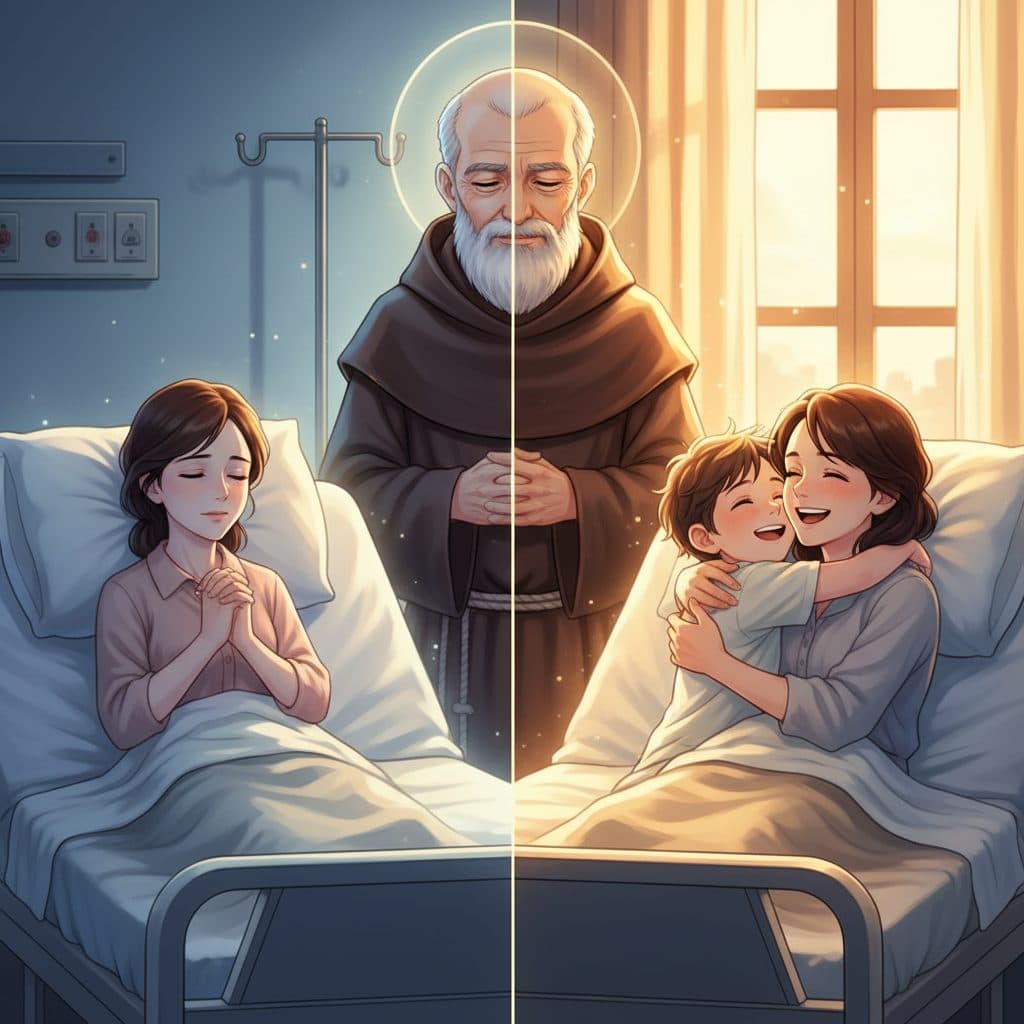
Illustration: AI-generated dramatization (Gemini Flash Image)
The story
Skip to the verdict ↓A seven-year-old from San Giovanni Rotondo was declared clinically lost from acute fulminant meningitis and made a complete recovery — the miracle used for Padre Pio's canonization.
On January 20, 2000, seven-year-old Matteo Pio Colella was admitted to the Casa Sollievo della Sofferenza (House for the Relief of Suffering) in San Giovanni Rotondo, Foggia, Italy — the hospital founded by Padre Pio himself. Physicians diagnosed acute fulminant bacterial meningitis, which had spread to affect his kidneys, respiratory system, and blood clotting. By the following day he had fallen into a coma, and physicians believed his death was imminent.
His mother, Maria Lucia, made her way to Padre Pio's tomb in the adjacent shrine and prayed for her son's life. Within hours, Matteo began to recover. He emerged from the coma, and subsequent examinations showed the infection had cleared and there was no residual neurological damage.
As an adult, Colella recounted a vision he said he had during the coma, in which Padre Pio told him not to worry. He was later ordained a deacon and has spoken publicly about the experience.
The Consulta Medica's panel described the recovery as "quick, complete, and lasting without consequences, and scientifically inexplicable." Pope John Paul II canonized Padre Pio on June 16, 2002, and Matteo's recovery was the miracle used for that canonization.
Genuinely contested — both whether it happened and whether nature explains it.
Reviewer Notes
Miracles Jar weighs each claim two ways — how extraordinary it would be, and how strong the evidence is.
Assessed by Miracles Jar AI
Medically unusual outcome — complete survival with zero sequelae from documented multi-organ failure — but pediatric meningitis does occasionally show extraordinary survival.
The case makes a moderately strong case for authenticity, though it falls short of excluding all natural explanation.
Bacterial meningitis causing multi-organ failure (kidney, respiratory, coagulation) with coma typically has a mortality rate of 20–30% and high survivor morbidity. Complete recovery without sequelae in this clinical scenario is very uncommon. His mother was simultaneously praying at Padre Pio's tomb in the same hospital complex. The Consulta Medica declared it "quick, complete, and lasting without consequences, and scientifically inexplicable." Against: pediatric patients occasionally survive fulminant meningitis with complete recovery; the boy received standard ICU care, which could account for survival even if the speed of recovery was unusual.
Children with bacterial meningitis who receive aggressive ICU management do sometimes make unexpectedly complete recoveries. Matteo's recovery is medically unusual but not in a category that excludes all natural explanation. The "scientifically inexplicable" designation reflects the Vatican panel's assessment, not a peer-reviewed medical consensus.
Evidence weighed:
- Acute fulminant bacterial meningitis affecting kidneys, respiratory system, and blood clotting — child declared clinically terminal — followed by complete recovery with no sequelae. Zero neurological sequelae from documented multi-organ failure is medically uncommon. (In favor, strong.)
- The Consulta Medica unanimously described the recovery as "scientifically inexplicable." (In favor, strong.)
- Boy was admitted to Casa Sollievo della Sofferenza, Padre Pio's own hospital, and received full ICU care. Modern ICU intervention for pediatric meningitis does sometimes produce surprising survival, even from coma. (Against, moderate.)
- His mother was praying at Padre Pio's tomb in the same complex while her son's condition reversed. Coincidence of location is emotionally resonant but not evidential. (Neutral, weak.)
Evidence ledger — what the verdict rests on
Acute fulminant bacterial meningitis affecting kidneys, respiratory system, and blood clotting — child declared clinically terminal — followed by complete recovery with no sequelae.
Zero neurological sequelae from documented multi-organ failure is medically uncommon.
Consulta Medica unanimously described the recovery as 'scientifically inexplicable.'
Boy was admitted to Casa Sollievo della Sofferenza, Padre Pio's own hospital, and received full ICU care.
Modern ICU intervention for pediatric meningitis does sometimes produce surprising survival, even from coma.
His mother was praying at Padre Pio's tomb in the same complex while her son's condition reversed.
Coincidence of location is emotionally resonant but not evidential.
What would raise the meter: Long-term follow-up documenting permanence, in a condition with a near-zero spontaneous-resolution base rate, would raise the meter.
What would lower it: A documented relapse, or case literature showing the condition fluctuates or remits on its own, would move it down.
How we weigh every claim — the full method, deductions and all →
The natural explanation
The leading natural account for this case is spontaneous remission & the body's own recovery. Read what it explains — and where it stops.
Sources
Tagged by proximity to the event. Primary sources are direct or contemporaneous; tertiary are downstream retellings.
- 1.Primarytestimony
Catholic News Agency, "Young Man Healed by Padre Pio Recounts Story of Miraculous Cure", 2015· no public link
Colella's own adult account; first-person but not independent.
- 2.Secondarychurch document
"The Path of Padre Pio to Sainthood: The Miracle of Matteo Pio Colella", 2002· no public link
Italian-language canonical record; most detailed procedural account.
- 3.Tertiarywebsite
"Padre Pio — Wikipedia", 2024· no public link
Useful for establishing canonization date and citing the Consulta Medica decision.
Cases like this
Nearest on the map — similar in how miraculous they’d be, and how strong the evidence is.